Give and Take Across Generations: How Changing Age Structure Can Lead to Economic Growth
The link between demographics and the economy is complex. “Give and Take Across Generations: How Changing Age Structure Can Lead to Economic Growth” presents a straightforward explanation of one facet of this important connection, by showing how lower fertility rates can benefit a nation’s economy.
We walk through an analysis that combines age-specific income and consumption patterns with population age structure, using data from the National Transfer Accounts (NTA) project. Thailand and Ethiopia serve as examples to illustrate how changing age structure can impact total income and consumption levels. This analysis shows that Ethiopia’s future age structure could create expendable income, a driver of economic growth and improved quality of life.
In this video, data for per capita income and consumption come from calculations completed by the NTA project. Income is defined as all compensation for work effort, including income, benefits, and certain government taxes. Consumption is the value of goods and services that meet an individual’s needs; this includes basic needs such as food and shelter as well as needs for services such as healthcare and education. A key assumption is that per capita income and consumption will stay the same for the future projected population scenarios.
Related Posts
Webinar: Bridging Research and Policies: Enhancing Budgeting Processes for Africa's Demographic Dividend
PRB hosted a high-level webinar with budget experts, parliamentarians, and national directors to discuss the importance of the Demographic Dividend Sensitive Budgeting approach in enhancing budgeting processes across Africa.

PRB x TED: How Do We Respond to an Aging World?
As headlines announce fewer babies and more older people the data are clear: The world is undergoing a massive demographic shift. But is demography our destiny?

Beyond the Headlines: As China and India Age, Young Africa Has Potential to Power Global Workforce
In this webinar, we examine data on the growth of sub-Saharan Africa’s working-age population and discuss its potential to power the global workforce.

Lesson Plans on Human Population and Demographic Studies
Find out the answers to these questions and more. The sections listed below explore eight elements of population dynamics.

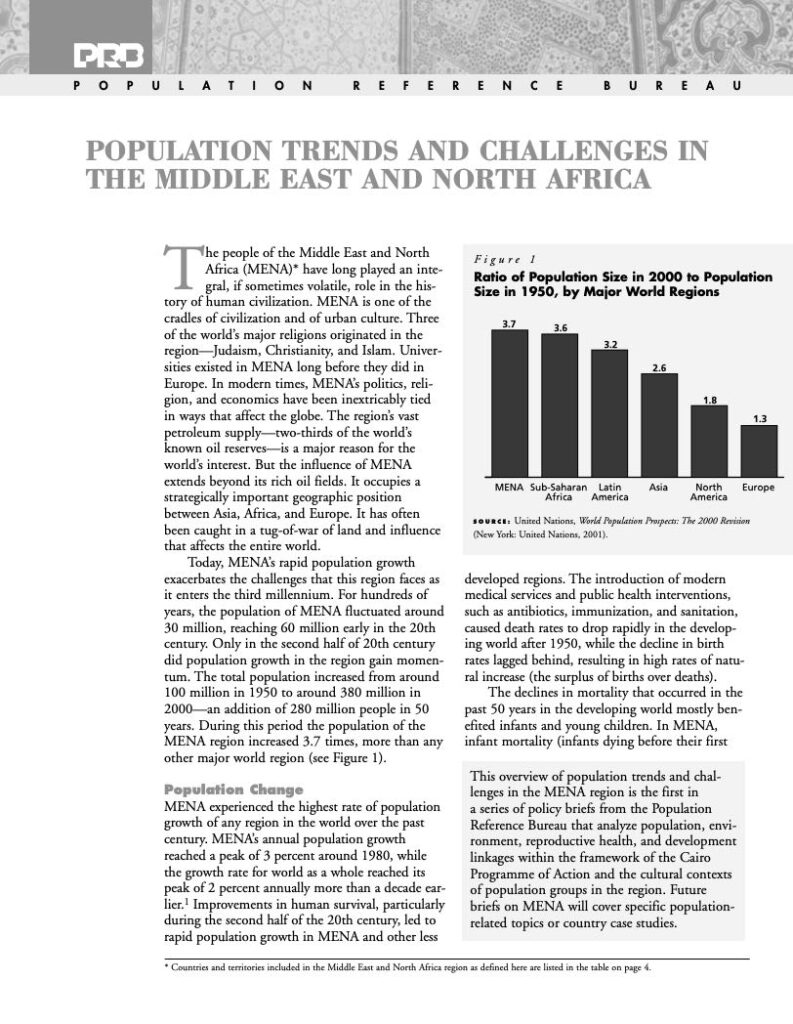
Population Trends and Challenges in the Middle East and North Africa
(2001) The people of the Middle East and North Africa (MENA) have long played an integral, if sometimes volatile, role in the history of human civilization.