(2010) Tanzania is one of the world's poorest countries, with a 2008 annual per capita income of just $1,263, and nearly 90 percent of the population living on less than $1.25 per day.1 Maternal, infant, and childhood mortality—important indicators of overall socioeconomic conditions—are high, even for East Africa.
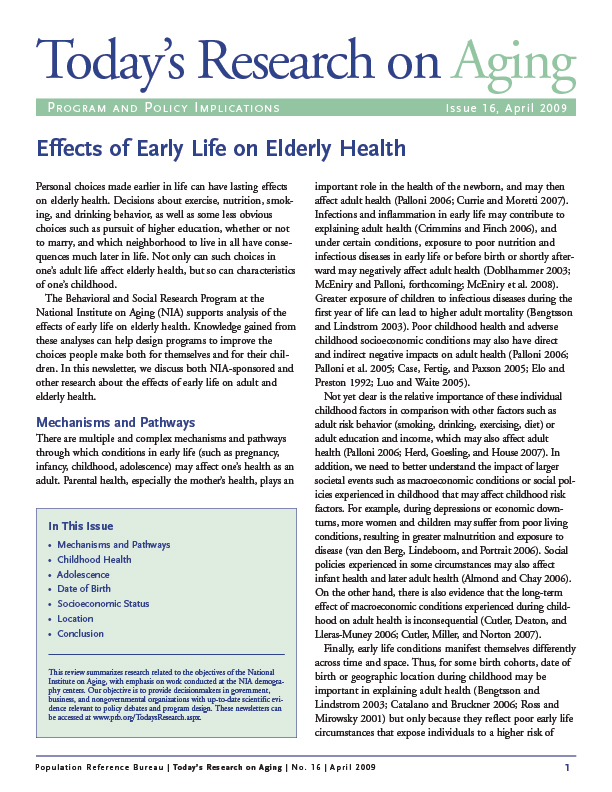
Today’s Research on Aging, Issue 16: Effects of Early Life on Elderly Health
(2009) Personal choices made earlier in life can have lasting effects on elderly health. Decisions about exercise, nutrition, smoking, and drinking behavior, as well as some less obvious choices such as pursuit of higher education, whether or not to marry, and which neighborhood to live in all have consequences much later in life.
(2008) Despite rapid population growth in parts of the U.S. South and West, 43 percent of all counties lost population since 2000-nearly twice the number of counties that lost population during the 1990s (1,346 counties vs. 689 counties).
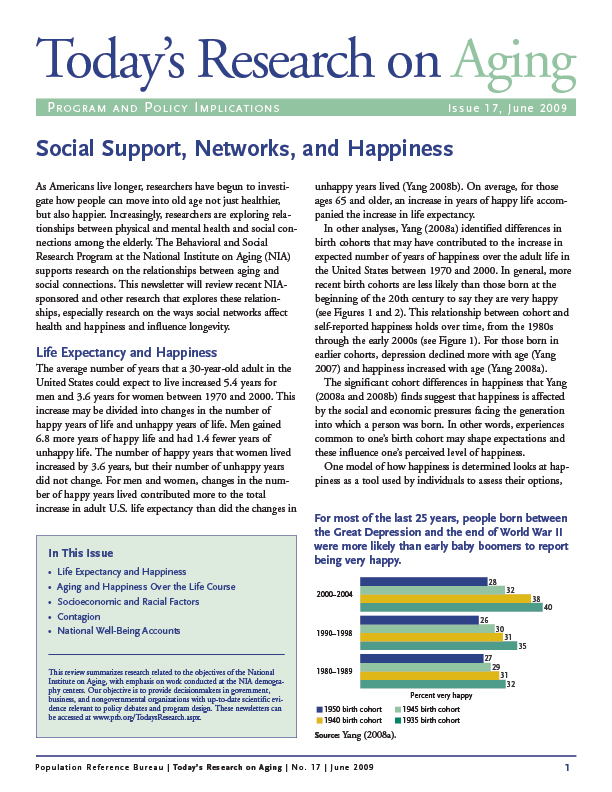
Today’s Research on Aging, Issue 17: Social Support, Networks, and Happiness
(2009) As Americans live longer, researchers have begun to investigate how people can move into old age not just healthier, but also happier. Increasingly, researchers are exploring relationships between physical and mental health and social connections among the elderly.
View Details
Array
(
[ID] => 4343
[id] => 4343
[title] => TRA17-2009-aging-happiness
[filename] => TRA17-2009-aging-happiness.pdf
[filesize] => 604992
[url] => https://www.prb.org/wp-content/uploads/2020/11/TRA17-2009-aging-happiness.pdf
[link] => https://www.prb.org/resources/todays-research-on-aging-issue-17-social-support-networks-and-happiness/tra17-2009-aging-happiness/
[alt] =>
[author] => 15
[description] =>
[caption] => Today’s Research on Aging, Issue 17, June 2009
Program and Policy Implications
Social Support, Networks, and Happiness
As Americans live longer, researchers have begun to investigate how people can move into old age not just healthier, but also happier. Increasingly, researchers are exploring relationships between physical and mental health and social con-nections among the elderly. The Behavioral and Social Research Program at the National Institute on Aging (NIA) supports research on the relationships between aging and social connections. This newsletter will review recent NIA-sponsored and other research that explores these relation-ships, especially research on the ways social networks affect health and happiness and influence longevity.
This newsletter reviews recent NIA-sponsored and other research that explores the relationships between aging and social connections.
[name] => tra17-2009-aging-happiness
[status] => inherit
[uploaded_to] => 9065
[date] => 2020-11-17 15:37:23
[modified] => 2020-12-21 00:00:34
[menu_order] => 0
[mime_type] => application/pdf
[type] => application
[subtype] => pdf
[icon] => https://www.prb.org/wp-includes/images/media/document.png
)
Download
(0.6 MB)
(2012) Arab countries continue to rapidly gain access to mobile cellular and to a smaller extent, mobile and wireless Internet, but lag behind in access to fixed broadband Internet access at home, according to the report ICT Adoption and Prospects in the Arab Region 2012.1
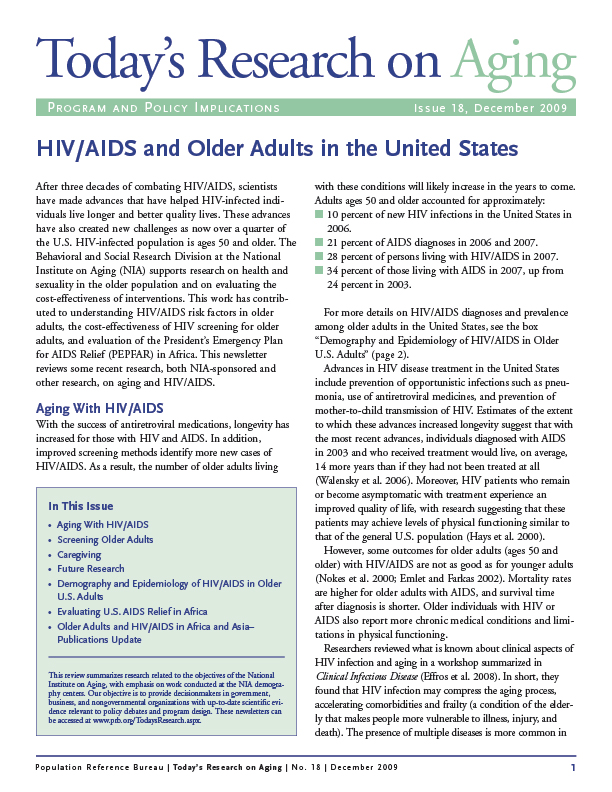
Today’s Research on Aging, Issue 18: HIV/AIDS and Older Adults in the United States
(2009) After three decades of combating HIV/AIDS, scientists have made advances that have helped HIV-infected individuals live longer and better quality lives. These advances have also created new challenges as now over a quarter of the U.S. HIV-infected population is ages 50 and older.
This newsletter reviews some recent research, either sponsored by the U.S. National Institute on Aging or by other organizations, on aging and HIV/AIDS.
View Details
Array
(
[ID] => 4342
[id] => 4342
[title] => TRA18-2009-HIV-AIDS.aging
[filename] => TRA18-2009-HIV-AIDS.aging_.pdf
[filesize] => 175701
[url] => https://www.prb.org/wp-content/uploads/2020/11/TRA18-2009-HIV-AIDS.aging_.pdf
[link] => https://www.prb.org/resources/todays-research-on-aging-issue-18-hiv-aids-and-older-adults-in-the-united-states/tra18-2009-hiv-aids-aging/
[alt] =>
[author] => 15
[description] =>
[caption] => Today’s Research on Aging, Issue 18, December 2009
Program and Policy Implications
HIV/AIDS and Older Adults in the United States
After three decades of combating HIV/AIDS, scientists have made advances that have helped HIV-infected individuals live longer and better quality lives. These advances have also created new challenges as now over a quarter of the U.S. HIV-infected population is ages 50 and older.
This newsletter reviews some recent research, either sponsored by the U.S. National Institute on Aging or by other organizations, on aging and HIV/AIDS.
[name] => tra18-2009-hiv-aids-aging
[status] => inherit
[uploaded_to] => 9069
[date] => 2020-11-17 15:36:46
[modified] => 2020-12-21 00:04:01
[menu_order] => 0
[mime_type] => application/pdf
[type] => application
[subtype] => pdf
[icon] => https://www.prb.org/wp-includes/images/media/document.png
)
Download
(0.2 MB)