
Project: Center for Public Information on Population Research (CPIPR)
197 Search Results Found For : "Ǯ o10_Ȼ6_4 (SOM) Z̷̽ ų̷ Ǯ â"

Change Comes Slowly for Religious Diversity in India
(2009) Religious diversity has been a defining characteristic of India's population for centuries. The country has no official state religion, but religion plays a central role in Indian daily life through its temple ceremonies, festivals, pilgrimages, family religious traditions, and the like. While Hinduism has been the dominant religion for several thousand years, Buddhism, Christianity, Islam, Jainism, and Sikhism have also flourished.
PRB Discuss Online: Americans at Work, What Lies Ahead?
(2008) The aging of baby boomers and the fact that women's labor force participation has already peaked are expected to slow U.S. labor force growth in the near future.
Do Muslims Have More Children Than Other Women in Western Europe?
(2008) Extremely low birth rates in most of Europe have fueled concerns about population decline, yet one segment of the continent's population—Muslims—continues to grow. The increasing number and visibility of Muslims in Western Europe, juxtaposed with the low fertility among non-Muslims, has led some Europeans to worry that the region will eventually have a Muslim majority, fundamentally changing Western European society.
Gender Inequality at Work
(2004) Women's increased participation in paid work is a central change in gender relations over the last 50 years. The question is no longer whether the average woman will work or not, but rather when during her life course she will work. Most women now work—women at all education levels, of each racial and ethnic group, and across successive family statuses.
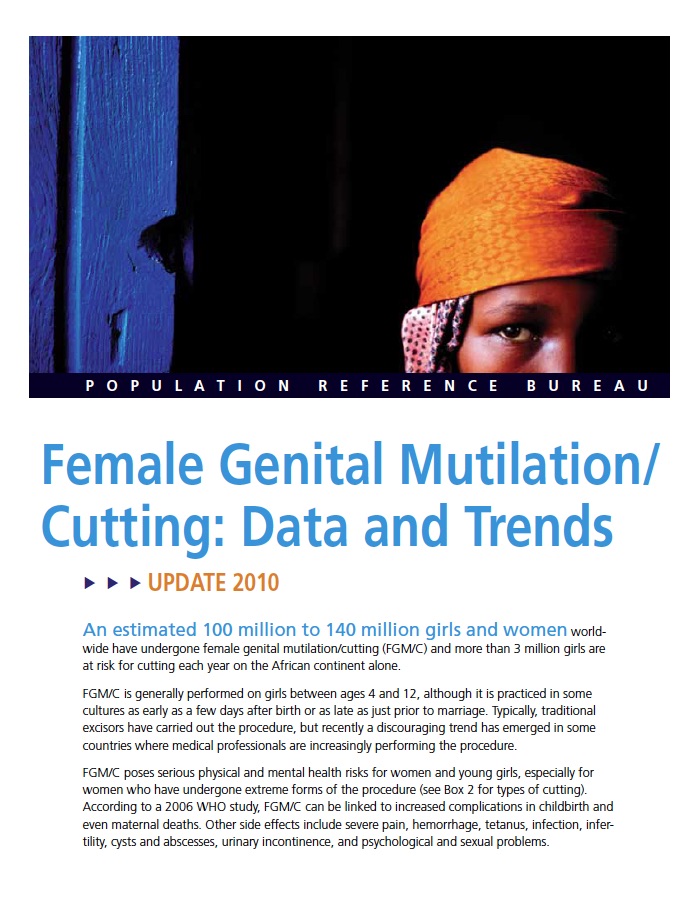
Female Genital Mutilation/Cutting: Data and Trends Update 2010
(2010) An estimated 100 million to 140 million girls and women worldwide have undergone female genital mutilation/cutting (FGM/C) and more than 3 million girls are at risk for cutting each year on the African continent alone.
View Details
Array
(
[ID] => 16401
[id] => 16401
[title] => 02022010-fgm-wallchart2010
[filename] => 02022010-fgm-wallchart2010.pdf
[filesize] => 202368
[url] => https://www.prb.org/wp-content/uploads/2021/02/02022010-fgm-wallchart2010.pdf
[link] => https://www.prb.org/resources/female-genital-mutilation-cutting-data-and-trends-update-2010/02022010-fgm-wallchart2010-2/
[alt] =>
[author] => 15
[description] =>
[caption] =>
[name] => 02022010-fgm-wallchart2010-2
[status] => inherit
[uploaded_to] => 16397
[date] => 2021-02-05 14:16:02
[modified] => 2021-02-05 14:16:02
[menu_order] => 0
[mime_type] => application/pdf
[type] => application
[subtype] => pdf
[icon] => https://www.prb.org/wp-includes/images/media/document.png
)
Download
(0.2 MB)
Project: IDEA: Informing Decisionmakers to Act
“The World’s Women and Girls 2011 Data Sheet,” Fact Sheet
(2011) Improvement in gender equity and women's empowerment has been uneven around the world and slow in many regions, according to the World's Women and Girls 2011 Data Sheet.