
485 Search Results Found For : "Y 리플거래【WWW․BYB․PW】 리플매매 리플투자✦리플리딩➆제이엠아이 JCh"


Project: Appalachia: Demographic and Socioeconomic Trends

Appalachia Sees Higher Incomes, Lower Poverty Rates, and Boosts in Education, but Still Lags Behind Rest of Nation

ARC and PRB release new data revealing Appalachia’s economic improvements, key vulnerabilities compared to the rest of the U.S. economy

View Details

Project: PACE: Policy, Advocacy, and Communication Enhanced for Population and Reproductive Health

2015 World Population Data Sheet Interactive: Focus on Women’s Empowerment

This year’s data include indicators on the status of women in key areas such as education, employment, and government. Looking at the numbers across the world, we can get a picture of women’s progress towards equality.

View Details

Project: PACE: Policy, Advocacy, and Communication Enhanced for Population and Reproductive Health

Webinar: Addressing Gender Through Integrated Population, Health, and Environment Approaches

Collecting, analyzing, and using gender-related indicators in projects is critical to addressing many of the underlying challenges that communities around the world face, particularly in integrated Population, Health, and Environment (PHE) projects.

View Details

Change Comes Slowly for Religious Diversity in India

(2009) Religious diversity has been a defining characteristic of India's population for centuries. The country has no official state religion, but religion plays a central role in Indian daily life through its temple ceremonies, festivals, pilgrimages, family religious traditions, and the like. While Hinduism has been the dominant religion for several thousand years, Buddhism, Christianity, Islam, Jainism, and Sikhism have also flourished.

View Details

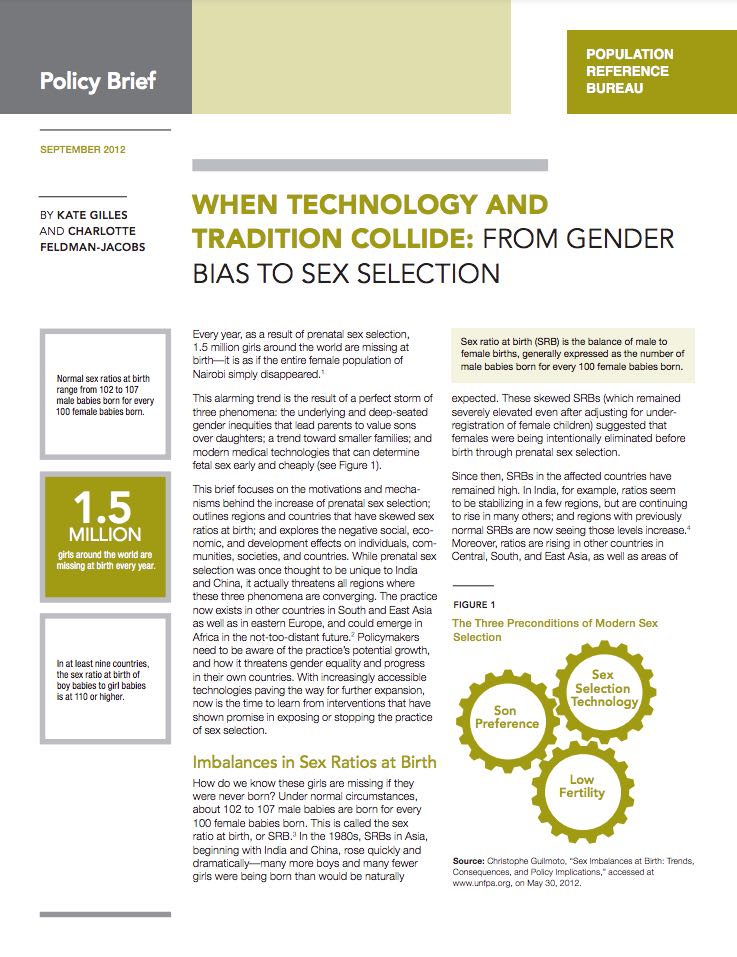
Policy Brief. When Technology and Tradition Collide: From Gender Bias to Sex Selection

(2012) Every year, as a result of prenatal sex selection, 1.5 million girls around the world are missing at birth—it is as if the entire female population of Nairobi simply disappeared.

View Details Array ( [ID] => 15617 [id] => 15617 [title] => 10152012-gender-bias-sex-selection [filename] => 10152012-gender-bias-sex-selection.pdf [filesize] => 1074294 [url] => https://www.prb.org/wp-content/uploads/2021/02/10152012-gender-bias-sex-selection.pdf [link] => https://www.prb.org/resources/when-technology-and-tradition-collide-from-gender-bias-to-sex-selection/10152012-gender-bias-sex-selection-2/ [alt] => [author] => 15 [description] => [caption] => [name] => 10152012-gender-bias-sex-selection-2 [status] => inherit [uploaded_to] => 15608 [date] => 2021-02-01 21:06:15 [modified] => 2021-02-01 21:06:15 [menu_order] => 0 [mime_type] => application/pdf [type] => application [subtype] => pdf [icon] => https://www.prb.org/wp-includes/images/media/document.png ) Download (1.0 MB)

Project: Appalachia: Demographic and Socioeconomic Trends

Report. Household Wealth and Financial Security in Appalachia (2013)

In 2007, with the onset of the deepest economic recession in the United States since the Great Depression, Americans lost jobs and experienced sharp declines in the value of their homes and investments.

View Details Array ( [ID] => 15387 [id] => 15387 [title] => appalachia-household-wealth-2013 [filename] => appalachia-household-wealth-2013.pdf [filesize] => 3068212 [url] => https://www.prb.org/wp-content/uploads/2021/01/appalachia-household-wealth-2013.pdf [link] => https://www.prb.org/resources/appalachian-region-hit-hard-by-recent-u-s-recession/appalachia-household-wealth-2013-2/ [alt] => [author] => 15 [description] => [caption] => [name] => appalachia-household-wealth-2013-2 [status] => inherit [uploaded_to] => 15381 [date] => 2021-01-31 20:46:36 [modified] => 2021-01-31 20:46:36 [menu_order] => 0 [mime_type] => application/pdf [type] => application [subtype] => pdf [icon] => https://www.prb.org/wp-includes/images/media/document.png ) Download (3.0 MB)

Will Rising Childhood Obesity Decrease U.S. Life Expectancy?

(2005) A new study contends that rising childhood obesity rates will cut average U.S. life expectancy from birth by two to five years in the coming decades—a magnitude of decline last seen in the United States during the Great Depression.

View Details