505 Search Results Found For : "demographic dividend"
World Population Futures
The United States at 300 Million
HOW WE HAVE CHANGED SINCE THE UNITED STATES WAS A NATION OF 200 MILLION (September 2006) The United States is set to reach a milestone in October. It will become the third country—after China and India—to be home to at least 300 million people.
Beyond the Headlines: What’s Really Happening With Global Fertility?
This guide explains what’s behind falling fertility rates, unpacks common assumptions about fertility decline, and explores how policymakers can respond.
Lecture: First Annual Malthus Lecture: “Meat”
(2010) The Malthus Lectureship, a partnership between the Population Reference Bureau and the International Food Policy Research Institute (IFPRI), promotes the study of the connections among nutrition, food, agriculture, and population and invites an outstanding scholar or policymaker to give a presentation each year. The first Annual Malthus Lecture took place on March 3, 2010, in Washington, D.C.
2011 World Population Data Sheet (English-PDF)
(2011) Global population will reach 7 billion later in 2011, just 12 years after reaching 6 billion in 1999.
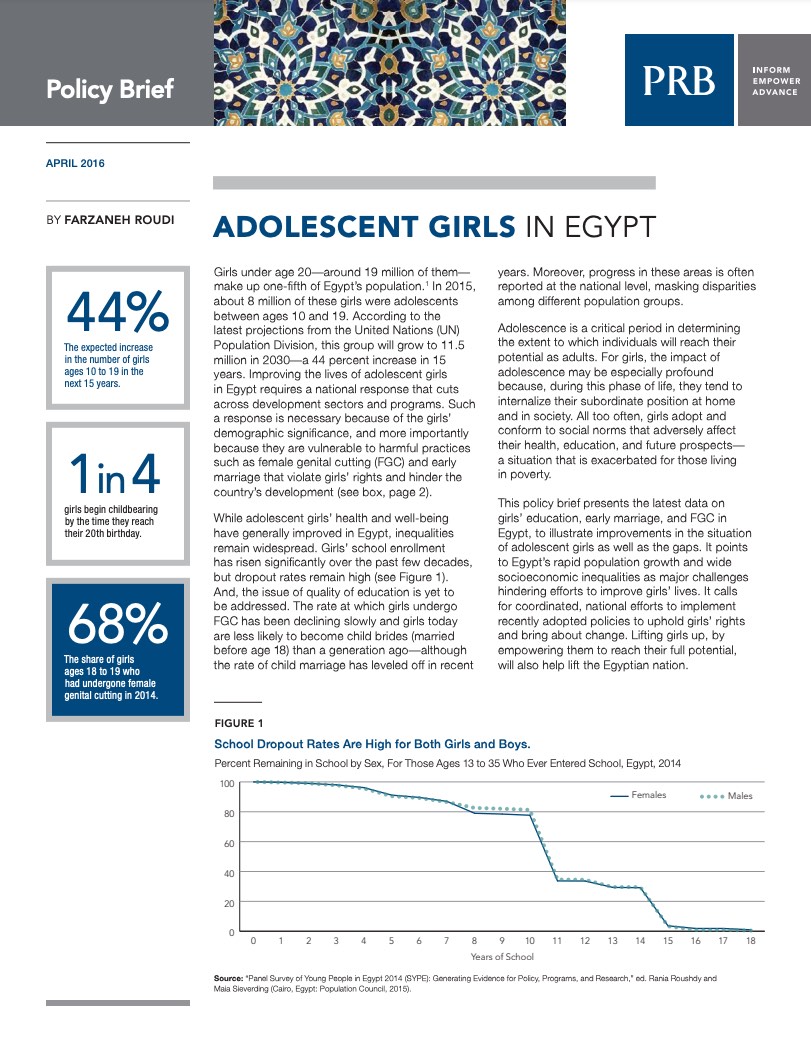
Policy Brief. Adolescent Girls in Egypt
(2016) In Egypt, harmful practices that violate girl's rights are hindering the country's development and ignoring the demographic significance of adolescent girls in the country.
Spread of HIV Is Slowing in Cambodia
(2003) In only 20 years, HIV/AIDS has developed into the most devastating epidemic the world has faced. Forty million individuals worldwide live with HIV/AIDS and millions more individuals, families, children, and communities affected by HIV/AIDS face multiple challenges.1 Yet while many countries continue to experience increasing HIV prevalence rates, Cambodia appears to be making progress.
Cuadro de datos de la población mundial 2011 (PDF)
(2011) Global population will reach 7 billion later in 2011, just 12 years after reaching 6 billion in 1999.