
China Abandons One-Child Policy
China has abandoned its “one-child” policy, according to news reports. The policy was previously relaxed January 2014, but in response to the country’s aging population, the Chinese government has proposed an update allowing two children per couple.
China has the world’s largest population, and in the 1970s managed to achieve one of the fastest fertility declines in human history. The country’s one-child population policy has resulted in a number of unique demographic events and transitions. So what would be the demographic implications of this two-child policy?
Figure 1
Note: Projections calculated using Spectrum Software.
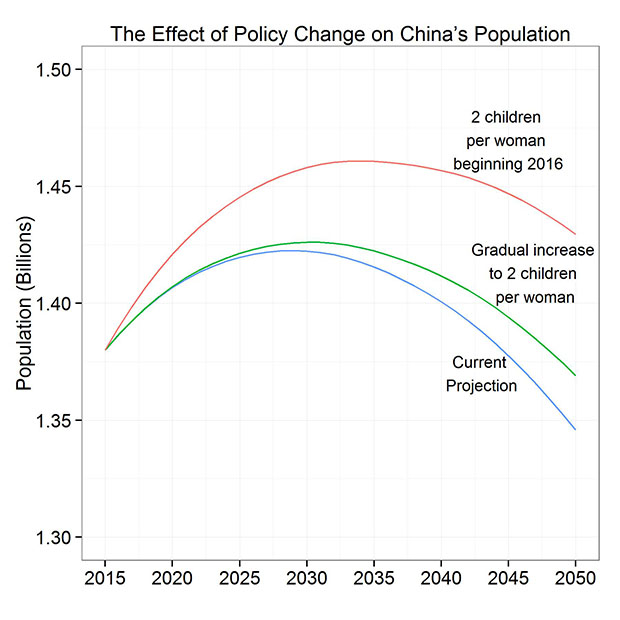
PRB demographer Kristin Bietsch calculated three scenarios of what population might look like in 2050 (see Figure 1). The current projection (blue line) is PRB’s projection under the old one-child policy for the population size of China. The population peaks around 2030 at 1.42 billion and begins to decline.
The high scenario (red line) is based on the idea that the total fertility rate (TFR) in China will increase to two children per woman in 2016 (a highly unlikely scenario given current desires for small families). This high scenario would peak only about five years later than the current scenario, at around 1.46 billion.
A more realistic projection is represented by the green line, where the TFR would gradually increase to around two children in 2050—a similar-looking trajectory to our current projection of China through 2030. If population increases gradually according to this scenario, it would also peak around 2030 at 1.43 billion people.
The bottom line: The difference in 2050 between the current projection and gradual increase scenario is 23 million people, less than 2 percent higher than PRB’s projection under the one-child policy.
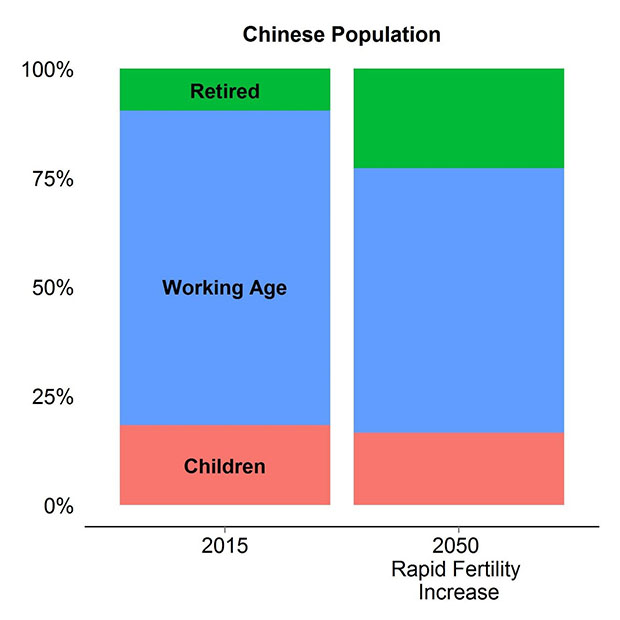
Figure 2 shows the age distribution in China for 2015 and 2050 if fertility increases immediately to two children per woman. Even with this increase, the age structure of China will change dramatically in the next 35 years, with a more than doubling of the retired-age (65 and older) population, and even a decrease in the number of children (those under age 15). There will be fewer working-age people per nonworking-age people in 2050 compared to 2015.
Figure 2
Related Posts
Understanding and Comparing Population Projections in Sub-Saharan Africa
The release of a new set of population projections by the Institute for Health Metrics and Evaluation (IHME) in July 2020 was greeted with extensive coverage in the media and stimulated fresh debate among demographers about calculation and communication of projections.

Population Age Structure and Pathways to Inclusive, Effective Governance
Among countries with a youthful population, a window of opportunity to achieve key development goals opens across four sectors―health, education, the economy, and governance―as fertility declines and the age structure of the population gets older.

Aging and Health in China: What Can We Learn From the World’s Largest Population of Older People?
The United Nations projects that there will be 366 million older Chinese adults by 2050, which is substantially larger than the current total U.S. population of 331 million.