
Senior Women Journalists Chosen for 'Women Deliver' Awards
(March 2015) Three alumna of PRB’s Women’s Edition program and a fourth journalist who participates in PRB’s study tours and trainings in Francophone West Africa are among 15 journalists being honored by Women Deliver for their excellent reporting on the health and rights of women and girls. Women Deliver recognized these women to mark International Women’s Day on March 8 and they will be among the nominees for awards at the group’s 2016 Copenhagen conference.
The four journalists who have taken part in PRB’s USAID-funded journalist trainings are listed below, and in their own words told Women Deliver a little about their experiences and beliefs:
FARAHNAZ ZAHIDI MOAZZAM, PAKISTAN
Express Tribune
Farahnaz was a member of PRB’s Women’s Edition project in 2010-2012. As National Desk Editor for the The Express Tribune she confronts and challenges cultural and religious norms that threaten girls’ and women’s health and rights in Pakistan, including fistula, sexual violence, female genital mutilation/cutting, and religious extremism, among others. Her stories have even pressured local authorities and policymakers to enforce laws that protect women, and in one case put some perpetrators of sexual assault behind bars.
In her own words: “As a story-teller, I know that there is no story in the world where both a male and a female character are not involved. I tilt towards the female side of the story, not just because I am a woman, but because I understand the Pakistani woman’s indigenous sensibilities as I am one. Hence, my stories are not just sob stories. I am a positive person. So my stories are stories of triumphant women.”
RINA JIMENEZ-DAVID, PHILIPPINES
Philippine Daily Inquirer
Rina was a member of PRB’s Women’s Edition project in 2010-2012. Rina’s voice is synonymous with girls’ and women’s rights in the Philippines. Since 1989, she has published four columns weekly for the country’s most widely read newspaper – many of which have been dedicated to girls’ and women’s health and rights. Rina’s reporting helped maintain momentum around the 14-year long debate of the groundbreaking Philippines’ reproductive health bill, which guarantees universal access to contraception, sexual education and maternal care.
In her own words: “Girls’ and women’s health issues aren’t front-page news because they are considered ‘continuing’ crises rather than alarming developments, such as the threat of Ebola or the MERS-COV virus. My own attitude through the years has evolved from bemoaning the absence of such stories from the front pages to working to find spaces for them in other sections, such as columns like mine.”
CATHERINE MWESIGWA, UGANDA
New Vision
Catherine was a member of Women’s Edition in 2008-2010. Catherine paves the way for women to lead in her newsroom, community and beyond. As New Vision’s Deputy Editor, Catherine is a role model for young female writers who aspire to be leaders in a field traditionally dominated by men. Her coverage pushes the public and policymakers to prioritize girls’ and women’s needs, and played an important role in influencing Ugandan officials to pass a law banning the practice of female genital mutilation/cutting in Uganda.
In her own words: “When political leaders and the media make the connection between girls’ and women’s health and welfare to socioeconomic development and productivity, children’s education outcomes, and nations’ political stability, women’s health issues will make it to the front pages.”
MAIMOUNA GUEYE, SENEGAL
Le Soleil
Maimouna has participated in PRB’s study tours and trainings in Francophone West Africa. As Editor-in-Chief and coordinator of Le Soleil’s health supplement, Maimouna uses her platform to raise awareness about critical maternal and reproductive health issues. Her work is widely credited with encouraging the Senegalese government to enhance its family planning program. In fact, Ministry of Health officials frequently use the poignant, first-hand testimonies featured in Maimouna’s articles to highlight how policies directly affect women.
In her words: “We need intense advocacy directed toward media owners so they become more sensitive to all issues affecting women. Training journalists to have an interest in women’s issues is another dimension that needs work. If in a newsroom there are no women journalists, who will speak for them?”
The 15 honorees were selected by an internal review board from a competitive pool of more than 100 journalists who were nominated by dozens of Women Deliver’s partners and supporters. Women Deliver has created an online voting contest to select the top three journalists, and the three winners will receive scholarships to attend Women Deliver’s 2016 conference, which will be held in Copenhagen, Denmark.
Related Posts
Webinar: Bridging Research and Policies: Enhancing Budgeting Processes for Africa's Demographic Dividend
PRB hosted a high-level webinar with budget experts, parliamentarians, and national directors to discuss the importance of the Demographic Dividend Sensitive Budgeting approach in enhancing budgeting processes across Africa.

Research Identifies New Strategies to Reduce Undercount of Young Children in U.S. 2020 Census
PRB identifies factors predicting where children under age 5 are more likely to be missed in the 2020 Census and develops a new undercount risk measure for young children.

Health Sector Reform: How It Affects Reproductive Health
(June 2003) Many less developed countries are reforming their health systems in an effort to achieve public health goals more affordably and effectively.
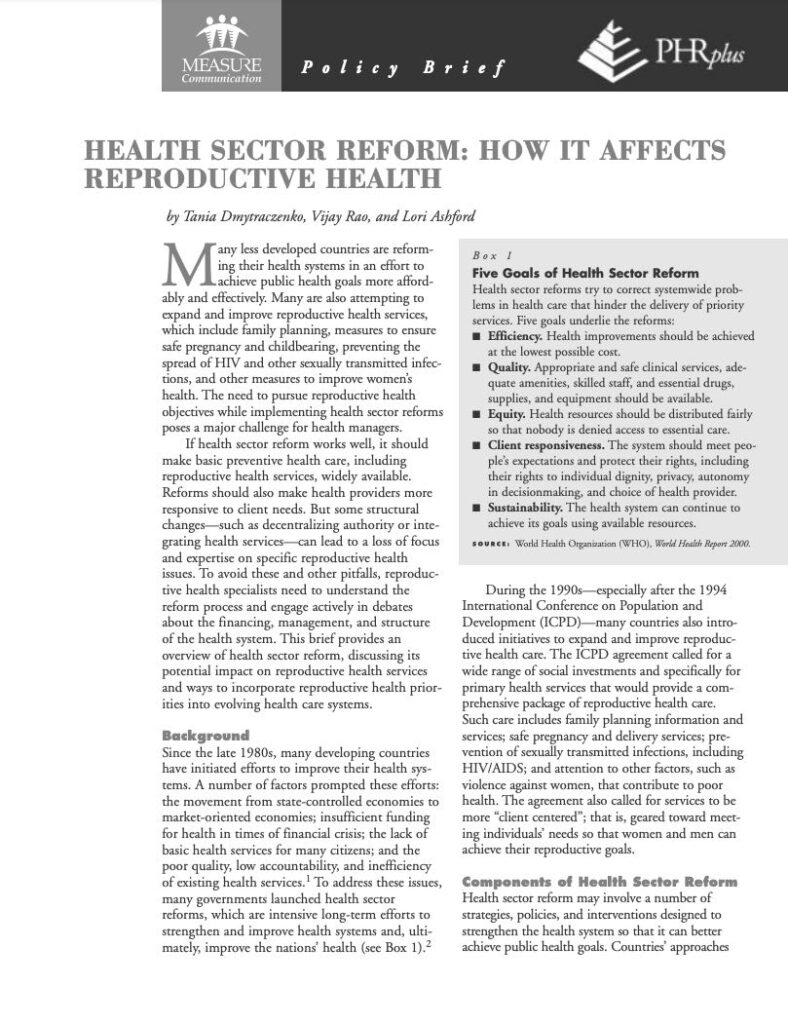
Report. Health Sector Reform: How It Affects Reproductive Health
This report also in French and Spanish. (June 2003) Many less developed countries are reforming their health systems in an effort to achieve public health goals more affordably and effectively.