
The Emerging Democratic Republic Of Congo: The Role of the Demographic Dividend
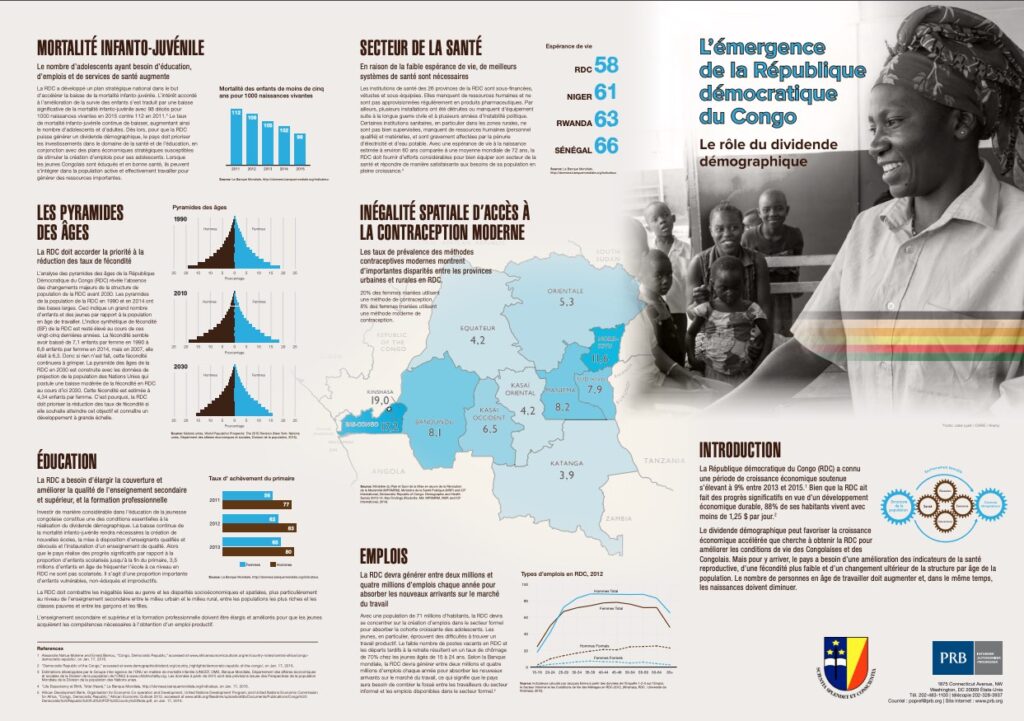
The Democratic Republic of Congo (DRC) has experienced a period of sustained economic growth, averaging about 9 percent between 2013 and 2015. Although the DRC has made significant progress towards sustainable economic development, 88 percent of its inhabitants live on less than $1.25 a day. This wall chart, currently only available in French, explains how a demographic dividend can promote accelerated economic growth to improve the living conditions of Congolese citizens.
To succeed, the country needs to first focus on improving reproductive health indicators that will aid in lowering fertility, leading to a subsequent change in the age structure of the population. The number of working-age people must increase, and at the same time, births must decrease. In order for the DRC to see a more empowered working-age population, a multisectoral approach to national investments is key. From health care to job creation to improved education, calculated investments must be made in order to advance development and realize a demographic dividend in the DRC.
You can learn more about the demographic dividend on our partner site.
Related Posts
Understanding and Comparing Population Projections in Sub-Saharan Africa
The release of a new set of population projections by the Institute for Health Metrics and Evaluation (IHME) in July 2020 was greeted with extensive coverage in the media and stimulated fresh debate among demographers about calculation and communication of projections.

Population Age Structure and Pathways to Inclusive, Effective Governance
Among countries with a youthful population, a window of opportunity to achieve key development goals opens across four sectors―health, education, the economy, and governance―as fertility declines and the age structure of the population gets older.

Aging and Health in China: What Can We Learn From the World’s Largest Population of Older People?
The United Nations projects that there will be 366 million older Chinese adults by 2050, which is substantially larger than the current total U.S. population of 331 million.