
Baby-Boomer Retirees Changing the U.S. Landscape
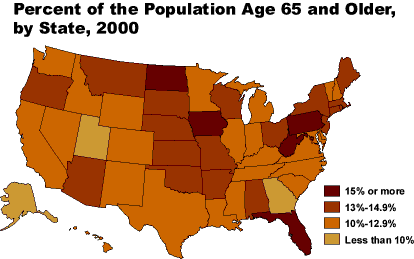
(October 2000) People ages 65 and older are far less likely to move than their working-age counterparts. Still, those who do move tend to converge on a small number of “retirement magnets” — places that are especially attractive to the older population — and can have a significant demographic and social impact on an area. Florida, where older people make up an estimated 18 percent of the population in 2000, is the best example of a retirement magnet.
In states such as West Virginia, Pennsylvania, Iowa, and North Dakota, older people are also a growing share of the population, not because of migration but because of “aging in place.” Aging in place occurs when young people move elsewhere, leaving behind a relatively large percentage of people ages 65 and over. More states will begin to experience aging in place when the first baby boomers turn 65 in 2011.
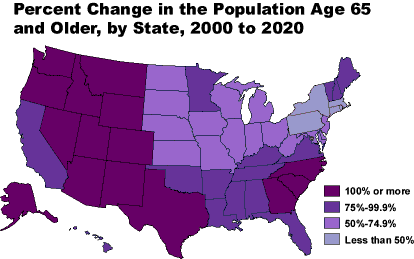
The regional distribution and characteristics of future generations of older people therefore depend largely on the migration patterns of younger generations. Over the next 25 years, the older population is projected to double in several states in the Mountain West (Montana, Idaho, Wyoming, Colorado, New Mexico, Arizona, Utah, and Nevada); the Pacific Coast (Washington, Oregon, and Alaska); and the South (the Carolinas and Texas).
Citations
U.S. Census Bureau, “Projections of the Total Population of States, 1995 to 2025,” accessed online at www.census.gov/population/projections/state/stpjpop.txt on September 11, 2000; and U.S. Census Bureau , “Projections of the Population, by Age and Sex, of States: 1995 to 2025,” accessed online at www.census.gov/population/projections/state/stpjage.txt on September 11, 2000.
Related Posts
Census Issues, Impact of Dobbs Decision, and Population Aging Among Highlights of 2024 Population Association of America Conference
PRB staff offer summaries of new research and insightful sessions at the annual demography meeting.
How Accurate Was the 2020 Census—and Why Should You Care?
Significant undercounts in the 2020 Census could have serious consequences for underrepresented groups and individual states.
Understanding and Comparing Population Projections in Sub-Saharan Africa
The release of a new set of population projections by the Institute for Health Metrics and Evaluation (IHME) in July 2020 was greeted with extensive coverage in the media and stimulated fresh debate among demographers about calculation and communication of projections.

How Will We Measure the Accuracy of the 2020 Census?
Getting an accurate 2020 Census count is important because census numbers impact daily life in the United States in many ways.