How High Temperatures Are Changing Who Gets Born
Hotter weather shifts the balance of births toward fewer males than usual. This matters for maternal health, gender inequality, and the makeup of populations.

Hotter temperatures don’t just threaten lives already lived—they also shape which lives begin. In our new study, we find that temperatures above 68°F (20°C) shift the sex ratio at birth, resulting in fewer boys than expected. The likely reason: Male fetuses appear more vulnerable to heat stress, making their loss during pregnancy more likely. And in India, where son preference drives sex-selective abortion, heat adds a further twist—it seems to reduce those abortions, making the sex ratio less male-biased, too. Ultimately, our environment may determine who is born and who is not.
Sex ratios at birth—the ratio of male to female births—are closely linked to maternal health, pregnancy loss, and population composition. In most populations, around 103 to 105 boys are born for every 100 girls. But in some parts of India, that ratio climbs above 115:100, driven by sex-selective abortions rooted in strong son-preference norms. In this sense, sex ratios are also a window into gender inequality.
While research has paid considerable attention to how high temperatures affect mortality among older adults, far less attention has gone to the earliest moments of life. Yet pregnancy may be one of the most consequential—and least studied—windows through which environmental stress shapes entire populations. That’s the gap our research sets out to address.
Heat Above 68°F Is Associated With Fewer Male Births
To investigate this, we drew on 5 million birth records from the Demographic and Health Surveys Program, combined with high-resolution environmental data, to study temperature impacts across sub-Saharan Africa and India. What we found is that when temperatures during pregnancy exceed 68°F (20°C), fewer boys are born than we would otherwise expect.
Why would heat affect male births specifically? An established evolutionary idea, the Trivers-Willard hypothesis, offers one explanation. Men have higher mortality rates than women throughout the life-course, meaning a weak male pregnancy is less likely to result in an offspring who goes on to reproduce. The theory predicts that in stressful environments, frail male pregnancies are more likely to be lost, freeing up resources for a stronger pregnancy. Our findings are consistent with that: Heat appears to act as one such stressor, shaping the sex composition of populations.
In sub-Saharan Africa, the mothers most affected are those with little or no formal education, those living in rural areas, and those experiencing their fourth or later births.
Heat’s Effect Depends on Social Context
But biology isn’t the whole story. One of our more surprising findings is what we observed in India, where the pattern looks quite different from sub-Saharan Africa.
In India, male birth reductions are most pronounced for older mothers, mothers with several children already, and—crucially—mothers in northern states with strong son-preference norms who do not yet have a son. These are precisely the groups most likely to pursue sex-selective abortion under normal circumstances. This suggests that, in India, extreme heat may actually be changing the sex ratio at birth by reducing sex-selective abortions.
The comparison with sub-Saharan Africa, where sex-selective abortion is not a significant factor, helps isolate this behavioral dimension. The figure below visualizes how both a biological health mechanism (pregnancy loss) and a socio-behavioral mechanism (sex-selective abortion) may impact the sex ratio at birth.
Figure. The Link Between Temperature and Sex Ratios at Birth
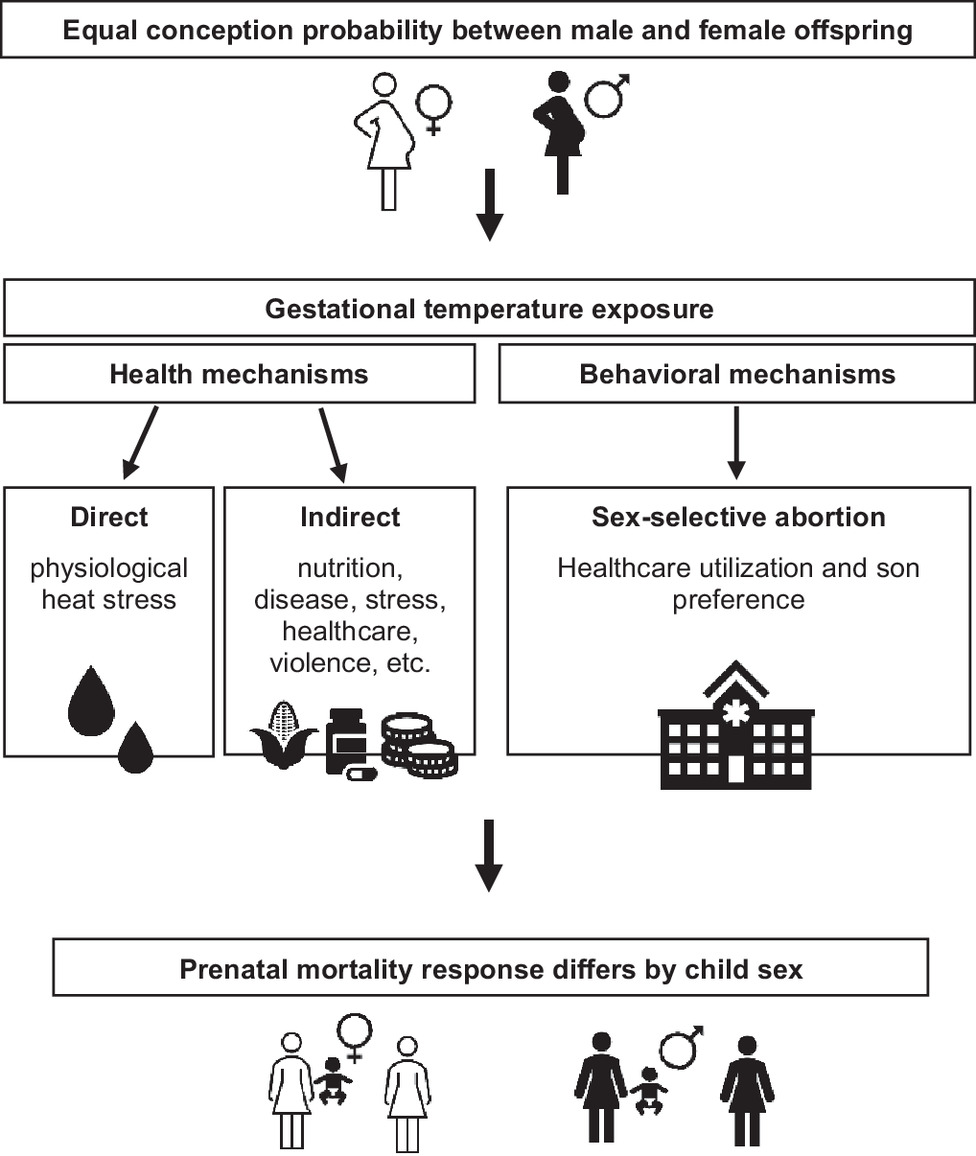
Source: Jasmin Abdel Ghany et al., “Temperature and Sex Ratios at Birth,” Proceedings of the National Academy of Sciences 123, no. 8 (2026): e2422625123.
We also found that the effect appears at moderate heat intensity and does not grow proportionately stronger as temperatures climb further. Above 68°F (20°C), sex ratios at birth become less male-biased—but higher temperatures above that threshold don’t seem to amplify the effect in a straightforward way. That said, overall pregnancy loss may still increase with heat intensity, even if the sex difference in that loss remains relatively stable.
What This Means for the Future—and Why It Matters
Does this mean we will see fewer boys born as temperatures rise? The answer is more nuanced than it might seem. In the regions we studied, global warming is increasing the frequency of days at very high heat intensity, often above 86°F (30°C). Little change in temperature will be occurring at the much lower threshold of 68°F (20°C), where the sex ratio effects kick in. This is why populations already living in high-heat environments may see less additional change than those in regions where temperatures are only beginning to cross that 68°F mark. Whether the same dynamics apply elsewhere remains an open question.
Our study shows that the natural environment shapes human reproduction and population composition through both biological and social mechanisms. Extreme heat is linked not only to maternal health and fetal survival, but in some contexts to gender discrimination as well. The environment, it turns out, doesn’t just affect how long we live—it affects the very composition of the generations that follow us.
We believe more work is urgently needed to understand how these effects will evolve, and to develop practical interventions that can protect pregnant mothers from heat exposure. Without that, the reproductive health inequalities we observe today risk being poorly understood—and poorly addressed.
Jasmin Abdel Ghany, Ph.D., is a Postdoctoral Prize Research Fellow at Nuffield College, University of Oxford. Her research focuses on the impact of environmental factors on population health and inequalities.
Related Posts
Adolescents and Youth Are Key to Fully Achieving Universal Health Coverage
In 2021, adolescents and youth between ages 10 and 24 are estimated to make up approximately 24% of the world’s population.
Aging and Health in China: What Can We Learn From the World’s Largest Population of Older People?
The United Nations projects that there will be 366 million older Chinese adults by 2050, which is substantially larger than the current total U.S. population of 331 million.