
In Dakar, a New Generation Steps Forward to Lead Their Countries' Development
Supporting localization isn’t about stepping back—it’s about showing up differently. In Dakar, we witnessed what’s possible when we stop talking about youth leadership and start listening to it.
This blog is the fourth in our series on centering youth in local development. Access other blogs in the series here.
Local dialogue spaces have the potential to transform power and aid in the international development sector.
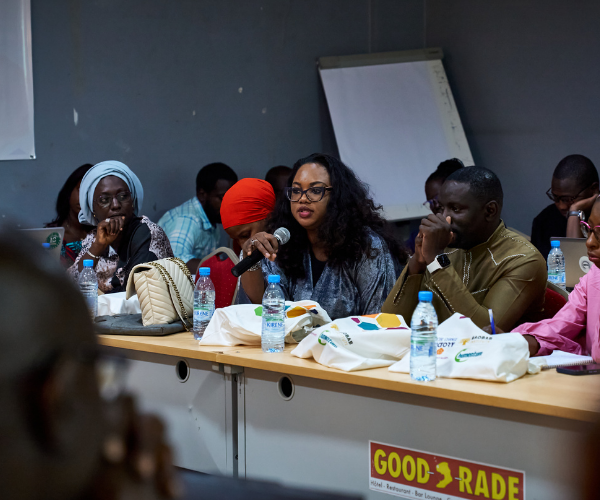
This potential was evident in Dakar in late November 2024 when the Baobab Institute and Social Change Factory, with funding from the TIME Initiative (Transforming INGO Models for Equity), brought together around 40 Senegalese organizations for a groundbreaking meeting on the meaning and implications of localization in Senegal. The meeting, held entirely in French, was particularly significant for this fact—language remains a major obstacle to equitable global dialogue on localization and power shifting due to the dominant use of English.
Participants engaged in rich discussions deeply rooted in the realities of a young generation determined to shape their country’s future. They generated several key resolutions—such as collectively defining localization as a shift in power dynamics and interdependence, identifying transformation priorities like institutional governance and digitalization, and outlining next steps to reinforce local leadership. These exchanges also created strong momentum for continued collaboration, planting solid seeds for a future joint declaration summarizing collective commitments, recommendations to guide implementation of equitable development models, and a shared follow-up framework to sustain this locally driven reflection.
One of the key achievements of the workshop was the collective development of a shared definition of localization, shaped through the reflections and exchanges among young Senegalese leaders: “Localization is a process of shifting power and resources, and improving interdependence among stakeholders in the development sector.” This definition, grounded in their lived experience and local context, reflects a nuanced understanding of structural challenges in the sector and offers a strong foundation for more equitable and contextualized dialogue moving forward. The outcomes from this local dialogue space mark the promising beginnings of a broader, locally rooted effort to localize localization thinking.
This workshop was the most inspiring I have attended in the past five years. It opened my eyes to essential elements often overlooked in discussions on localization.
This young generation of development aid professionals possesses the skills needed to contribute to their country’s development, provide technical support to governments and elected officials, and address current deficits in technical advisory support to decentralized authorities. Such activities, historically, have been gaps that international aid organizations have filled. Now, in countries like Senegal, these young professionals have closed the gaps.
Yet, within the framework of the development aid sector, they are not sufficiently recognized as direct and key contributors to their nation’s sustainable development.
They must be recognized as direct and key contributors—as assets, with vital technical skills.
INGOs’ inability to recognize and embrace the current generation’s capabilities is a missed opportunity to fully leverage their potential.
Shaped by technical approaches disconnected from how development actually functions within their own countries, today’s young professionals struggle to bridge the gap between their expertise and their country’s structural needs. Their training, focused on technical tools, has moved away from the principles of sustainable development and civic participation that characterized the development aid sector in the 1990s. This disconnection reduces their ability to integrate their skills into their daily context and build their own relationships with decisionmakers.
Moreover, these professionals express an urgent need for an updated civic education grounded in contemporary realities to better understand the economic and political functioning of their country and the world, as well as interactions between various stakeholders.
Localization and power redistribution can only be achieved within an open dialogue among all stakeholders engaged in development aid.
It is the combination of reflections initiated by the TIME Initiative—within INGOs and among Senegalese organizations—that has helped me better understand the role I can play in a collective transition driven by passionate and determined actors.
In Dakar last November, my experience in the sector gave me the opportunity to provide technical, strategic, and political answers to the questions posed by young professionals eager to take charge of their country’s development. My contribution was simply to share experiences and perspectives gathered over the years. And just like that—by listening and responding to the questions posed in a locally built dialogue space rather than deciding what the questions should be—a bridge between generations began to take shape.
This bridge is critical because power shifting is also about intergenerational collaboration and recognition of today’s young professionals as our future colleagues for our mission. The questions and ideas discussed during these country-led exchanges warrant further exploration, and I look forward to continued dialogue and collaboration with those who are shaping new ways of thinking and acting on localization.
Related Posts
Understanding and Comparing Population Projections in Sub-Saharan Africa
The release of a new set of population projections by the Institute for Health Metrics and Evaluation (IHME) in July 2020 was greeted with extensive coverage in the media and stimulated fresh debate among demographers about calculation and communication of projections.