
PRB Report Launch: Preventing Noncommunicable Disease Epidemic in Africa Is Possible
“Africa’s future does not need to be defined by an overwhelming noncommunicable disease burden,” said Toshiko Kaneda, senior research associate at the Population Reference Bureau (PRB), to an engaged crowd of more than 100 people gathered in Nairobi for the launch of PRB’s new report on preventing noncommunicable diseases (NCDs) among the region’s youth.
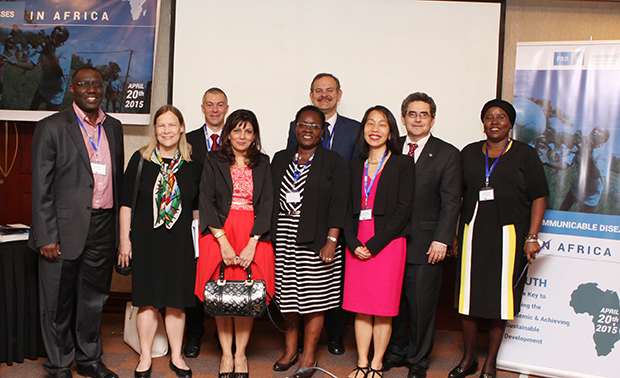
At the Nairobi launch of the PRB report, a diverse group of speakers emphasized the need for immediate action to prevent noncommunicable disease risk factors among youth in Africa, and the importance of healthy and productive young people to Africa’s future.
The PRB report, written by Kaneda and PRB senior policy analyst Reshma Naik with support from the AstraZeneca Young Health Programme, examines Africa’s growing health threat from NCDs such as cancer, diabetes, cardiovascular diseases, and chronic respiratory conditions, and describes prevention strategies. The first comprehensive resource of its kind for Africa, the PRB report includes detailed country-level data on the four main NCD risk factors among youth: tobacco use, alcohol abuse, unhealthy diet, and insufficient exercise.

At the Nairobi event, Kaneda told representatives from academia, civil society groups, youth agencies, and Kenyan government ministries that youth in some African countries already have high levels of all of the NCD risk factors, and the share at risk is likely to rise further unless policies and programs are put in place to counter this worrisome trend.
Risk behaviors are often established in early adolescence and young adulthood and set the stage for NCDs later in life. Focusing on youth is critical in Africa because of its large and growing number of young people, and because Africa has the youngest population among the world regions, she told the crowd.
She pointed to a variety of the report’s recommendations: policies such as cigarette taxes; the importance of involving young people, families, schools, and communities in addressing these issues; and integrating NCD prevention with sexual and reproductive health programming for young people because the associated risk and protective factors for these overlap.
A diverse group of speakers underscored the need for immediate action and the importance of healthy and productive young people to Africa’s future. Speakers included David Githanga, chairman of the Kenya Paediatric Association; Josephine Kibaru-Mbae, director general, National Council for Population and Development, Kenya; and Jonathan Klein, executive director, NCD Child, and associate executive director, American Academy of Pediatrics.
“This PRB report provides critical data for governments, health authorities, universities and NGOs and we are delighted to have been able to support this work,” said David Smith, AstraZeneca’s executive vice president for global operations, speaking at the Nairobi event. “Our hope is that it will be used to raise awareness, inform planning, and ultimately contribute to preventing the unhealthy behaviors in adolescents which, if not tackled, will lead to the predicted increase in the NCD burden in Africa.”
AztraZeneca’s Youth Health Programme announced new activities in Africa to address some of the report’s recommendations.
The links below provide more information about PRB’s work on NCDs:
- Addressing Risk Factors for Noncommunicable Diseases Among Young People in Africa: Key To Prevention and Sustainable Development (Data Sheet)
- Noncommunicable Diseases in Africa: Youth Are Key to Curbing the Epidemic and Achieving Sustainable Development (Policy Brief)
- Addressing Risk Factors for Noncommunicable Diseases Among Young People in Africa: Key To Prevention and Sustainable Development (Data Appendix)
Related Posts
Understanding and Comparing Population Projections in Sub-Saharan Africa
The release of a new set of population projections by the Institute for Health Metrics and Evaluation (IHME) in July 2020 was greeted with extensive coverage in the media and stimulated fresh debate among demographers about calculation and communication of projections.