
Progress Stalled
What if improving life expectancy isn't guaranteed?

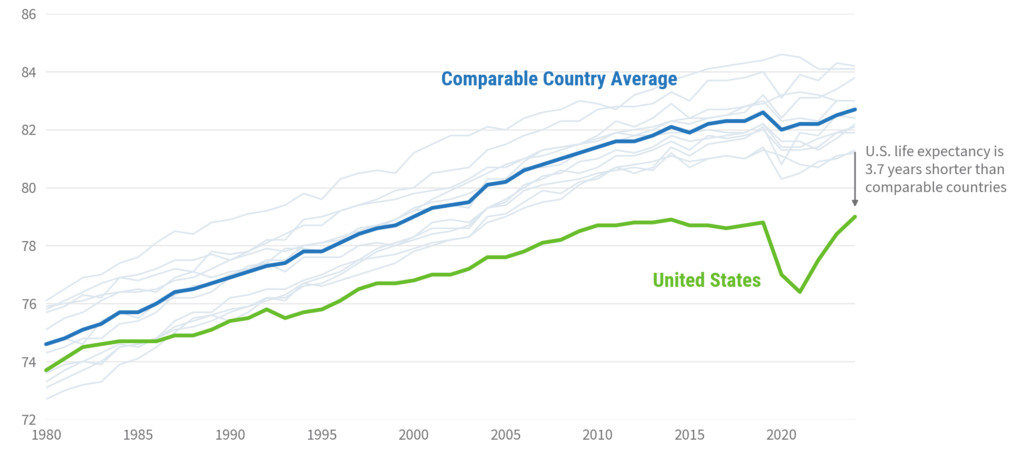
Recent headlines heralded U.S. life expectancy reaching 79 years in 2024, its highest ever. Less publicized was that this number reflects only a tiny improvement over 15 years that saw many setbacks—in 2010, U.S. life expectancy was 78.7. A “record high” that mostly just returns Americans to where they already were seems an odd cause for celebration.
For over a century, improving life expectancy has been a bright spot in the human story. In Europe, where I currently live, life expectancy at birth has more than doubled since 1850. Thanks to advancements in public health, medical technology, and living conditions, we no longer face the prospect of losing half our children before age five, and we can expect to live longer and healthier into older age.
While significant mortality shocks such as the 1918 flu and World War II caused sharp, temporary drops, these were followed by a return to steep gains in life expectancy. When I was a demography graduate student in the early 2000s, this march of mortality progress felt unstoppable. Academic debates centered on whether we’d ever reach a limit, since record life expectancy continued to break through all previous predictions.
But 25 years later, the march has become more of a crawl. At the extreme, U.S. life expectancy fell for three straight years starting in 2014 and is still barely treading water after large COVID losses. But this trend is not uniquely American. In a paper in Population and Development Review, our research team found slowdowns in mortality improvements in most high-income countries in the decade leading up to 2020, with the U.S., the UK, Canada, the Netherlands, and Germany improving the slowest. But some countries, like Japan, South Korea, and Denmark, continued to improve at a steady pace, suggesting we aren’t approaching a biological ceiling on how long humans can live.
Figure. Life Expectancy at Birth, in Years, 1980–2024
What’s Causing Mortality Stagnation?
In the U.S., “deaths of despair” due to drug overdose, alcohol, and suicide have received a lot of attention. While real and heartbreaking, overdose deaths are thankfully not common enough to explain broader mortality trends (in 2023, they accounted for about 3% of deaths). The dominant story, in both the U.S. and UK, is stalling improvements in deaths from cardiovascular disease, including heart attacks and strokes. Major advancements in prevention—statins and antihypertensive drugs, reductions in smoking—led to significant declines in cardiovascular disease throughout the late 20th century.
While the causes of the recent slowdowns in progress are still a puzzle, the lagged impact of rising obesity rates may be one culprit. People now in midlife were among the first generations to grow up with the obesity epidemic. This means they have, on average, lived more years with obesity than generations before them, accumulating health risks, including a higher risk of cardiovascular disease. While obesity in the U.S. rose earlier and higher, most countries have been affected. Japan is a notable outlier, with only 5.2% of the population estimated to be obese in 2024, compared to 42% in the U.S. and 29% in the UK.
Scars of COVID
In many high-income countries, COVID-19 led to the largest declines in life expectancy since World War II. The prevailing assumption was that these losses would be transient, with a quick return to previous trajectories. In a pre-print paper, my colleagues and I found that 31 of 34 high-income countries had still not fully made up lost ground five years after the onset of the pandemic. The U.S. had the largest five-year life expectancy deficit of any country we studied, losing 1.73 years from 2020 to 2024 and sitting 0.55 years below expectations in 2024— another important caveat to “record” life expectancy headlines.
Our findings suggest that COVID-19 may not be a short-lived shock. These lasting impacts could be a direct result of the virus, as well as downstream healthcare, social, and economic disruptions.
Generational Health Drift
But mortality rates may be just the tip of the iceberg. Historically, increases in life expectancy have been tied to improvements in health among the living. But stalling mortality may now reflect worsening health at all ages. New research finds that younger cohorts are entering midlife with higher rates of chronic disease and worse mental health than their predecessors, suffering from what some have called the “generational health drift.” For example, diabetes rates for people in their forties nearly doubled for Gen X (5.9%) compared to Baby Boomers (3.1%) in Britain.
This drift is particularly concerning in the context of population aging. Continued improvements in health and physical functioning across generations could buffer the fiscal strain associated with caring for a higher share of older people, but worsening health could exacerbate it. In the UK, more people are leaving paid work before pension age due to long-term illness, simultaneously removing productive people from the labor force while increasing state benefits spending. Reversing this drift and helping people reach older ages as healthy as possible should be a priority for countries with rapidly aging populations.
Reasons for Optimism
Short-term fluctuations in mortality are not uncommon—and long-term trends have been consistently good. As with fertility booms and busts, demographers should be careful not to overreact to short-term changes. New GLP-1 drugs like Ozempic may finally turn the tide on ever-rising population obesity and subsequent cardiovascular disease risk. Additional scientific breakthroughs have the potential to dramatically change the landscape of human health and longevity in ways we can’t begin to fathom. Preliminary data from 2025 suggests continuation of a life expectancy positive trend in the US.
But while the promise of future technology is exciting, considerable progress can still be made today. For better and for worse, population mortality remains remarkably responsive to social conditions. The catastrophic life expectancy losses in Eastern Europe during the post-Soviet mortality crisis have been followed by remarkable recoveries, with younger age groups now seeing lower mortality rates than their peers in the U.S. The continued life expectancy gains of high-achieving countries like Japan and South Korea show us that there is still much room for improvement—and that the shortfalls seen in many places are likely due to human-made social factors rather than biological limits.
Falling short of achievable life expectancy is not just bad on paper. It represents millions of “missing” people who could be alive if mortality rates in their country matched what is currently possible. People who die prematurely also don’t get a chance to have the children they might have had. An estimated 200,000 fewer children were born in the U.S. from 2010 to 2019 due to the premature death of their potential mothers, highlighting the links between mortality and fertility.
At a time when the media is hyper-focused increasing births, we’d be wise to invest more heavily in keeping the people we already have alive and well.
Jennifer Dowd is Professor of Demography and Population Health and Deputy Director of the Leverhulme Centre for Demographic Science, University of Oxford. She holds a Ph.D. in Demography and Economics from Princeton University and completed postdoctoral training in Epidemiology at the University of Michigan. You can read more of her work in her Substack newsletter Data for Health.
Related Posts
Understanding and Comparing Population Projections in Sub-Saharan Africa
The release of a new set of population projections by the Institute for Health Metrics and Evaluation (IHME) in July 2020 was greeted with extensive coverage in the media and stimulated fresh debate among demographers about calculation and communication of projections.

Population Age Structure and Pathways to Inclusive, Effective Governance
Among countries with a youthful population, a window of opportunity to achieve key development goals opens across four sectors―health, education, the economy, and governance―as fertility declines and the age structure of the population gets older.