Pulling Back the Curtain on Migration Trends
Contrary to common narratives, the percentage of international migrants among the world’s population has remained relatively stable—and small—for decades.

There is perhaps no more contested topic than migration. From the humanitarian crises driving refugees across borders to hyper-politicized debates over national identity, the movement of people exposes deep fractures within our interconnected global economy. As conflict, climate change, economic pressures, and political instability accelerate displacement, migration has become a defining geopolitical flashpoint of our era.
In this time of heightened polarization, evidence-based analysis is essential to ensure that migration and the policies around it are grounded in reality rather than rhetoric.
Perception Versus Reality
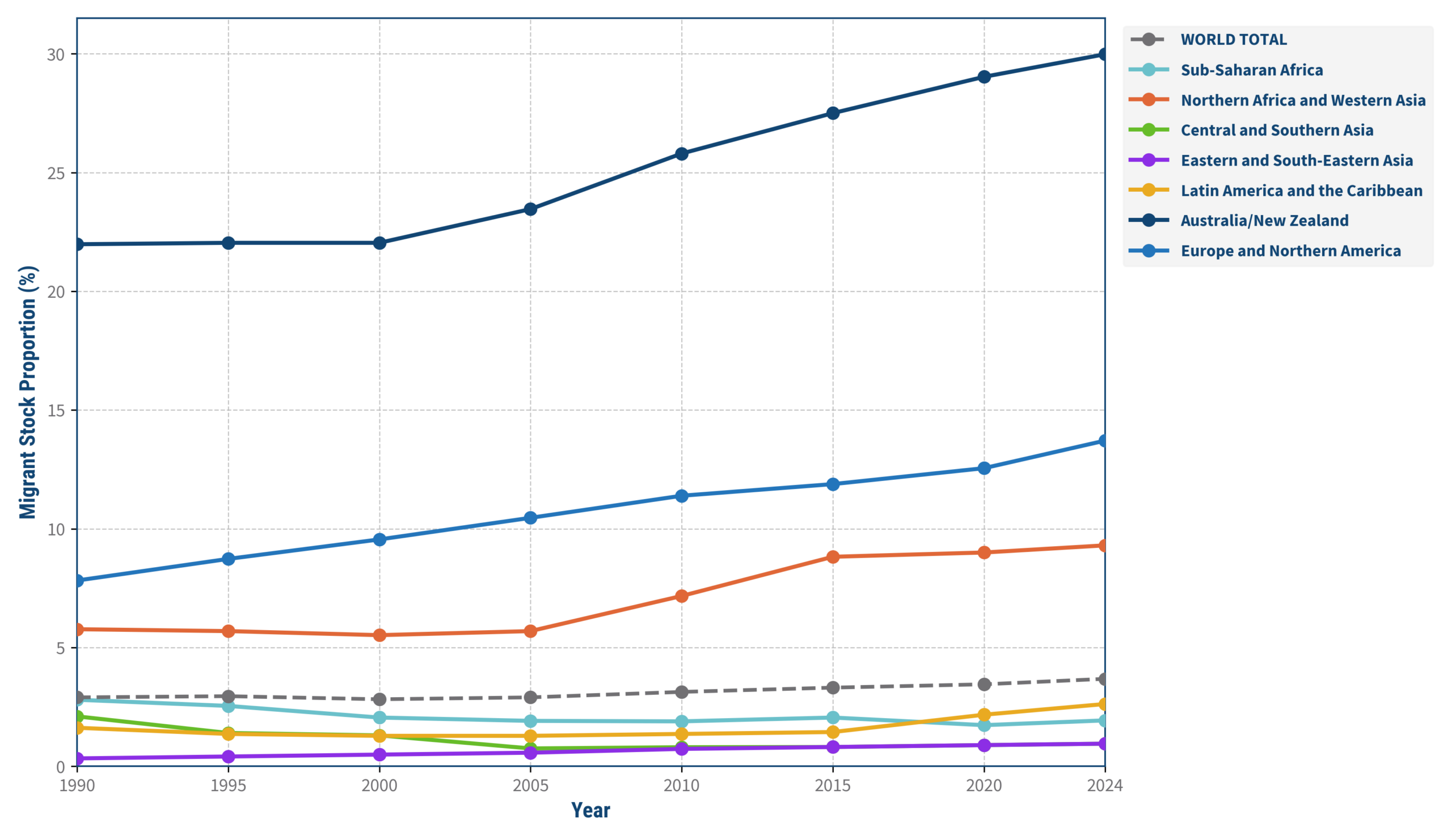
Prevailing narratives suggest a world defined by porous borders and surges of migrants. But the data tell a different story, revealing that cross-border migration is the exception rather than the rule, with most people remaining in the country in which they were born. The United Nations estimates that there were 304 million international migrants worldwide in 2024, up from 275 million in 2020. Despite the increase in absolute numbers, the share of international migrants in relation to the world’s population has remained relatively stable since the UN started collecting these estimates in 1990, now standing at 3.7%.
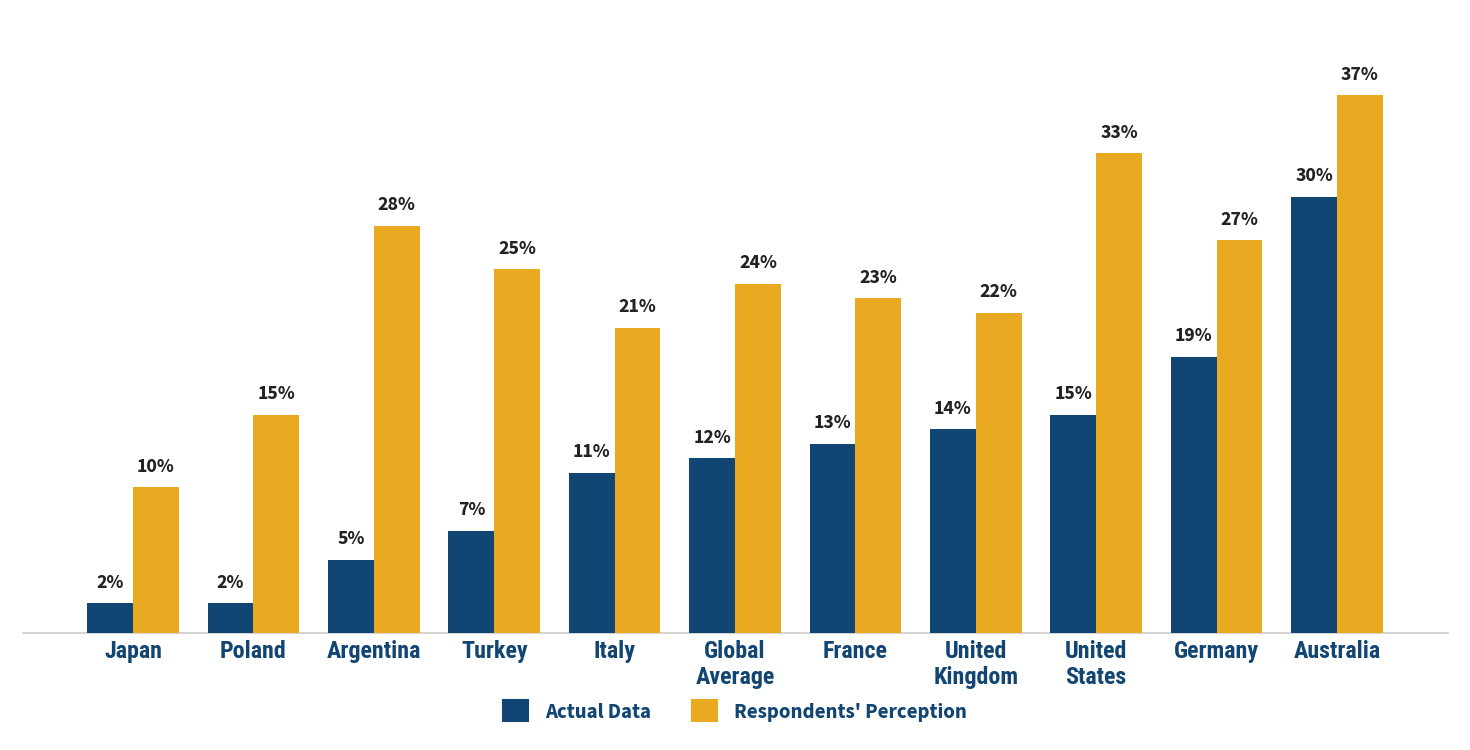
Yet opinion polls find a stark mismatch between people’s perception of how many immigrants live in their countries and the reality. In a 2023 Ipsos survey that asked people in 10 countries what percentage of the population was foreign-born, the average perceived number (24%) was double the real figure (12%) (see Figure 1).
Figure 1. Survey Results: What Percentage of Your Country’s Population Do You Think Immigrants Represent?
According to UN data analyzed by the Migration Data Portal, more than half of all international migrants (53%) stayed within their region of origin. Consider Europe: The continent hosted 94.1 million international migrants at mid-year 2024, nearly half (48%) of them from other European countries.
While the global top-line for migration stands below 4%, the disaggregated data at the regional levels tell a more nuanced story. Some regions attract more transcontinental migration than others. Migration to Australia/New Zealand, Europe, North America, and Northern Africa and Western Asia has increased, particularly since 2005 (see Figure 2).
Figure 2. Migrants as a Percentage of Total Population (1990–2024)
The international migrant worker population remains significantly gendered, with much larger numbers of male (61.3%) than female (38.7%) migrant workers worldwide. In high-income destination countries across Europe and North America, however, migrant women often outnumber men, likely reflecting jobs in the care economy. In contrast, the Gulf Cooperation Council countries host more male migrants due to their demand for labor in construction and security.
The Dynamics of Internal Migration
As someone who has moved to five different cities in the last 15 years alone, it is tempting to think that internal migration is the norm—but the data show it is not. In the United States, researchers from the Census Bureau and Harvard University used anonymized decennial census, survey, and tax data for people born between 1984 and 1992 to compare where people lived at age 16 to where they lived at age 26. They found that nearly 6 in 10 young adults lived within just 10 miles of their address as teens. About 80% migrated fewer than 100 miles from their childhood homes, and 90% migrated fewer than 500 miles.
Notably, this data may connect to another demographic indicator, fertility. About 42% of working parents in the U.S. rely on grandparents for childcare, and research has found that grandparents’ help with childcare positively influences both maternal employment and fertility.
Climate Change and Migration
While some of the traditional push/pull factors of migration remain salient—climate change, conflict, economic differentials—they don’t tell the whole story on their own. These pillars are not isolated; they overlap and intersect to shape outcomes. Consider a severe climate shock: It can directly devastate economic livelihoods, forcing some households to migrate while trapping others without financial means in instability or even conflict. A mobility-immobility spectrum, then, is a more useful lens for analyzing these drivers.
A 2021 World Bank report estimates that about 200 million people could be displaced due to climate change by mid-century. The UN Refugee Agency, UNHCR, reports that the majority of people who flee climate-related disasters move within their own countries. The agency finds that in 2022, for example, disasters triggered a record 32.6 million internal displacements, of which 98% were caused by weather-related hazards such as floods, storms, wildfires and droughts. Three-quarters of those who do leave the country due to such disasters end up moving to countries that are themselves highly vulnerable to the effects of climate change.
While we know that sudden onset disasters displace millions of people worldwide, the complex interlinkages between climate and other factors, such as conflict and fragility, make it difficult to determine how many displacements can be attributed to climate change alone. What is clear is that climate change operates as a severe threat multiplier in fragile settings affected by conflict. Climate disasters result in instability, resource scarcity, and poverty that in turn escalate existing social tensions, leading directly to spikes in child marriage, human trafficking, and conflict-related sexual violence.
Climate change overlaps and intersects with other factors influencing migration, such as conflict and economic differentials, to shape outcomes. A recent review finds that households’ migration response to extreme weather events varies and is influenced by factors such as wealth and human capital. Essentially, the same weather event can result in an increase or decrease in migration, depending on whether it pushes people to leave their homes or impoverishes them to such an extent that they are forced to stay. While some family members may have the mobility to seek work elsewhere, women are frequently the ones left behind, forced to take on an increased burden of domestic and care work while navigating compromised water and sanitation systems.
Indeed, the most vulnerable populations are not the ones migrating, as migration requires resources and capital. Instead, the ones who are left behind are often stuck in a cycle of worsening environmental conditions and deep poverty. Targeted interventions that either facilitate safe and orderly migration for those who want to leave but can’t afford to, or provide local adaptation resources to lift trapped households from poverty, are critical policy considerations.
Conflict and Forced Displacement
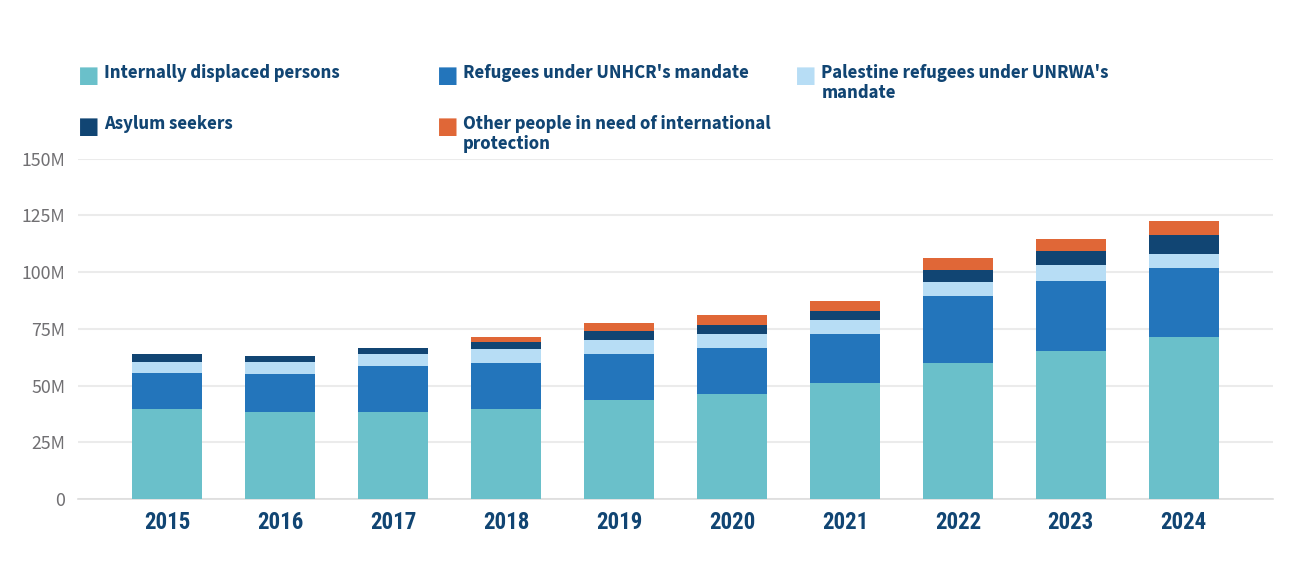
Conflict, persecution, violence, and human rights violations can cause large-scale forced displacement. According to a UNHCR report, 123.2 million people worldwide—or 1 in 67 people—were displaced in this way in 2024, an increase of 6% over the year before (see Figure 3). A massive portion of the global refugee population originates from just a handful of countries, with about 70% of refugees under UNHCR’s mandate coming from six nations: Afghanistan, Sudan, South Sudan, Syria, Ukraine, and Venezuela. Most of these individuals remain close to home, with 65% fleeing into neighboring countries that are often already struggling with their own economic and political instability.
Figure 3. People Forcibly Displaced Worldwide (2015–2024)
Urban areas are the primary destinations for displaced populations, hosting 60% of refugees and 80% of internally displaced persons (IDPs).
As capital megacities face infrastructure constraints and high living costs, secondary cities are absorbing the bulk of rural-to-urban migration. Unlike primary cities, these smaller municipalities often lack the institutional capacity and administrative expertise to generate independent financial revenues, and municipal planning lags far behind actual population growth, leading to deficits in public health, education, and housing infrastructure.
These resource scarcities carry gendered costs. According to a World Bank report, when displaced households face deep economic shocks and structural deprivations, adolescent girls suffer the steepest drops in school completion. Further, the intense psychological and economic stress of displacement drastically elevates the risk of violence, a vulnerability that is compounded when underfunded municipalities fail to provide secure housing and safe public spaces.
Migration as a Catalyst for Development
Despite the challenges presented by forced displacement, in the long term, migration acts as a powerful force shaping human development. Consider that in 2024, global remittance flows reached an estimated $905 billion, with $685 billion directed to low- and middle-income countries (LMICs). These financial inflows frequently surpass official development assistance and foreign direct investment combined, acting as a critical stabilizing buffer during macroeconomic crises.
For instance, according to the World Migration Report, remittance flows declined by a modest 1.6% in the immediate aftermath of the COVID-19 pandemic, even as foreign direct investment to LMICs plummeted by more than 30%. For smaller economies, remittances may constitute a massive share of national wealth, making up 45.4% of GDP in Tajikistan and 38.2% in Tonga. While the motivation for migration among refugees and IDPs is not always economic, there is evidence that they send remittances too.
The utility of remittances for development in countries of origin cannot be overstated. The UN estimates that three-quarters of remittances are used for essentials such as food, medical expenses, school fees, or housing. The rest can be either saved or invested in assets or activities that generate income.
Conclusion
Migration is a structural feature of a deeply unequal world. Attempting to manage this reality by narrowing legal pathways or squeezing the financial lifelines of the poor does not stop mobility, but rather drives movement into irregular channels and potentially cuts off the vital remittance flows that sustain developing economies. True demographic and economic stability depends on a shift toward evidence-based policy that treats human mobility not as a flashpoint to be weaponized, but as a strategic asset in a volatile century.
Related Posts
Understanding and Comparing Population Projections in Sub-Saharan Africa
The release of a new set of population projections by the Institute for Health Metrics and Evaluation (IHME) in July 2020 was greeted with extensive coverage in the media and stimulated fresh debate among demographers about calculation and communication of projections.

Population Age Structure and Pathways to Inclusive, Effective Governance
Among countries with a youthful population, a window of opportunity to achieve key development goals opens across four sectors―health, education, the economy, and governance―as fertility declines and the age structure of the population gets older.