
Social Security’s Reserves Could Be Depleted in the Next Decade—Demographics Are a Big Reason Why
Much of this was foreseeable, yet Social Security has not had a major overhaul in over four decades.

Social Security’s funding shortfall may be arriving sooner than projected just a year ago. While federal spending is partly to blame, demographic forces are also fueling this change.
Retiring Baby Boomers are exposing weaknesses in outdated Social Security policy. Today, 8.3% of Americans ages 59 to 77 retire every year, and between now and 2050, 17.4 million more will join their ranks. Meanwhile, recent immigration policy changes are poised to shrink the labor force, and falling fertility means fewer future workers will be paying into the system that supports retirees.
Much of this was foreseeable, yet Social Security has not had a major overhaul in over four decades. Here’s where the program got demographic change right, where it got it wrong, and what comes next.
Social Security Projections Missed the Fertility Decline
The last major Social Security reform came in 1983, when the risk of insolvency was severe enough that Congress acted fast, phasing in an increase to the full retirement age from 65 to 67. At the time, Social Security was projected to stay solvent until 2060. That proved wildly optimistic; the most recent trustees’ report, released this June, puts insolvency at 2032.
A key culprit is fertility. Social Security is a “pay-as-you-go” system, where today’s retiree benefits are funded by today’s workers. Fewer births mean fewer future workers supporting a growing retiree population, and the 1983 trustees could not have foreseen how far U.S. fertility would fall in the 2000s (Figure 1). Ironically, the “pessimistic” fertility scenario they calculated but didn’t use has turned out to be much closer to reality. Had they used it, the system would be on firmer footing today.
These downgrades haven’t stopped. Trustees continue lowering fertility assumptions—nearly every year, and the combination of lower fertility and reduced immigration is set to add another $4 trillion to the projected Social Security shortfall. Even now, current projections may still be too optimistic about how many workers will be paying into the system down the road.
Figure 1. Social Security Has Overestimated Future Fertility in Recent Decades
Official and Social Security Trustees Projected Total Fertility Rates (1980–2100)
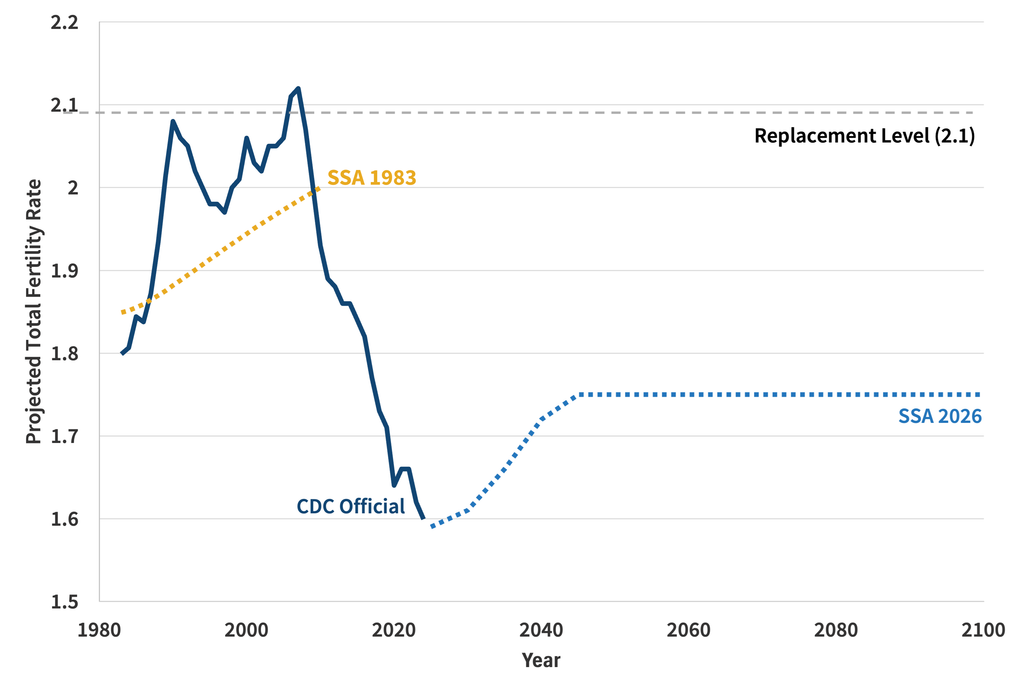
Notes: The 1983 and 2026 projections shown reflect the trustees’ intermediate assumptions for future total fertility rates.
Sources: Social Security Area Populations Projections, 1983, Table 5; The 2026 Annual Report of the Board of Trustees of the Federal Old-Age and Survivors Insurance and Federal Disability Insurance Trust Funds, Table V.A1; NCHS Table 1-7 (archived) for total fertility rates 1940-2000 for official 1983 to 1989 estimates, NVSR 74-3, Table 4 (revised) for official 1990 to 2023 estimates, Births: Final Data for 2024, Table A, for official 2024 estimate.
Immigration Keeps Social Security Viable; Recent Policy Changes Jeopardize It
Immigration is another factor behind the accelerating shortfall. Foreign-born workers made up 19.1% of the U.S. labor force in 2025 and had higher labor force participation than U.S.-born workers. In short, having more immigrants who are working and paying Social Security taxes supports more retirees in real time.
But immigration has dropped under the current administration. Net immigration was cut in half in 2025 compared to the year before, a decline steep enough that the Social Security Administration revised its immigration assumptions downward between 2025 and 2026 (Figure 2). If the slowdown proves temporary, the damage may be limited. If it becomes the new normal, it will accelerate the drawdown of Social Security’s already-shrinking reserves.
Figure 2. Social Security Administration Downgraded Its Immigration Estimates for 2026
Social Security Trustees’ Assumptions for Net Change in Immigration (2025 and 2026)
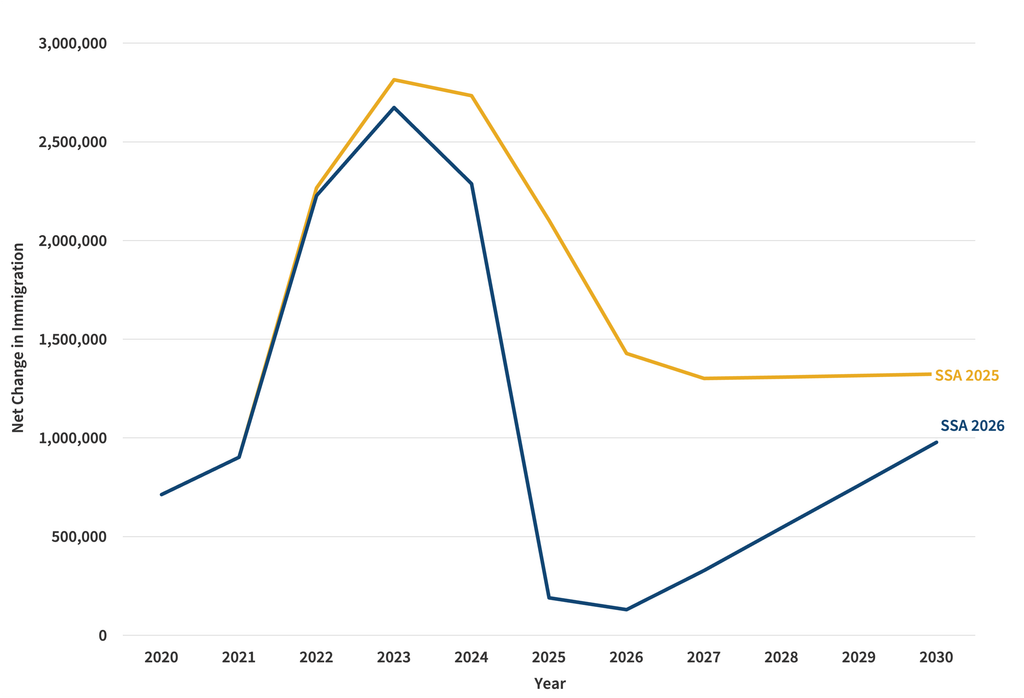
Note: The 2025 and 2026 data are based on historical counts and, after 2025, intermediate assumptions.
Sources: 2025 Social Security Administration immigration assumptions; 2026 Social Security Administration immigration assumptions.
It’s also worth noting that many immigrants pay into the system without ever collecting from it. Among the 3.3% of the population ages 60 and older who never receive Social Security benefits, half are immigrants who arrived after the age of 50 and never earned enough credits to qualify. On balance, immigrants have contributed to Social Security more than they have drawn from it.
People Are Increasingly Facing Longer Retirements, but Not for the Reason You Might Think
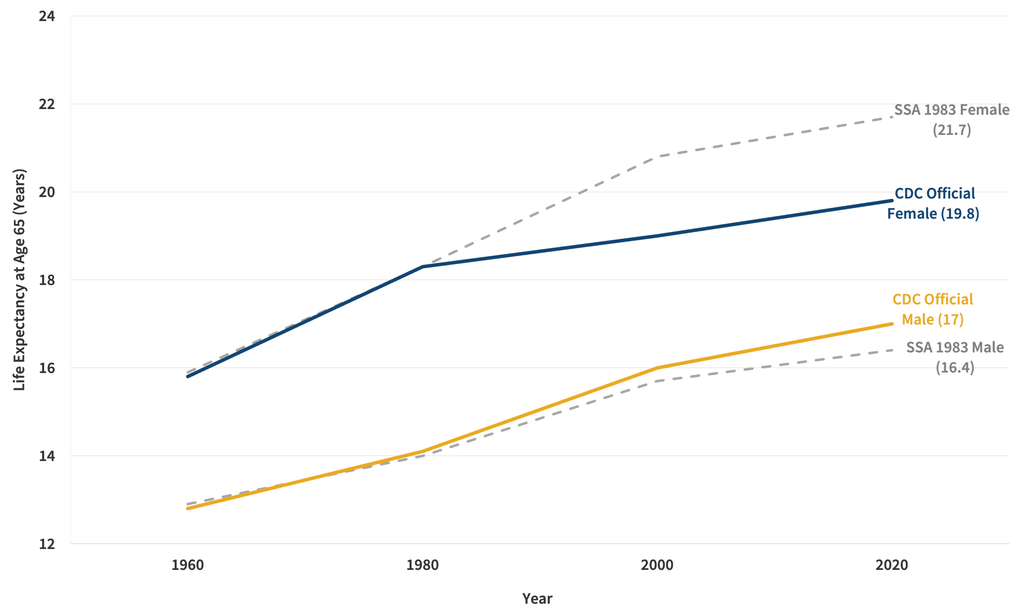
Retirements are lengthening, but not because Americans are living dramatically longer. The 1983 trustees’ projections for older men have held up reasonably well, but they were too optimistic for older women (Figure 3). And the U.S. still lags peer countries like Canada, France, the U.K., and Japan on life expectancy overall.
Figure 3. Life Expectancy for Women at Age 65 Has Not Increased as Much as Expected
Official and Social Security Trustees Life Expectancy for Males and Females at Age 65 (1960–2020)
Sources: Social Security Area Populations Projections, 1983, Table 3; NCHS Figure 1 for 2020 estimates; NCHS Table 15 for 1960, 1980, and 2000 estimates.
What’s actually changed is when people stop working. The median retirement age is 62, and early retirement has been climbing since 2009. In 2026, 46% of retirees left the workforce before they’d planned to; for three-quarters of them, the reason was something outside of their control, like a health issue, a disability, or a workplace change. Labor force participation among people 55 and older has fallen steadily since the pandemic, dropping to 36.9% by July 2026, a full percentage-point below the year before. While some of this decline is because Baby Boomers are retiring, it also reflects people who want to work but cannot.
The effect on Social Security finances cuts both ways. On one hand, workers who claim benefits early draw less over their lifetimes. On the other, they stop paying into the system sooner. When older workers are pushed out by ageism, caregiving responsibilities, or disability rather than choice, the system loses a taxpayer and gains a beneficiary at the same time.
What Comes Next
Raising the retirement age, a proposal that surfaces occasionally in Congress, won’t move the needle much. A recent PRB analysis found that a two-year increase in the minimum retirement age would barely budge the overall size of the workforce. With retirements climbing every year regardless, that kind of policy tweak can’t offset the demographic shift underway. That’s consistent with what’s already happening on the ground: As noted above, nearly half of recent retirees left work earlier than planned, often for reasons beyond their control. Raising the eligibility age doesn’t address why people are leaving the workforce early in the first place—it just potentially puts more strain on the system.
More promising solutions target the actual pressure points this article has laid out: too few workers supporting a growing retiree population. Drawing more of the un- and underemployed into the labor force—including older workers sidelined involuntarily—would help. And addressing Social Security’s fiscal shortfall sooner rather than later matters because the fixes get more painful with each year of delay: Benefit cuts, tax increases, or both would need to be steeper the longer Congress waits.
Inaction has a cost, too. If Congress doesn’t address Social Security policy, benefits could shrink to roughly three-quarters of what they are today, a devastating blow for the one-fifth of older Americans that rely on Social Security for 75% or more of their family income. Those with the least financial cushion would be hit hardest.
Shoring up Social Security will not be easy. But it wasn’t easy in 1983, either; it took a bipartisan commission an entire year to agree upon the proposed reforms still in place today. Social Security is often referred to as the “third rail of politics” because touching it is so politically dangerous. But given where demographics are headed, doing nothing may be the more dangerous option.
Related Posts
Understanding and Comparing Population Projections in Sub-Saharan Africa
The release of a new set of population projections by the Institute for Health Metrics and Evaluation (IHME) in July 2020 was greeted with extensive coverage in the media and stimulated fresh debate among demographers about calculation and communication of projections.

Population Age Structure and Pathways to Inclusive, Effective Governance
Among countries with a youthful population, a window of opportunity to achieve key development goals opens across four sectors―health, education, the economy, and governance―as fertility declines and the age structure of the population gets older.