
States in U.S. With Higher Tax Rates Are Better for Children
(February 2012) A new index of child well-being finds a strong relationship among state tax rates, the size of state investments in children, and children’s quality-of-life. The STATE Child Well-Being Index (CWI)—developed for the Foundation for Child Development by demographers William O’Hare of the Annie E. Casey Foundation and Mark Mather and Genevieve Dupuis of the Population Reference Bureau—provides the most-comprehensive measure of children’s quality-of-life on a state-by-state basis.
“Because less than 10 percent of the federal budget is invested in children’s programs, state spending has a large impact on children’s well-being,” said Ruby Takanishi, president of the Foundation for Child Development. “With this new measure, we can see proof of the direct impact of state policies: When states invest in children, children do better.”
The report, Investing in Public Programs Matters: How State Policies Impact Children’s Lives, focuses on the results of the STATE CWI, which draws from a richer data set than previous state-level studies of child well-being. The STATE CWI assesses children’s quality-of-life in each state across 25 indicators clustered into seven domains (family economic well-being, health, safe/risky behavior, educational attainment, community engagement, social relationships, and emotional/spiritual well-being) and compares them across states. The report also includes a detailed analysis of the relationship between state-level demographic and economic factors and children’s welfare.
Relationship Between State and Local Tax Rates and Child Well-Being Rankings
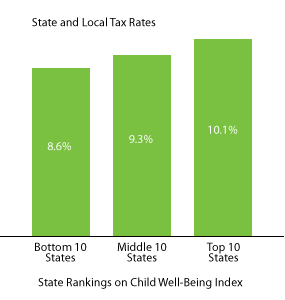
Source: William O’Hare, Mark Mather, and Genevieve Dupuis, Investing in Public Programs Matters: How State Policies Impact Children’s Lives (New York: Foundation for Child Development, 2012).
Key findings from the report include:
- Higher state taxes are linked to better outcomes for children. States that have higher tax rates make bigger investments in children and have higher CWI values than states with lower tax rates.
- Greater investments in government programs are strongly related to better quality-of-life for children in a state. Specifically, the amount of per pupil spending on education, the limits of Medicaid child eligibility thresholds, and the levels of Temporary Assistance for Needy Families (TANF) benefits show substantial correlations with child well-being.
- The best and worst states for children. The states with the highest child well-being index values were New Jersey, Massachusetts, New Hampshire, Utah, Connecticut, and Minnesota. The states with the lowest index values were New Mexico, Mississippi, Louisiana, Arkansas, and Nevada.
- Child well-being varies greatly among states. Not only did overall child well-being values range tremendously from state to state, but great variation was also found in specific indicators such as the child poverty rate (three times higher in Mississippi than in Vermont, for example) and the rate of children without health insurance (five times higher in Texas than in Massachusetts).
“Now more than ever, the well-being of children lies in the hands of state policymakers,” said Mark Mather, associate vice president of Domestic Programs at PRB. He noted that only 4 percent of the $24,800 per capita expenditures that federal, state, and local governments spent on the elderly in 2008 came from the state and local government, while 67 percent of the $11,232 per capita expenditures by federal, state, and local governments on children came from state and local sources.
The report also recommends ways states and the federal government can target investments to protect the health and education of U.S. children. “When we don’t invest in children, we see real consequences. In this time of economic uncertainty, it is critical that we do a better job of helping children become the productive workers and engaged citizens of tomorrow,” said O’Hare, senior fellow at the Casey Foundation.
Related Posts
Why Americans Are Delaying Parenthood
Four studies offer new insights on the decision to have kids in a low birth rate era.

Adolescents and Youth Are Key to Fully Achieving Universal Health Coverage
In 2021, adolescents and youth between ages 10 and 24 are estimated to make up approximately 24% of the world’s population.
Aging and Health in China: What Can We Learn From the World’s Largest Population of Older People?
The United Nations projects that there will be 366 million older Chinese adults by 2050, which is substantially larger than the current total U.S. population of 331 million.