
U.S. Population Growth Is Slowing to Near Zero
An immigration cliff—combined with fertility declines and population aging—places the United States closer to the demographic experience of Europe.

An immigration cliff—combined with fertility declines and population aging—places the United States closer to the demographic experience of Europe.
New Census Bureau data show that U.S. population growth slowed significantly between 2024 and 2025, increasing by just 1.8 million people—or 0.5%—compared with 1.0% growth the prior year. The Bureau projects an even smaller increase of just 0.2% in 2026.1
A sharp decline in immigration is driving the decline. Lower fertility rates and an aging population have slowed U.S. population growth from within, making immigration a more central factor in determining recent growth trends.
When immigration slows, population growth slows with it, leaving fewer young adults and families to sustain growth in the years ahead.
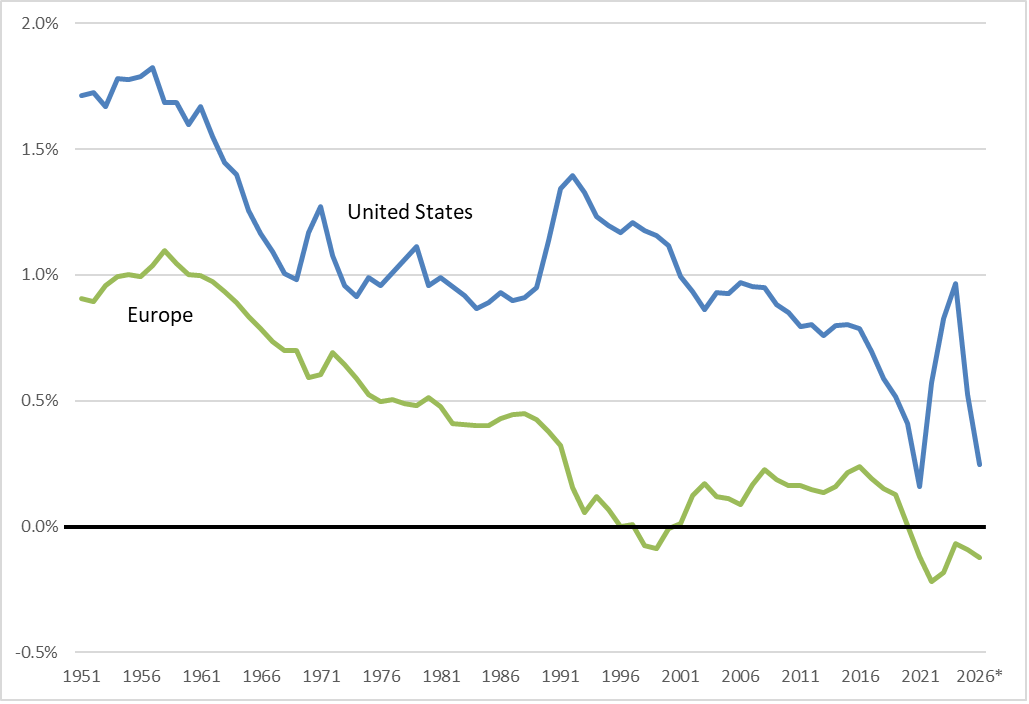
The United States used to be a demographic outlier compared with most high-income countries. But this immigration cliff—combined with relatively low fertility and population aging—places the United States closer to the demographic experience of Europe. U.S. population growth has slowed markedly over the long run—from roughly 1.7% to 1.8% in the 1950s to about 0.5% in 2025—while Europe’s growth fell earlier and further, dropping from around 1.0% in the 1950s to near zero by 2000 and slightly negative in the 2020s.
The U.S. is projected to add about 835,000 people in 2026—the smallest gain since 2021, during the COVID-19 pandemic. If current trends persist, the United States could face population decline within the next decade—an unprecedented shift for the nation.
Figure: Annual Population Growth in the United States and Europe Has Slowed Over Time
Annual percent change in population in the United States and Europe, 1951–2026
 *Projected.
Note: Population change reflects the period from July 1 of the previous year to June 30 of the labeled year.
Source: Data from U.S. Census Bureau, Population Estimates Program; United Nations, World Population Prospects (2024 Revision).
Slower population growth is not inherently a problem. But policymakers and planners need to prepare for what’s coming: A slow-growing population means:
- Fewer new entrants into the workforce and fewer potential health care providers and caregivers for older adults.
- Modestly slower economic growth, unless worker productivity improves or more adults enter the workforce to help balance the effects of population aging.
- Increased fiscal pressure on public programs, like Social Security and Medicare, and pension systems for retirees.
- Slower growth in the consumer base for goods and services tied to younger people—such as new housing, child care, education, and some retail.
Many European countries have experienced slow-growing or declining populations for decades, offering useful lessons about adapting to demographic change. “Active ageing” policies in Europe aim to help older adults remain healthy, socially and economically engaged through coordinated national strategies on employment, lifelong learning, health services, and long-term care.
Their experience shows that outcomes depend less on population trends themselves than on policy responses—including efforts to boost labor force participation, improve productivity, and integrate immigrants into the workforce.
As U.S. population growth slows, these lessons will become more important for shaping the country’s demographic future.
1. PRB analysis of the U.S. Census Bureau’s Monthly Population Estimates for the United States from July 1, 2025 to June 30, 2026.
Related Posts
Understanding and Comparing Population Projections in Sub-Saharan Africa
The release of a new set of population projections by the Institute for Health Metrics and Evaluation (IHME) in July 2020 was greeted with extensive coverage in the media and stimulated fresh debate among demographers about calculation and communication of projections.