
Young Adults Have the Same Dreams as Their Parents. The Path There Looks Nothing Like It.
A Q&A With Rob Crosnoe and Shannon Cavanagh, authors of The Journey into Adulthood in Uncertain Times

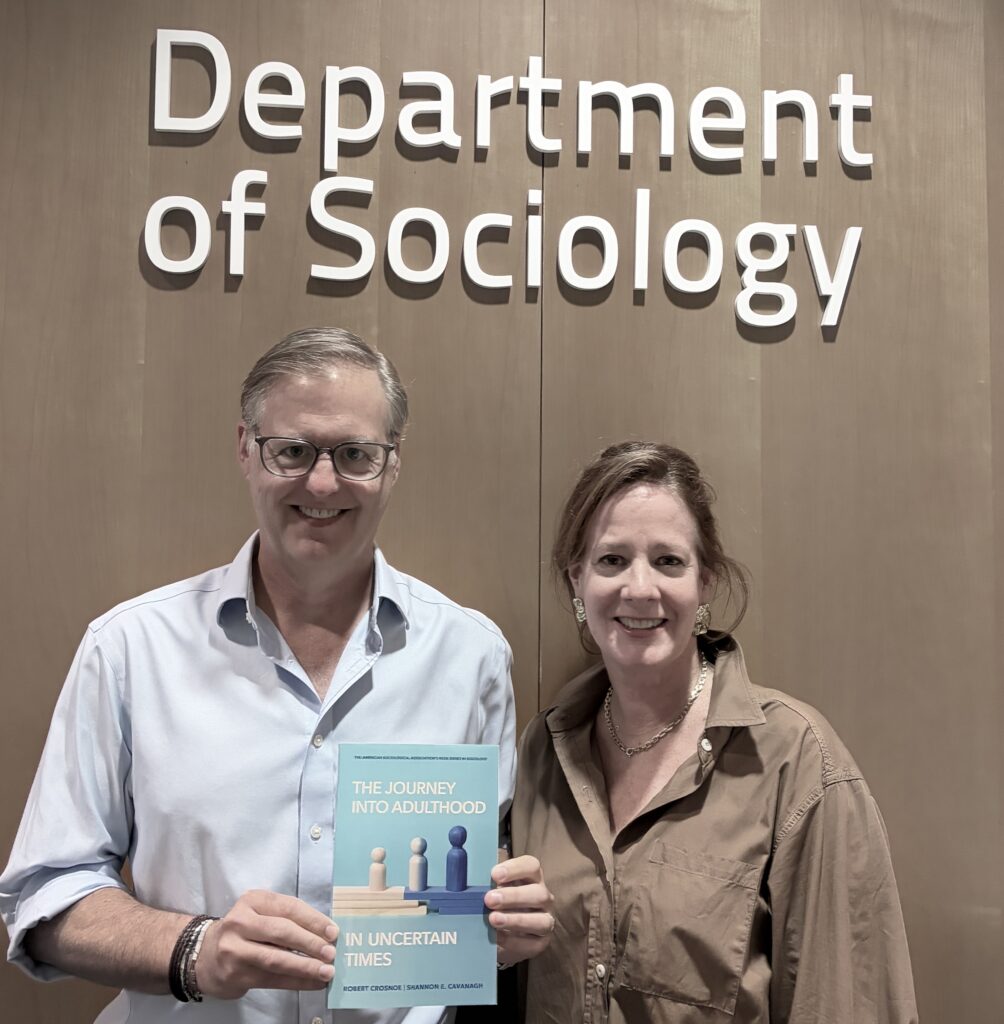
Ahead of World Population Day, PRB sat down with Rob Crosnoe and Shannon Cavanagh, sociologists at the University of Texas at Austin and authors of The Journey Into Adulthood in Uncertain Times, to talk about what’s really changed for young people coming of age today. Drawing on quantitative and qualitative survey data over five decades, the husband-and-wife author team argue that the goals haven’t shifted much—most still want stable jobs, partners, and families—but the road to get there has grown longer, more uneven, and harder to predict. Below, they talk about the difference between “hard times” and “uncertain times,” why deferred family building looks different from foregone family building, and what it would take to give the next generation more solid ground to launch from.
1. Let’s start at the beginning. What was your impetus for this book? Was it something personal, inspired by your own parenthood or your own growing up? Or was it broader, something that society at large was just not getting about the modern transition to adulthood?
At the start there was something concrete, followed by some motivation that got more personal over time. On the concrete part, we launched the project that evolved into this book in the early 2010s as a study of the impact of the Great Recession on young adults. There was a widespread belief at the time that young adults would fare the worst during this crisis, and there was a lot of talk about whether they would become a “lost generation.”
We ended up in several different interdisciplinary working groups—sociologists, psychologists, economists—in the U.S. and Europe to scientifically address these important issues. As we conducted this collaborative and independent research, especially as more years passed, we began to see that the impact of this crisis on young adults might not be as cataclysmic or pervasive as we had feared. Not to minimize the suffering that so many faced and the great stress they felt, but we were not seeing a lost generation who would carry the indelible scars of this crisis until the day they died.
Instead, the real story was less about how this short-term shock derailed young people and much more about how the decades-long restructuring and globalization of our economy—not to mention the transformation of how we as Americans think about parenting and when a kid stops being a kid—was very gradually changing what people thought of young adulthood, how they treated young adults, and what young adults expected from life. That larger story—so much less concrete than the simpler narrative about a particular event in history—was what fascinated us, and this book is our attempt to tell that story, which, not coincidentally, was becoming more relevant to our own children’s lives with each passing day
2. What’s the difference between “hard times” and “uncertain times,” and why does that distinction matter for how we understand young adults today?
Interestingly, one of the reviewers of an early draft of the book raised this same question, which prompted us to think more deeply about some of the words and phrases we had used far too casually before then. Here is how we describe this distinction in the book. Hard times refer to periods in which a country experiences a run of economic stagnation, stress, and/or volatility. In other words, there are some fairly objective standards by which it can be said that there are fewer or weaker opportunities for people to get ahead at the moment. People agree that things are hard out there. Uncertain times refer to periods when there are key questions and debates in a country about what the future holds for “someone like me,” where the country is heading, or what comes next for me or us or both. In other words, the future is cloudy, and there is disagreement about what comes next. It is what people feel, regardless of objective measures.
Both hard times and uncertain times shape the transition into adulthood. This country has had bouts of hard times of late, including the Great Recession and the COVID-19 pandemic, where what young adults could do to get ahead were constrained and their opportunities were foreclosed. This country is also facing uncertain times, where young adults are unsure about where things are going and what they can do to help themselves. That uncertainty is proving to be stickier than the often-temporary ups and downs of the most common economic indicators.
3. Your book argues that goals of young people haven’t changed, but the paths they take to reach them have. Does that framing hold up equally well for different demographic groups, or does it fit the college-educated folks better than others?
In a socioeconomically stratified country like the U.S., there is always going to be a divide in how young people come of age. Before the restructuring and globalization of the economy that began decades ago, young adults who had not gone to college—particularly men—could still find a foothold, build a stable life, and launch their children up the ladder of social mobility. That is so much harder now. Today, young adults from disadvantaged backgrounds may reach the same point as their grandparents, but it will take a lot longer and feel more precarious. College graduates won’t find the sure footing their grandparents did either—they’ll struggle longer and change jobs more often—but they’ll usually get there. In both cases, the dreams are the same and the destination can be similar, but the path is far more winding. The basic story holds across groups, even if the details—and the stakes—differ considerably.
4. Is the American experience of delayed adulthood unique, or are young people in other wealthy countries on a similar trajectory? What does an international lens tell us?
The pattern of delayed adulthood in the U.S. closely mirrors what we see in other nations, at least the wealthy ones. As it relates to family building, the U.S. is becoming more like our European peers, with later ages for leaving home, getting married, and having a first child. Young people who are NEET (neither in work nor school) have also generated a lot of worry across Europe and in wealthy non-European countries like Australia. That said, the U.S. story diverges in one important way: Weaker state supports mean young Americans have less of a safety net during hard times. For those whose only support is a family with limited resources, these delays and roadblocks on the path to adulthood may carry greater long-term consequences than they would elsewhere.
4. Teen fertility is at historic lows, yet young adults are also delaying starting families. Is the overall picture one of deferred family building or foregone family building?
That’s the million-dollar question. The current decline in the U.S. total fertility rate has been driven largely by a dramatic drop in fertility among young people—the very group that historically drew concern for unplanned and births. It appears young people—young women in particular—are damned if they do, damned if they don’t. Still, recent analysis from family demographer Phillip Cohen demonstrates that more women are mothers by age 45 today than two decades ago. The best estimates suggest that this change is largely about deferred rather than foregone family building. Young people appear to be waiting rather than opting out—the conditions that once helped people start families in their 20s are increasingly out of reach, including affordable housing, stable employment, and health insurance.
5. The book touches on the striking share of young men, especially men of color, who are disconnected from work school, and romantic relationships. What policy levers, if any, does the research point to for reaching that group?
We think that comprehensive policies that recognize and address the ways race and gender organize most aspects of everyday life—including work, housing, and school—lay the foundation for a just society. Institutions such as the educational system, the labor market, and even marriage do many good things for both individual people and the population as a whole, including grounding people in community, giving them purpose, and making the world safer for everyone. Having so many young people, young men of color especially, floating through life is not good for anyone. It is not about changing attitudes or making people feel better so much as it is about creating opportunities and connections.
6. Skepticism about institutions has always been a marker of youth. What does your research show about whether today’s distrust is actually different in kind or degree from previous generations—and do you think it’s rational given what you found?
That is right—young people have always been pretty skeptical about adult society and its institutions. What struck us, though, was how evenly divided the young adults we interviewed were in this regard. Some really seemed to believe in the American Dream and feel like hard times made them stronger. They expressed a lot of grit, no matter the circumstances. An equal number were cynical and distrustful and believed more in American corruption than American exceptionalism. The fact that young men and those who were downwardly mobile were overrepresented in this second and more cynical group aligned with current cultural and political assessments about the 2016, 2020, and 2024 presidential elections.
The truth is that a lot of what scaffolded the transition into adulthood in the past—the GI Bill, unemployment insurance, family services, quality public education, public investments in science and technology—has faded, so perhaps they are right to think that now, more than ever, they are on their own. As institutionalists who benefited from the social investments in young people of the past, hearing their skepticism gave us pause, but it also made us realize that all this worry and concern about young adults today is, at heart, a crisis of confidence.
7. What role have technology and social media played in shaping this transition?
We know how much the internet, smartphones, and social media organize young adulthood today, but we faced a real challenge in investigating them: These technologies only appeared at the tail end of the historical window we were studying. This omission matters most when it comes to social and emotional well-being. Depression rates have risen during the social media age, and while research suggests social media plays some role, it’s not the only factor. AI presents a similar gap; we had essentially finished this book when ChatGPT entered the conversation. So we will have to leave these questions for a future project. What we can say—as social scientists who understand the ways that technological change reshapes the life course, as college professors navigating a new classroom reality, and as parents watching our own kids’ social media habits—is that we are not optimistic about all the ways the world has changed.
8. If you could change one structural thing—housing, labor markets, education financing—to better support these young adults, what would it be? What would move the needle most?
Making change on a broad scale is about changing structures more than about changing people themselves, which is notoriously hard to do. Our sense is that guaranteed basic income could have the greatest impact. What we have shared in this book about the state of young adulthood today is really a story about inequality, about how the intergenerational transmission of disadvantage becomes calcified for each new cohort of children. We suspect that access to basic income can make the work of navigating young adulthood, and all of its emotional and social ups and downs, easier when one is relieved from the burden of economic despair. Some economic certainty can go a long way in a world where a sense of uncertainty seems to be the big roadblock for young people.
9. You’ve spent nearly two decades studying how young people grow up, and watched your own kids do exactly that in the process. Did the research change how you parented?
Yes, in one clear way. How starkly a college degree differentiates young people’s socioeconomic positions and family-building trajectories made higher education seem far less optional for our own kids. And doing this work made us even more sensitive to the genuine weight of anxiety that young adults carry today, including our own two children.
10. What would you want a 22-year-old to take away from this book—not a policymaker or a concerned parent, but someone living through the transition right now?
We would want them to be assured that things are indeed different compared to when their parents or grandparents were coming of age, that the game has changed, so that it is unfair for today’s adults to judge them by the same metrics from when they were 22. The rules are different, so of course they need to adapt and adjust accordingly. In that light, their pathways are rational responses to the world they inherited. And finally, we would want them to know that this too shall pass. We actually have a 22-year-old son who has just left college and is uncertain about the future, so we have had some practice in this kind of talk.
Rob Crosnoe and Shannon Cavanagh, authors of The Journey Into Adulthood in Uncertain Times, teach sociology at the University of Texas at Austin.
Related Posts
Power and Partnership: Supporting Youth Through the PACE Project
PACE’s approach to listening to and meaningfully supporting youth partners’ goals has developed into an intentional model.
Adolescents and Youth Are Key to Fully Achieving Universal Health Coverage
In 2021, adolescents and youth between ages 10 and 24 are estimated to make up approximately 24% of the world’s population.
The Nation’s Preexisting Condition: How Rising Inequality Exacerbated the Economic Toll of the Coronavirus
In 2019, many economic indicators seemed to be pointing in the right direction. The unemployment rate had fallen to its lowest level since 1969, the poverty rate fell to the lowest level in 60 years, and the Dow Jones Industrial Average reached an all-time high.

Fostering Employment in Productive Sectors to Maximize Ethiopia’s Potential to Reap a Demographic Dividend
Declining mortality and fertility rates are transitioning Ethiopia toward an age structure that has the potential to provide significant economic benefit.