
2009 World Population Data Sheet (PDF - English)
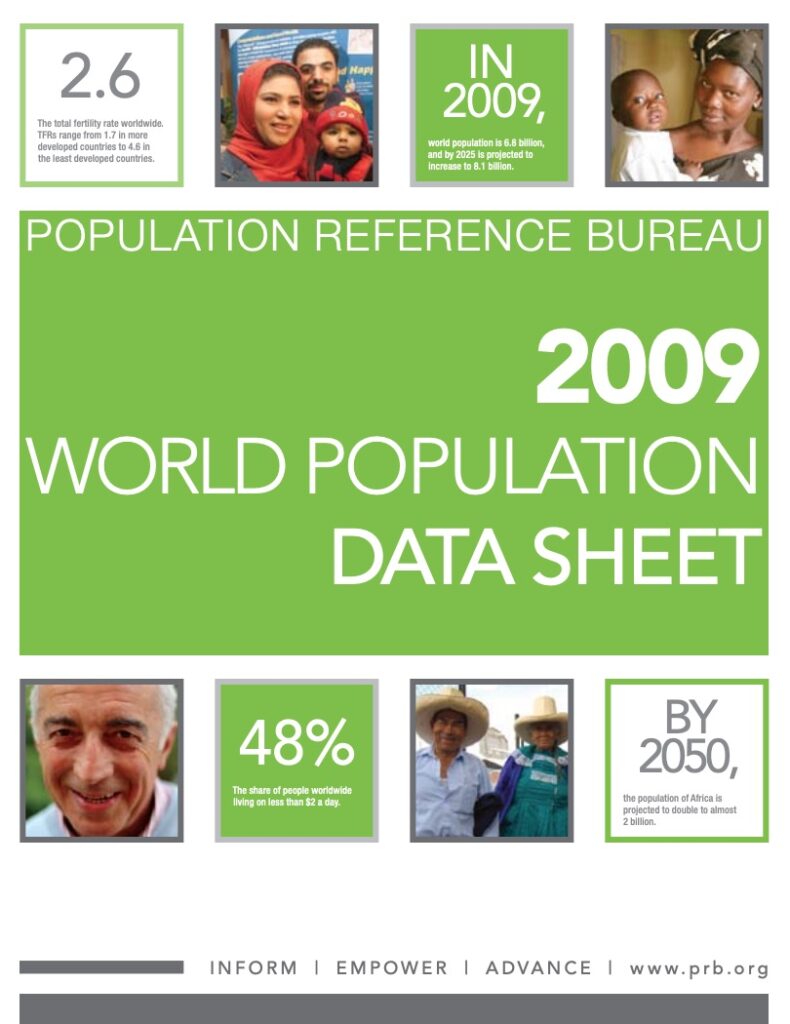
- This data sheet also in French, Spanish, and Arabic.
(Aug. 12, 2009) Global population numbers are on track to reach 7 billion in 2011, just 12 years after reaching 6 billion in 1999. Virtually all of the growth is in developing countries. And the growth of the world’s youth population (ages 15 to 24) is shifting into the poorest of those countries.
The Population Reference Bureau’s 2009 World Population Data Sheet and its summary report, to be released on Aug. 12, offer detailed information about country, regional, and global population patterns.
“Even with declining fertility rates in many countries, world population is still growing at a rapid rate,” said Bill Butz, PRB’s president. “The increase from 6 billion to 7 billion is likely to take 12 years, as did the increase from 5 billion to 6 billion. Both events are unprecedented in world history.”
The projection for population growth in developing countries assumes that fertility in those countries will fall to the same low levels as in today’s developed countries, around two children per woman. That is quite an assumption. Currently, the highest fertility rate is in Niger, 7.4 children per woman. The lowest rate is in Taiwan, 1.0 children per woman.
“The great bulk of today’s 1.2 billion youth—nearly 90 percent—are in developing countries,” said Carl Haub, PRB senior demographer and co-author of the data sheet. Eight in 10 of those youth live in Africa and Asia. “During the next few decades, these young people will most likely continue the current trend of moving from rural areas to cities in search of education and training opportunities, gainful employment, and adequate health care.” One of the major social questions of the next few decades is whether their expectations will be met.
The 2009 World Population Data Sheet provides up-to-date demographic, health, and environment data for all the countries and major regions of the world. It shows just how stark the contrasts are between rich and poor countries, as illustrated by the table with data from the United States, Canada, and Uganda.
Even though Canada and Uganda have close to the same population today, Uganda is projected to have more than double Canada’s population by 2050. The cause of these enormous differences is the difference in lifetime births per woman. Ugandan women have 6.7 children on average, five more than the average for Canadian women.
Key Demographic Indicators, 2009
| United States | Canada | Uganda | |
|---|---|---|---|
| Population mid-2009 | 307 million | 34 million | 31 million |
| Population 2050 (projected) | 439 million | 42 million | 96 million |
| Percent of population below age 15 | 20% | 17% | 49% |
| Percent of population ages 65+ | 13% | 14% | 3% |
| Percent of population ages 15-24 | 14% | 13% | 20% |
| Lifetime births per woman | 2.1 | 1.6 | 6.7 |
| Annual births | 4.3 million | 371,000 | 1.4 million |
| Annual deaths | 2.5 million | 244,000 | 384,000 |
| Life expectancy at birth | 78 years | 78 years | 50 years |
Other highlights from the 2009 World Population Data Sheet:
Africa’s population has just passed 1 billion. The continent’s population is growing by about 24 million per year, and will double by 2050.
About half the world lives in poverty. Nearly 50 percent of world population lives on less than the equivalent of US$2 per day. Hundreds of millions of people live barely above that level.
HIV prevalence now appears to be on the decline in Africa, but rates are still far higher than in other world regions. Swaziland has the world’s highest rate of HIV: 26 percent of its population ages 15 to 49 is HIV positive.
The birth rate among U.S. teenagers is twice as high as the average for all developed countries. The U.S. rate is 42 births per 1,000 teenage girls (ages 15-19); the rate for all developed countries is 21 per 1,000.
Related Posts
Lesson Plan: 2020 World Population Data Sheet
(2020) PRB’s World Population Data Sheet is an excellent reference and data analysis tool. Teachers are encouraged to have their students use the Data Sheet for a variety of topics and activities.

Lesson Plans on Human Population and Demographic Studies
Find out the answers to these questions and more. The sections listed below explore eight elements of population dynamics.

Report. Population Trends and Challenges in the Middle East and North Africa
(2001) The people of the Middle East and North Africa (MENA) have long played an integral, if sometimes volatile, role in the history of human civilization.
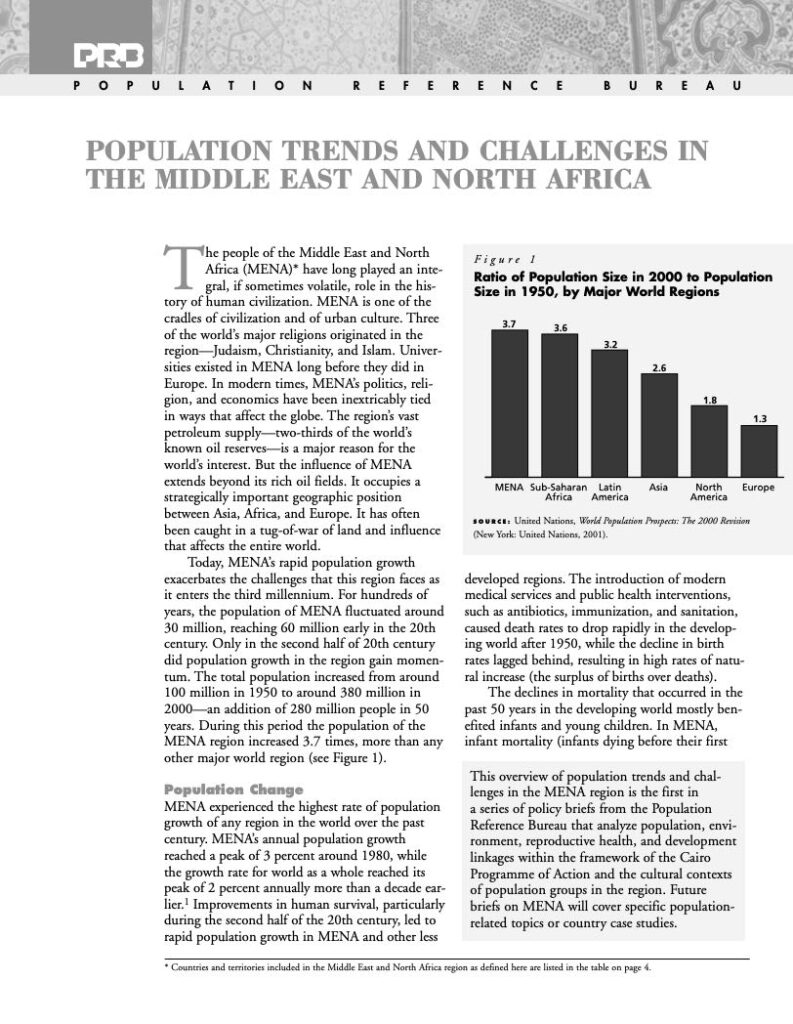
Population Trends and Challenges in the Middle East and North Africa
(2001) The people of the Middle East and North Africa (MENA) have long played an integral, if sometimes volatile, role in the history of human civilization.