
Albania's Fertility Decline Tied to Traditional Family Planning Methods
Population and Key Indicators: Albania
| 2010 Total Population (millions) | 3.2 |
| 2050 Total Population (millions) | 2.9 |
| Population Under Age 15 (%) | 25 |
| Population Age 65+ (%) | 9 |
| Average Number of Births per Woman | 1.6 |
| Life Expectancy at Birth (years) | 75 |
| Infant Mortality Rate (deaths under age 1 per 1,000 births) | 18 |
Source: Carl Haub, 2010 World Population Data Sheet (Washington, DC: Population Reference Bureau, 2010).
For more information, visit the PRB Albania country page on DataFinder.
(November 2010) Although sharing a land border with Greece and just across the Adriatic Sea from Italy, Albania was socially and politically isolated from the rest of Europe when it emerged from Soviet influence in the early 1990s. The communist government favored large families and banned contraception and abortion, and nearly all young women married and had at least one child before age 30. Yet Albania’s fertility had fallen from nearly seven children per woman in 1960 to about three by 1990, a decline tied to the rapid expansion of jobs and women’s education as well as improvements in child health and mortality.1 Fertility continued downward, and is now at 1.6 lifetime births per woman. Remarkably, this fertility decline was achieved by relying on withdrawal and other less effective, traditional family planning methods.
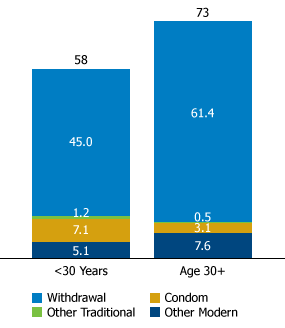
A Demographic and Health Survey (DHS) in 2008-09 found that 58 percent of married women of childbearing age relied on withdrawal to prevent a pregnancy—just 11 percent used a more effective method such as male condoms or oral contraceptives.2
The total contraceptive use in Albania is higher than in several other former communist countries in the region, but the percentage of women relying on modern contraceptives lags behind other eastern European countries.
Preference for Traditional Methods
Contraceptives were legalized in Albania in 1992 and have been distributed free at government health centers since 1993. But Albanian women have more confidence in withdrawal than in modern methods, underscoring how little couples knew about family planning and the weakness of subsequent family planning education efforts.
Contraceptive Use by Method and Age Among Married Women in Albania, 2008-09 (Percent)
Source: Albania Institute of Statistics, Institute of Public Health and ICF Macro, Albania Demographic Health Survey 2008-09.
The 2008-09 DHS survey found that while about 86 percent of married women ages 15 to 49 were familiar with the pill and the male condom, just 21 percent knew about the rhythm method and 16 percent knew about male sterilization—common methods in the United States and many other countries. While knowledge of methods has improved since a 2002 survey, the DHS found that fewer than one-half of the Albanian women knew about IUDs or contraceptive implants. About one-third of the women who were using a modern method said they had only been offered one contraceptive method from their provider; a similar percentage felt they had not been fully informed about possible side effects.
Concern about side effects has kept many women from adopting modern methods—but a primary reason given was lack of confidence that the modern methods, especially the condom, would prevent pregnancy as well as withdrawal would.
Slight Increase in Modern Methods
The 2008-09 DHS showed a slight increase in current and intended use of modern contraceptive methods among younger Albanians. Among married women under age 30, withdrawal was still the most common method, but these young women were more likely than older women to use condoms or other modern methods (see figure). Wives under age 30 were also more likely than older women to say they intended to use the pill in the future: 15 percent indicated the pill as their future method, compared with 9 percent of older women. If they follow through on their stated intention, the use of modern methods will increase substantially.
Abortion Common
Abortion was the primary method of birth control in many eastern and southern European countries, especially where contraceptives were not easily available under communist rule. But abortion was not widespread in Albania before legal restrictions were relaxed in the early 1990s. Although reliable estimates of the numbers before 1990 are not available, official statistics indicate a surge in abortions when the procedure became legal.3
There were about 250 abortions per 1,000 live births between 2004 and 2008; abortion was a component in Albania’s fertility decline, but not the key factor.4
Closer Ties to Europe Means More Change
Although tradition remains strong, Albania’s isolation from the rest of Europe has lessened as more Albanians experience life in other countries and as the government seeks greater international ties. Albania is still one of the poorest countries in Europe, but its economy has been growing rapidly.5
With closer ties to the rest of Europe and economic growth, Albanians may begin to adopt a greater variety of family planning methods.
Mary Mederios Kent is senior demographic writer at the Population Reference Bureau.
References
- Jane Falkingham and Arjan Gjonça, “Fertility Transition in Communist Albania, 1950-90,” Population Studies 55 (2001): 309-18; and Arjan Gjonca, Arnstein Aassve, and Letizia Mencarini, “Albania: Trends and Patterns, Proximate Determinants and Policies of Fertility Change,” Demographic Research 19, article 11 (2008): 261-92, accessed at www.demographic-research.org/Volumes/Vol19/11/, on Oct. 7, 2010.
- Albania Institute of Statistics, Institute of Public Health and ICF Macro, Albania Demographic and Health Survey 2008-09 (Tirana, Albania: Institute of Statistics, Institute of Public Health and ICF Macro, 2010).
- Institute national d’étude démographiques (INED), “Developed Countries Database,” accessed at www.ined.fr/en/pop_figures/developed_countries/developed_countries_database/, on Oct. 14, 2010.
- Gjonca, Aassve, and Mencarini, “Albania: Trends and Patterns, Proximate Determinants and Policies of Fertility Change.”
- U.S. State Department, “Country Background Notes: Albania,” accessed at www.state.gov/r/pa/ei/bgn/3235.htm, on Oct. 13, 2010.
Related Posts
Family Planning and the Gendered Impacts of Crises on Women: An Effective Tool Across Sectors to Support Women’s Empowerment and Build Resilience to Shocks
Holistic integrated solutions are key to address the interlinkages of the gendered impacts of crises.
Research Identifies New Strategies to Reduce Undercount of Young Children in U.S. 2020 Census
PRB identifies factors predicting where children under age 5 are more likely to be missed in the 2020 Census and develops a new undercount risk measure for young children.

Health Sector Reform: How It Affects Reproductive Health
(June 2003) Many less developed countries are reforming their health systems in an effort to achieve public health goals more affordably and effectively.
Report. Health Sector Reform: How It Affects Reproductive Health
This report also in French and Spanish. (June 2003) Many less developed countries are reforming their health systems in an effort to achieve public health goals more affordably and effectively.