
Cuadro de datos de la población mundial 2008
- This data sheet also in French and Spanish.
The demographic divide—the inequality in the population and health profiles of rich and poor countries—is widening. Two sharply different patterns of population growth are evident: Little growth or even decline in most wealthy countries and continued rapid population growth in the world’s poorest countries.
The Population Reference Bureau’s 2008 World Population Data Sheet and its summary report offer detailed information about country, regional, and global population patterns.
“Nearly all of world population growth is now concentrated in the world’s poorer countries,” said Bill Butz, PRB’s president. “Even the small amount of overall growth in the wealthier nations will largely result from immigration.”
In 2008, world population is 6.7 billion: 1.2 billion people live in regions classified as more developed by the United Nations; 5.5 billion people reside in less developed regions. “We will likely see the 7 billion mark passed within four years,” said Carl Haub, PRB senior demographer and co-author of this year’s Data Sheet. “And by 2050, global population is projected to rise to 9.3 billion. Between now and mid-century, these diverging growth patterns will boost the population share living in today’s less developed countries from 82 percent to 86 percent.”
The 2008 World Population Data Sheet provides up-to-date demographic, health, and environment data for 209 countries and 25 regions of the world. It points up stark contrasts between developed and developing countries, as shown in the table.
“The differences between Italy and the Democratic Republic of the Congo illustrate this widening demographic divide,” said Mary Mederios Kent, co-author of this year’s Data Sheet. “On one side are mostly poor countries with high birth rates and low life expectancies. On the other side are mostly wealthy countries with low birth rates and rapid aging.”
| United States | Italy | Dem. Rep. Congo | |
|---|---|---|---|
| Population mid-2008 | 305 million | 60 million | 67 million |
| Population 2050 (projected) | 438 million | 62 million | 189 million |
| Lifetime births per woman | 2.1 | 1.3 | 6.5 |
| Percent of population below age 15 | 20% | 14% | 47% |
| Percent of population ages 65+ | 13% | 20% | 3% |
| Life expectancy at birth | 78 years | 81 years | 53 years |
| Annual births | 4.3 million | 568,120 | 2.9 million |
| Annual deaths | 2.4 million | 575,300 | 0.8 million |
| Annual births minus deaths | 1.9 million | -7,200 | 2.1 million |
| Percent of population undernourished | <2.5% | <2.5% | 74% |
Other highlights from the 2008 World Population Data Sheet:
World population will have an urban majority. In 2008, for the first time, half of the world’s population will live in urban areas.
Despite some improvement, maternal mortality continues to be very high in developing countries. In those countries, 1 in 75 women still die from pregnancy-related causes. In both sub-Saharan Africa and in the 50 countries defined by the United Nations as least developed, that risk is a shocking 1 in 22. In stark contrast, about 1 in 6,000 women in the developed countries die from pregnancy-related causes.
Worldwide, women now average 2.6 children during their lifetimes, 3.2 in developing countries excluding China, and 4.7 in the least developed countries. Lifetime fertility is highest in sub-Saharan Africa at 5.4 children per woman. In the developed countries, women average 1.6 children. The United States, with an average of 2.1 children, is an exception to this low-fertility pattern in the world’s wealthier countries.
In less developed countries, 18 percent of the population is undernourished. In the least developed countries, 35 percent of the population consumes fewer than the minimum calories required to lead a healthy active life. That figure rises above 60 percent in several sub-Saharan countries.
Related Posts
Beyond the Headlines: As China and India Age, Young Africa Has Potential to Power Global Workforce
In this webinar, we examine data on the growth of sub-Saharan Africa’s working-age population and discuss its potential to power the global workforce.

Lesson Plans on Human Population and Demographic Studies
Find out the answers to these questions and more. The sections listed below explore eight elements of population dynamics.

Report. Population Trends and Challenges in the Middle East and North Africa
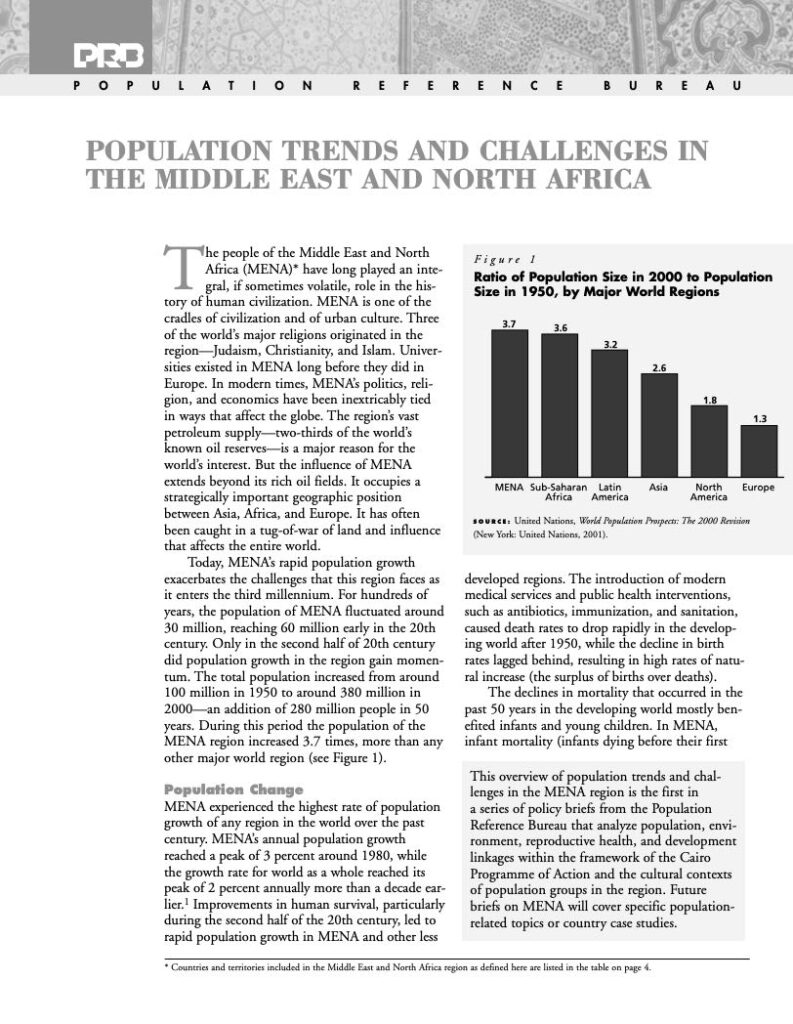
(2001) The people of the Middle East and North Africa (MENA) have long played an integral, if sometimes volatile, role in the history of human civilization.
Population Trends and Challenges in the Middle East and North Africa
(2001) The people of the Middle East and North Africa (MENA) have long played an integral, if sometimes volatile, role in the history of human civilization.