
The Dynamics of Family Planning: Key Demographic Insights
Since the early 1960s, many countries have instituted large-scale programs to provide contraceptive access and services to their populations. Since that time, hundreds of national surveys have been conducted and statistics have been collected from clinics and health centers at local levels. The rich data sets that have appeared over the years permit insights into the dynamics of how large-scale family planning programs do and do not work well.
This report by John Ross, an eminent demographer, is in a primer format covering the relationships between contraceptive use and demographic outcomes. This publication is useful for those who seek a deeper understanding of the dynamics that surround contraceptive use. The format for each topic states first the key relationship, then discusses it briefly, usually with references for further reading, and with an accompanying figure that illustrates the dynamics involved.
- Digital Feature: Use the interactive table of contents to navigate directly to each chapter
- Print Version
The contents are those of the author and do not necessarily represent the views of PRB.
Related Posts
Family Planning and the Gendered Impacts of Crises on Women: An Effective Tool Across Sectors to Support Women’s Empowerment and Build Resilience to Shocks
Holistic integrated solutions are key to address the interlinkages of the gendered impacts of crises.
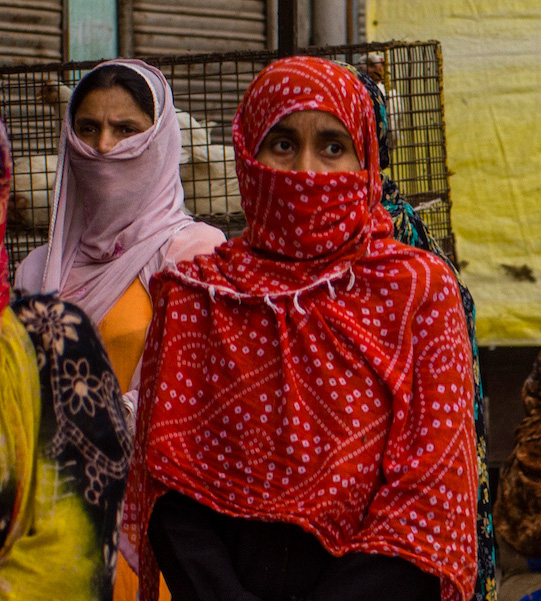
Health Sector Reform: How It Affects Reproductive Health
(June 2003) Many less developed countries are reforming their health systems in an effort to achieve public health goals more affordably and effectively.
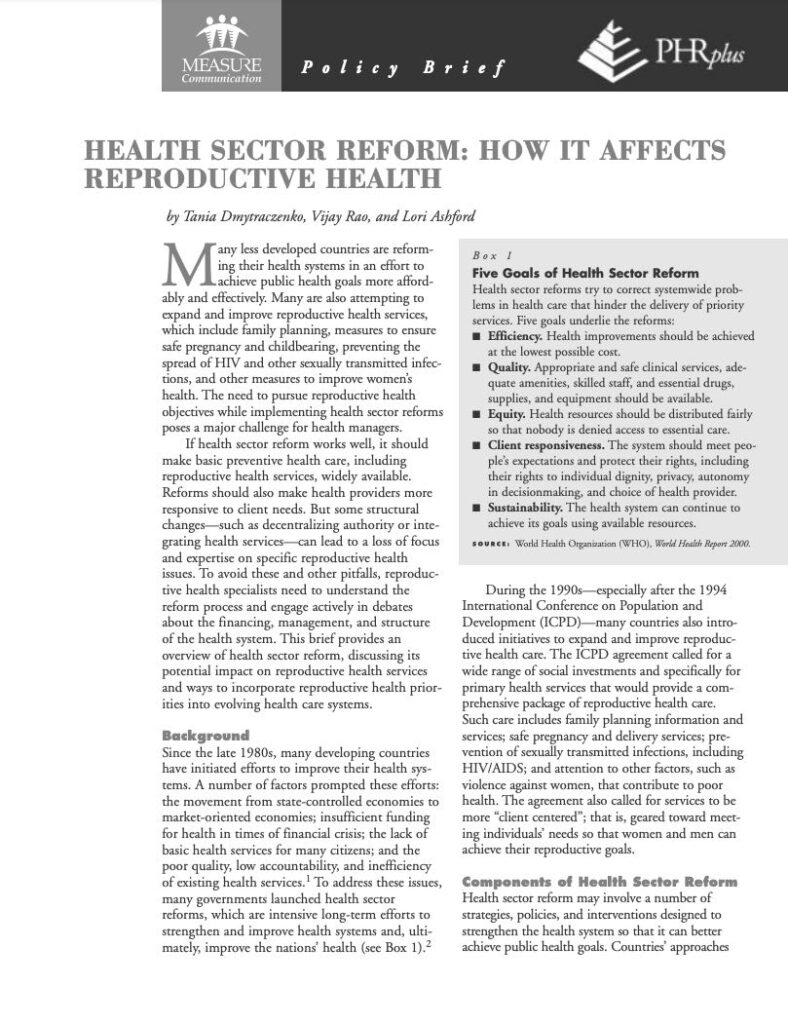
Report. Health Sector Reform: How It Affects Reproductive Health
This report also in French and Spanish. (June 2003) Many less developed countries are reforming their health systems in an effort to achieve public health goals more affordably and effectively.
Report. Reproductive Health in Policy & Practice: Case Studies From Brazil, India, Morocco, and Uganda
To assess how the Programme of Action, agreed upon at the 1994 International Conference on Population and Development (ICPD), is being implemented, senior researchers in Brazil, India, Morocco, and Uganda conducted country case studies.
Reproductive Health in Policy & Practice: Case Studies From Brazil, India, Morocco, and Uganda
To assess how the Programme of Action, agreed upon at the 1994 International Conference on Population and Development (ICPD), is being implemented, senior researchers in Brazil, India, Morocco, and Uganda conducted country case studies.