
Ending Child Marriage
(April 2011) According to PRB’s new policy brief,
Who Speaks for Me? Ending Child Marriage
, one in nine girls has been forced into marriage between ages 10 and 14 in developing countries. With limited education and economic opportunities, child brides are often condemned to a life of poverty, social isolation, and powerlessness, infringing on their human rights, health, and well-being. In developing countries with a growing youth population, investments in adolescent girls are critical. Ultimately, to meet development goals, nations and communities must end child marriage.
The Honorable Mary Robinson was the president of Ireland from 1990 to 1997 and UN High Commissioner for Human Rights from 1997 to 2002. She was awarded the Presidential Medal of Freedom by President Obama in 2009 and is chair of the Aspen Institute’s Global Leaders Council for Reproductive Health. She is also a member of The Elders, an independent group of eminent global leaders, brought together by Nelson Mandela, who support peace building, help address major causes of human suffering, and promote the shared interests of humanity. The Elders are working to forge a global civil society alliance for a world without child marriage.
In this interview, the Honorable Mary Robinson talks about why child marriage violates human rights and how the practice can be addressed and changed.
“It’s a question of supporting a broad alliance and making the issue more visible, not in a finger-pointing, condemnatory kind of way…but in a way that brings out the development gains of investing in girls…Educating girls helps them to be able to say no, to have a sense of their own worth…Communities need to have conversations about the need to ensure that girls have equal access to education and stay in school.” — Mary Robinson
Related Posts
Family Planning and the Gendered Impacts of Crises on Women: An Effective Tool Across Sectors to Support Women’s Empowerment and Build Resilience to Shocks
Holistic integrated solutions are key to address the interlinkages of the gendered impacts of crises.
Research Identifies New Strategies to Reduce Undercount of Young Children in U.S. 2020 Census
PRB identifies factors predicting where children under age 5 are more likely to be missed in the 2020 Census and develops a new undercount risk measure for young children.

Health Sector Reform: How It Affects Reproductive Health
(June 2003) Many less developed countries are reforming their health systems in an effort to achieve public health goals more affordably and effectively.
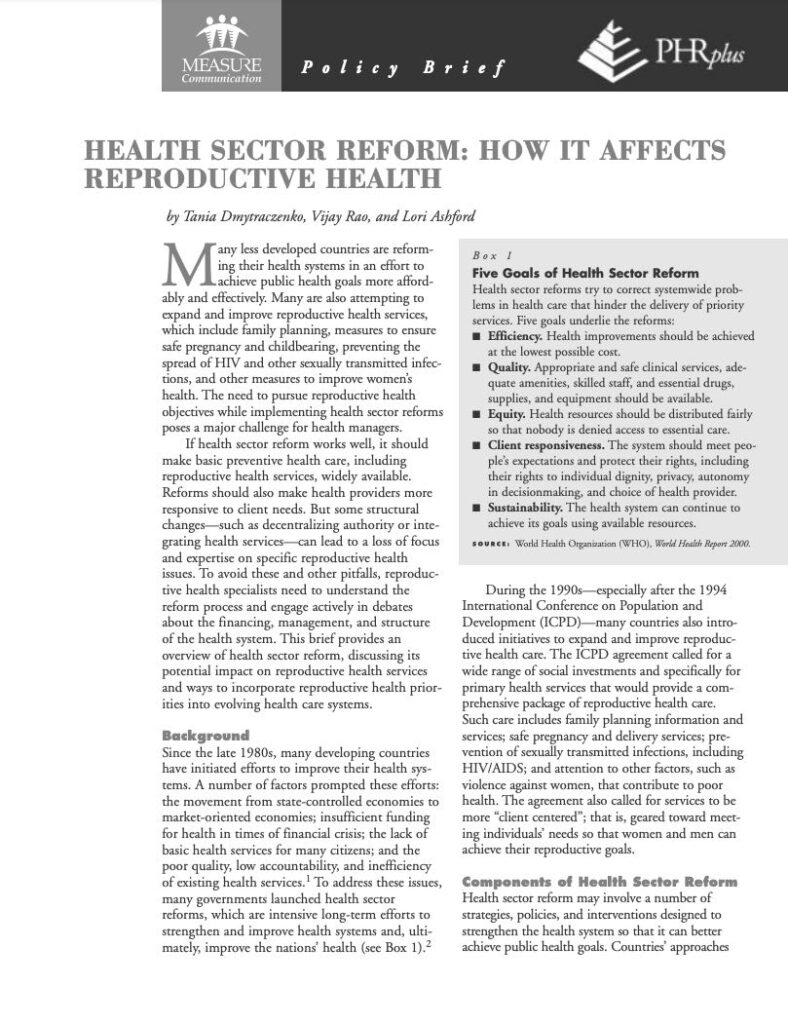
Report. Health Sector Reform: How It Affects Reproductive Health
This report also in French and Spanish. (June 2003) Many less developed countries are reforming their health systems in an effort to achieve public health goals more affordably and effectively.