
Engaging Effectively to Expand Access to Safe Abortion: A Policy Communication Guide
A strong policy communication strategy is an important part of the process for successful policy change to encourage safe abortion.

Each year, the lives of approximately 25 million women worldwide are endangered due to unsafe abortions. Reducing deaths and injuries related to unsafe abortion requires a policy environment that supports equitable access to sexual and reproductive health and rights—including contraception, safe abortion, and postabortion care—for all people. A strong policy communication strategy is an important part of the process for successful policy change to encourage safe abortion.
Engaging Effectively to Expand Access to Safe Abortion: A Policy Communication Guide is an action-oriented resource that equips users with information and practical steps for engaging in evidence-based discussions with policy audiences about expanding access to safe abortion in their country. Whether they are new to working on safe abortion issues or have extensive experience with this topic, the guide helps users develop a cohesive, coordinated, and compelling policy communication strategy grounded in data and tailored to their country’s context. It includes seven sections with information, real-world examples, and accessible exercises to teach users how to effectively share knowledge, interact with policy stakeholders, and frame participatory processes for discussing the decisions, plans, and actions that impact safe abortion access at local and national levels.
Related Posts
Health Sector Reform: How It Affects Reproductive Health
(June 2003) Many less developed countries are reforming their health systems in an effort to achieve public health goals more affordably and effectively.
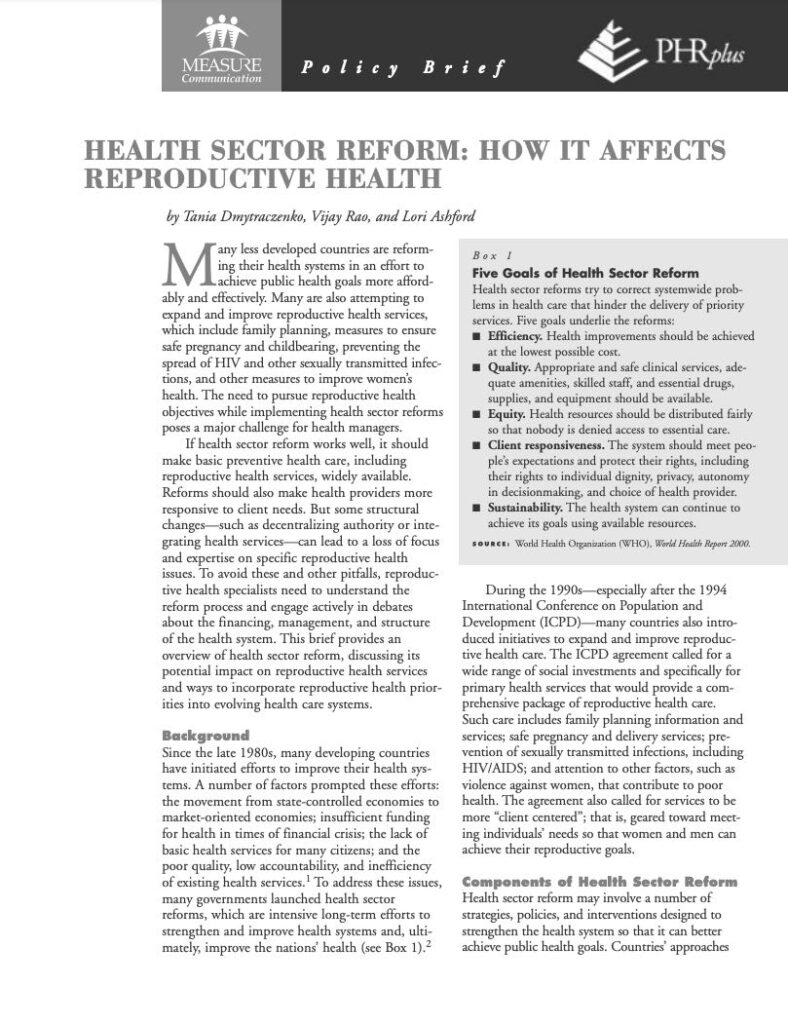
Report. Health Sector Reform: How It Affects Reproductive Health
This report also in French and Spanish. (June 2003) Many less developed countries are reforming their health systems in an effort to achieve public health goals more affordably and effectively.
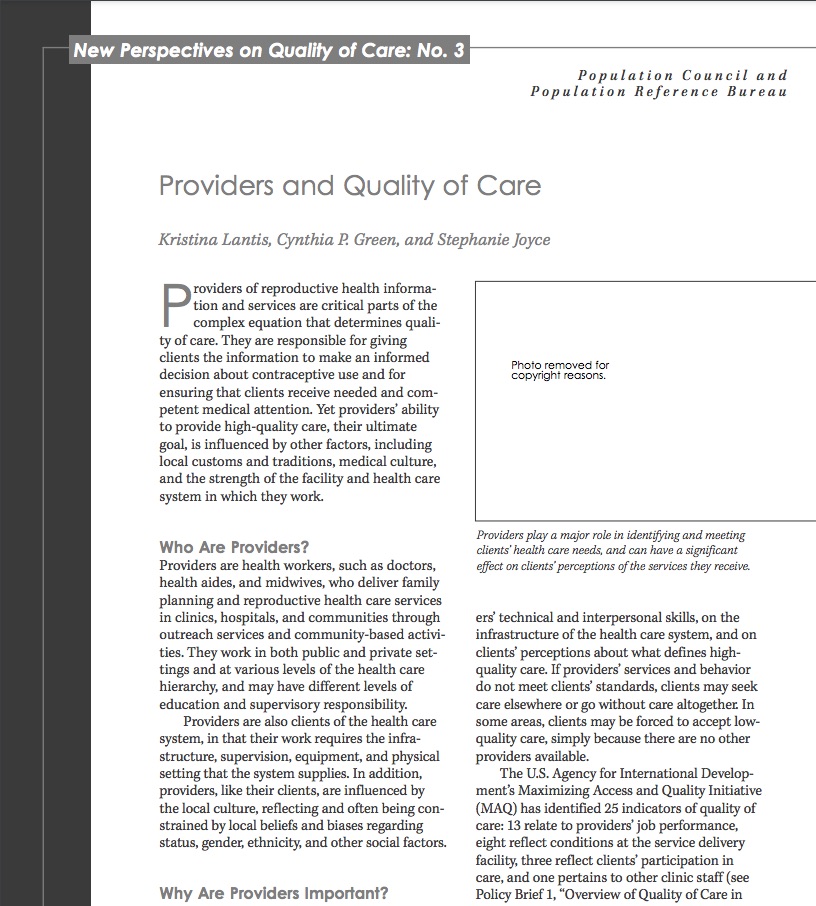
Providers and Quality of Care
(2002) Providers of reproductive health information and services are critical parts of the complex equation that determines quality of care.
Report. Reproductive Health in Policy & Practice: Case Studies From Brazil, India, Morocco, and Uganda
To assess how the Programme of Action, agreed upon at the 1994 International Conference on Population and Development (ICPD), is being implemented, senior researchers in Brazil, India, Morocco, and Uganda conducted country case studies.
Reproductive Health in Policy & Practice: Case Studies From Brazil, India, Morocco, and Uganda
To assess how the Programme of Action, agreed upon at the 1994 International Conference on Population and Development (ICPD), is being implemented, senior researchers in Brazil, India, Morocco, and Uganda conducted country case studies.