
In the News: Speaking English in the United States
(June 2006) Recent reports on the growing U.S. Hispanic population and the current debate over whether and how to stem illegal U.S. immigration have given new energy to those who want English declared the country’s official language.
Figure 1
Transition to Speaking English at Home Among Los Angeles-Area Immigrant Families, 2004
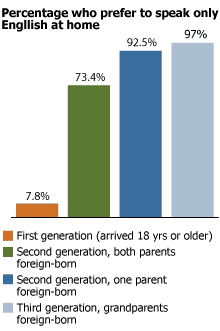
Source: Rubén G. Rumbaut, “A Language Graveyard? Immigration, Generation, and Linguistic Acculturation in the United States” (2005).
In late April, President George W. Bush told reporters that he thought the U.S. national anthem, “The Star-Spangled Banner,” should only be sung and recorded in English.1 And late last month, the U.S. Senate added two amendments to its immigration bill: the first declaring English the national language, and the second recognizing it as the country’s “common and unifying tongue.”2
The amendments were immediately denounced by opponents as racist or anti-Hispanic. Some analysts also argued that the measures could potentially restrict dissemination of public health and safety messages in languages other than English.3
But while nearly 50 million Americans spoke a language other than English at home in 2004—nearly one-fifth of all U.S. residents age 5 or older—what the debate misses is that today’s immigrants are on average making the transition to speaking English more quickly than immigrants at any other time in U.S. history.
Young immigrants (those ages 5 to 17) almost always are speaking English over their native tongues by adulthood, according to Rubén G. Rumbaut, professor of sociology and co-director of the Center for Research on Immigration, Population, and Public Policy at the University of California-Irvine. (See Figure 1 for the transition to speaking English by Los Angeles-area immigrant generations.)
“Those who arrive by age 12 or 13 make a quick transition to English—that’s the dividing line,” says Rumbaut, who has studied language assimilation in the United States for three decades. “It’s a piece of cake for those who arrive much earlier on, because of the dominance of English in every medium in the United States, from video to the Internet. English wins.”
In addition, Spanish isn’t the only fast-growing language in the United States: Chinese, Tagalog, Vietnamese, and Arabic have also seen impressive gains since 1990, while European languages that were once common in the United States (such as French, German, and Polish) are becoming less prevalent. But Rumbaut says that the children of new immigrants speaking other languages will almost invariably turn to English as their primary tongue.
“The fate of all these languages is to succumb to rapid assimilation,” says Rumbaut. “The idea that the United States will devolve into riots and become Quebec unless everybody speaks English and English only, is absolutely not true. Demography will take care of the problem itself—it is not really a policy issue.”
More Than One-Half of All Immigrants ‘Very Proficient’ in English
The number of Americans speaking a language at home other than English has more than doubled since 1980, reflecting the influx of millions of immigrants to the United States in recent decades, particularly Spanish-speaking immigrants from Latin America. About 31 million U.S. residents speak Spanish at home—easily making it the second-most spoken language in the country.
The idea that speaking languages other than English hinders full participation of U.S. citizenship has substantial public support. For example, in a Los Angeles Times poll of California voters after their 1998 vote to end bilingual education in that state, three out of every four agreed with the statement: “If you live in America, you need to speak English.”4 A majority of Hispanics share this attitude, according to a new Pew Hispanic Center survey: 57 percent of Hispanics say that “immigrants have to speak English to say that they are part of American society.”5
But a majority of those who speak languages other than English at home report themselves already very proficient in English, according to 2004 data from the American Community Survey (see Table 1). Fewer than 50 percent of people who use Spanish or another non-English language at home speak English less than “very well”—including 48 percent of those who speak Spanish. Almost 70 percent of U.S. adults ages 18 to 64 who spoke Spanish in the home said they also spoke English either “well” or “very well.”6
Table 1
Language Spoken at Home by U.S. Residents Ages 5 and Older, 2004
Primary language | Estimate (millions) | Speaks English less than “very well” | |
|---|---|---|---|
In millions | Percentage | ||
| Language other than English | 49.63 | 22.31 | 44.94% |
| Spanish | 30.52 | 14.64 | 47.96% |
| Other Indo-European language | 9.63 | 3.32 | 34.42% |
| Asian/Pacific-Islander language | 7.61 | 3.10 | 49.50% |
| Other languages | 1.86 | 0.54 | 29.25% |
Source: U.S. Census Bureau, United States: Selected Social Characteristics: 2004 (2004).
“The last people you have to tell that English is important are immigrants,” says Rumbaut. “English is already the de facto language of the country and of the world.”
The Transition to English Accelerates
U.S. immigrants are making the transition to speaking English much more quickly than did past immigrants. Historically, this transition took three generations, with adult immigrants who often did not learn English, children who were bilingual in English and their parents’ language, and a third generation that spoke English almost exclusively.
Today, however, more first- and second-generation Americans are becoming fluent in English. In a study that followed more than 5,200 second-generation immigrant children in the Miami and San Diego school systems, Rumbaut and Princeton University professor of sociology Alejandro Portes found that 99 percent spoke fluent English and less than one-third maintained fluency in their parents’ tongues by age 17.7
Indeed, Census Bureau data for 2000 show that more than 67 percent of the 6.5 million U.S. children ages 5 to 17 who spoke Spanish in their homes also spoke English “very well,” while 86 percent spoke English either “very well” or “well” (see Table 2).
Table 2
Ability to Speak English for U.S. Residents Ages 5-17, 2000
Primary language | Estimate (millions) | English speaking level | |||
|---|---|---|---|---|---|
Very well (millions) | % | Well (millions) | % | ||
| Spanish | 6.53 | 4.40 | 67.34 | 1.24 | 32.66 |
| Other Indo-European language | 1.54 | 1.19 | 77.67 | 0.23 | 22.33 |
| Asian/Pacific-Islander language | 1.15 | 0.80 | 69.56 | 0.24 | 30.44 |
| Other languages | 0.31 | 0.25 | 80.60 | 0.42 | 19.40 |
Source: U.S. Census Bureau, 2000 Supplementary Survey Summary Tables, table P035 (2006).
Similar percentages of children who spoke a language other than English or Spanish at home also spoke English “well” or “very well.” The Census data also show that these children are learning English at higher rates than either their parents or grandparents.
Another study conducted by Rumbaut shows that more than 73 percent of second-generation immigrants in Southern California who have two foreign-born parents prefer to speak English at home instead of their native tongue (see Figure 1).8 By the third generation, more than 97 percent of these immigrants—Mexican, Salvadoran, Guatemalan, Filipino, Chinese, Korean, and Vietnamese—prefer to speak only English at home.
“The single most important indicator of how readily any speaker will switch to English and become fluent is the age of arrival, followed by level of education and length of stay,” says Rumbaut. “But the three-generational model of language shift is happening faster today than any time in U.S. history.”
Speakers of Asian Languages, Russian, and Arabic Growing Quickly in Number
The mix of languages other than English spoken at home in U.S. households has also changed in the last 15 years, according to the Census Bureau. Spanish remained the second-most spoken language in the United States between 1990 and 2000, increasing by almost 11 million speakers. But by 2000, Chinese supplanted French as the third-most spoken language in the country, almost doubling its number of users.
Use of Tagalog, Vietnamese, Russian, and Arabic also surged in the 1990s, while the number of people using European languages typically associated with older immigrant waves (such as German, Italian, and Polish) fell by at least 8 percent over the decade (see Figure 2).
Figure 2
Ten Languages Other Than English or Spanish Most Frequently Spoken at Home in the United States, 1990 and 2000
| 1990 |  | 2000 |
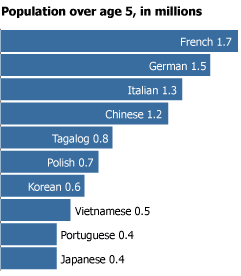 | 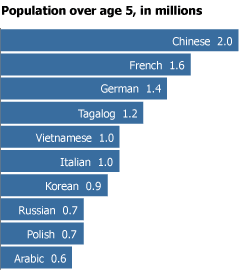 |
Source: U.S. Census Bureau, Language Use and English-Speaking Ability: 2000 (2003).
Of the 20 non-English languages most frequently spoken at home in the United States, the largest proportional increase was for Russian speakers, who nearly tripled from 242,000 in 1990 to 706,000 in 2000. The second-largest increase was for French Creole speakers (including Haitian Creoles)—more than doubling from 188,000 to 453,000.
Rumbaut says, however, that these figures are imprecise measures of the vitality of these languages. “They don’t tell you anything about who is speaking them, how often, or which language is preferred,” he says. “In California, many of these groups have their own radio stations, TV stations, Sunday schools—and all these efforts are failing to sustain the language into the second generation.”
Mary Kent is editor at the Population Reference Bureau. Robert Lalasz is senior editor at the Population Reference Bureau.
References
- Peter Baker, “Administration is Singing More Than One Tune on Spanish Version of Anthem,” Washington Post (May 3, 2006), accessed online at www.washingtonpost.com, on May 22, 2006.
- Donna Smith, “Senate Says English is National, Unifying Tongue,” Boston Globe (May 18, 2006), accessed online at www.boston.com, on May 22, 2006.
- Smith, “Senate Says English is National, Unifying Tongue.”
- James Crawford, “A Nation Divided by One Language,” Guardian Unlimited (March 8, 2001), accessed online at www.guardian.co.uk, on May 16, 2006.
- Pew Hispanic Center, Hispanic Attitudes Toward Learning English (2006), accessed online at http://pewhispanic.org/files/factsheets/20.pdf, on June 7, 2006.
- U.S. Census Bureau, “Ability to Speak English for U.S. Residents Ages 5-17, 2000.”
- U.S. Census Bureau, 2000 Supplementary Survey Summary Tables, table P035 (2006), accessed online at http://factfinder.census.gov, on May 3, 2006.
- Alejandro Portes and Richard Schauffler, “Language and the Second Generation: Bilingualism Yesterday and Today,” in The New Second Generation, ed. Alejandro Portes (New York: Russell Sage Foundation, 1996).
- Rubén G. Rumbaut, “A Language Graveyard? Immigration, Generation, and Linguistic Acculturation in the United States,” paper presented to the International Conference on The Integration of Immigrants: Language and Educational Achievement, Social Science Research Center, Berlin, June 30-July 1, 2005: table 8.
Related Posts
American Community Survey Resources, Shortcuts, and Tools Workshop
Expert data users from PRB, the U.S.

Research Identifies New Strategies to Reduce Undercount of Young Children in U.S. 2020 Census
PRB identifies factors predicting where children under age 5 are more likely to be missed in the 2020 Census and develops a new undercount risk measure for young children.