
Report. Population and Water Scarcity in the Middle East and North Africa
The Middle East and North Africa (MENA)* is the most water-scarce region of the world. Home to 6.3 percent of the world’s population, the region contains only 1.4 percent of the world’s renewable fresh water. As population pressures in the region increase, the demand for water resources rises. This brief examines the challenges of meeting this demand given scarce water resources. Country strategies to deal with water shortages depend on local conditions, including topography, the extent of water scarcity, available financial resources, and technical and institutional capacity. Overall, developing a mix of strategies that increase supply, manage demand, and reduce long-term pressures on water is urgent more than ever before, as population pressures in the region continue to increase.
Fresh Water: A Scarce and Critical Resource
Water sustains humans’ health, food production, and economic development. But only 3 percent of Earth’s water is salt-free, or fresh water. Moreover, nearly 70 percent of fresh water is locked in glaciers and icebergs, and is not available for human use. The fresh water that is available comes from rain or from rivers, lakes, springs, and some groundwater reserves, such as aquifers.1 (Water below the water table, contained in solid or fractured rock, is known as groundwater; aquifers are geologic formations that store, transport, and yield groundwater to wells.) Today’s wells can reach water buried deep within Earth, so these freshwater supplies can be depleted on a massive scale. Most aquifers can be recharged by the annual water cycle, but water trapped in ancient underground formations cannot be renewed.
Rapid population growth has exacerbated the water scarcity MENA faces. While natural factors such as intermittent droughts and limited freshwater reserves can cause scarcity, high population growth imposes additional pressures.2 Experts measure water availability in terms of the amount of annual renewable fresh water per person. A country is considered “water stressed” when its total renewable freshwater resources lie between 1,000 cubic meters and 1,700 cubic meters per person per year. “Water-scarce” countries have an average of less than 1,000 cubic meters of renewable fresh water per person per year. Twelve of the world’s 15 water-scarce countries are in MENA (see Figure 1).
Figure 1
Water-Scarce Countries in the Middle East and North Africa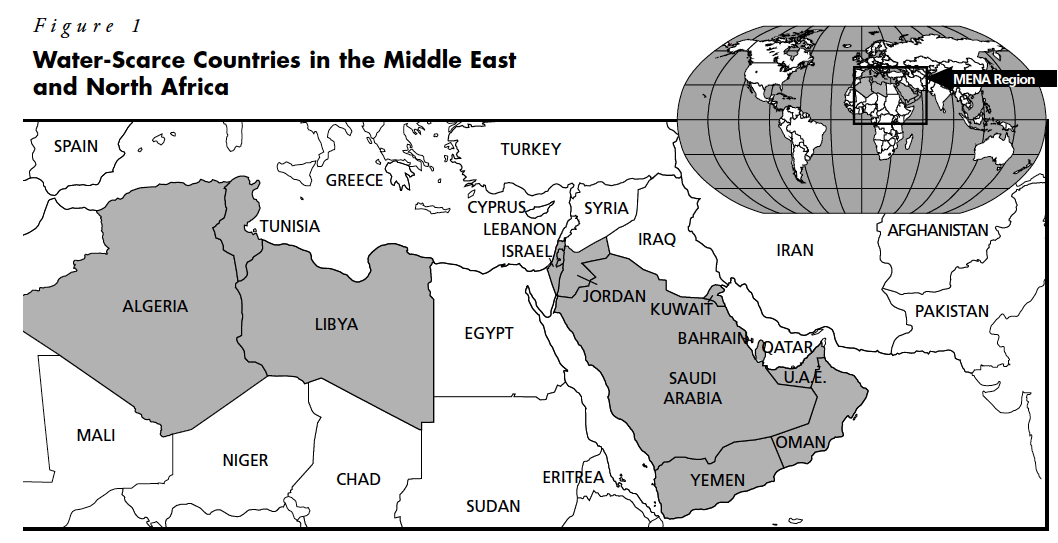
Note: Water-scarce countries (shaded above) are those with less then 1,000 cubic meters of renewable fresh water per person per year.
Source: Peter Gleick, The World’s Water 2000-2001, The Biennial Report on Freshwater Resources: Table 1; and Carl Haub and Diana Cornelius, 2001 World Population Data Sheet.
These thresholds for water scarcity and water stress do not reflect the freshwater resources that may eventually become accessible for human use. Accessibility is determined by a nation’s ability to collect and transport water to users and by the quality of the water. Human activities often pollute existing sources of fresh water, making it unusable or expensive to treat and reuse. Once water is available for human use, however, many factors affect how that water is used.
The Role of Population in Demand for Fresh Water
Population growth usually increases demand for water in all sectors of the economy: agricultural, industrial, and domestic. As Table 1 shows, agriculture accounts for the overwhelming majority of water demand in MENA. Between 1965 and 1997, the amount of MENA land under irrigation nearly doubled, in part because population growth increases demand for food. Industry requires water for manufacturing and cooling processes, as well for removing wastes generated by these processes. Domestic use, which includes drinking, food preparation, washing, cleaning, and watering gardens, accounts for a small portion of total use in most countries.
Table 1
Population Growth and Fresh Water in Middle East and North Africa
| Population (millions) | |||||
|---|---|---|---|---|---|
| 1970 | 2001 | 2025 | % of Population Living in Urban Areas, 2001 | Annual Renew- able Fresh Water (km2)b | |
| MENAa | 173.4 | 385.6 | 568 | 59 | 632.3 |
| Algeria | 13.8 | 31 | 43.2 | 49 | 14.3 |
| Bahrain | 0.2 | 0.7 | 1 | 88 | 0.1 |
| Egypt | 35.3 | 69.8 | 96.2 | 43 | 86.8 |
| Iran | 28.8 | 66.1 | 88.4 | 64 | 137.5 |
| Iraq | 9.4 | 23.6 | 40.3 | 68 | 96.4 |
| Israel | 3 | 6.4 | 8.9 | 91 | 2.2 |
| Jordan | 1.6 | 5.2 | 8.7 | 79 | 0.9 |
| Kuwait | 0.7 | 2.3 | 4.2 | 100 | 0.02 |
| Lebanon | 2.5 | 4.3 | 5.4 | 88 | 4.8 |
| Libya | 2 | 5.2 | 8.3 | 86 | 0.6 |
| Morocco | 15.3 | 29.2 | 40.5 | 55 | 30 |
| Oman | 0.7 | 2.4 | 4.9 | 71 | 1.0 |
| Qatar | 0.1 | 0.6 | 0.8 | 91 | 0.1 |
| Saudi Arabia | 5.7 | 21.1 | 40.9 | 83 | 2.4 |
| Syria | 6.3 | 17.1 | 27.1 | 50 | 46.1 |
| Tunisia | 5.1 | 9.7 | 12.5 | 62 | 4.1 |
| Turkey | 35.3 | 66.3 | 85.2 | 66 | 200.7 |
| United Arab Emirates | 0.2 | 3.3 | 4.5 | 84 | 0.2 |
| Yemen | 6.3 | 18 | 39.6 | 26 | 4.1 |
| Per Capita Annual Renewable Fresh Water (m2) | % of Freshwater Use, by Sector | ||||
|---|---|---|---|---|---|
| 1970 | 2001 | 2025 | Domestic | Industrial | |
| MENAa | 3,645 | 1,640 | 1,113 | 8 | 5 |
| Algeria | 1,040 | 462 | 331 | 25 | 15 |
| Bahrain | 455 | 140 | 97 | 39 | 4 |
| Egypt | 2,460 | 1,243 | 903 | 6 | 8 |
| Iran | 4,770 | 2,079 | 1,555 | 6 | 2 |
| Iraq | 10,304 | 4,087 | 2,392 | 3 | 5 |
| Israel | 740 | 342 | 247 | 16 | 5 |
| Jordan | 555 | 174 | 103 | 22 | 3 |
| Kuwait | 27 | 9 | 5 | 37 | 2 |
| Lebanon | 1,944 | 1,120 | 896 | 28 | 4 |
| Libya | 302 | 114 | 72 | 11 | 2 |
| Morocco | 1,960 | 1,027 | 741 | 5 | 3 |
| Oman | 416 | 206 | 5 | 2 | 94 |
| Qatar | 901 | 170 | 129 | 23 | 3 |
| Saudi Arabia | 418 | 114 | 59 | 9 | 1 |
| Syria | 7,367 | 2,700 | 1,701 | 4 | 2 |
| Tunisia | 800 | 422 | 327 | 9 | 3 |
| Turkey | 5,682 | 3,029 | 2,356 | 16 | 11 |
| United Arab Emirates | 897 | 60 | 44 | 24 | 9 |
| Yemen | 648 | 228 | 103 | 7 | 1 |
| % of Population With Access to Safe Water | % of Population With Access to Adequate Sanitation | ||||
|---|---|---|---|---|---|
| Total | Urban | Rural | Total | Urban | |
| MENAa | 84 | 93 | 79 | 86 | 95 |
| Algeria | 89 | 94 | 82 | 92 | 99 |
| Bahrain | – | – | – | – | – |
| Egypt | 97 | 99 | 96 | 98 | 100 |
| Iran | 92 | 98 | 83 | 83 | 86 |
| Iraq | 85 | 96 | 48 | 79 | 93 |
| Israel | – | – | – | – | – |
| Jordan | 96 | 100 | 84 | 99 | 100 |
| Kuwait | – | – | – | – | – |
| Lebanon | 100 | 100 | 100 | 99 | 100 |
| Libya | 72 | 72 | 68 | 97 | 97 |
| Morocco | 80 | 98 | 56 | 68 | 86 |
| Oman | 41 | 30 | 92 | 98 | 61 |
| Qatar | – | – | – | – | – |
| Saudi Arabia | 95 | 100 | 64 | 100 | 100 |
| Syria | 80 | 94 | 64 | 90 | 98 |
| Tunisia | 80 | 92 | 58 | 84 | 96 |
| Turkey | 82 | 82 | 84 | 91 | 98 |
| United Arab Emirates | – | – | – | – | – |
| Yemen | 69 | 74 | 68 | 38 | 89 |
a Total MENA population includes the Palestinians living in the West Bank and Gaza.
b This indicator represent freshwater resources in a country; actual annual renewable supply will vary from year to year. The data typically include both surface water and groundwater supplies, including surface inflows from neighboring countries. The United Nations Food and Agricultural Organization (FAO) refers to this as total natural renewable water resources. Flows to other countries are not subtracted from these numbers; therefore, these data represent the water made available by the natural hydrologic cycle, unconstrained by political, institutional, or economic factors. (Data for Israel are from 1986; all other data refer to 1997 estimates.)
c Gross national income (GNI) is the total value of all goods and services produced within a country, plus net income earned abroad by nationals. GNI PPP refers to gross national income converted to “international” dollars using a purchasing power parity (PPP) conversion factor. International dollars indicate the amount of goods and services one could buy in the United States with a given amount of money. GNI PPP provides an indicator of people’s welfare that is comparable across countries and is free of the price and exchange rate distortions that can occur when GNI is converted using market exchange rates.
Sources: Peter H. Gleick, The World’s Water 2000-2001: The Biennial Report on Freshwater Resources; United Nations, World Population Prospects: The 2000 Revision; C. Haub and D. Cornelius, 2001 World Population Data Sheet; and UNICEF, “Statistical Data” (www.unicef.org/statis/, accessed May 23, 2002).
But in countries that have little agriculture or industry, such as Kuwait, most water is used in households. While demand for water in all sectors has increased rapidly, it is increasing most quickly at the domestic level.3 Because demographic trends play a role in increasing demand, policymakers and water management specialists need to understand and examine these trends when considering the factors that drive freshwater demand.4
Population Growth
MENA’s population more than doubled between 1970 and 2001, rising from 173 million people to 386 million people and reducing the average amount of fresh water available per capita by more than half, to 1,640 cubic meters per person per year (see Table 1). But the regional average masks the severity of freshwater scarcity in some countries: Three-quarters of MENA’s available fresh water is located in Iran, Iraq, Syria, and Turkey. The average amount of renewable fresh water available in Bahrain, Jordan, Kuwait, Libya, Qatar, Saudi Arabia, the United Arab Emirates, and Yemen is already below 250 cubic meters per person per year.
Currently, MENA’s population is growing by 2 percent per year (or nearly 7 million people per year), second only to sub-Saharan Africa. Although the region’s total fertility rate (average number of births per woman) declined from 7.0 births per woman in 1960 to 3.6 births in 2001 and is expected to continue to fall, MENA’s population is expected to nearly double in 50 years, lowering the average per capita amount of renewable fresh water to around 1,100 cubic meters a year. The fastest population growth is occurring among Yemenis and Palestinians, who are the least equipped economically and technologically to address the challenges of water scarcity.
Population Momentum
MENA’s population is expected to grow rapidly, in part because of its young age structure. With one-third of the region’s population under age 15, an unprecedented number of young women are reaching reproductive age. Even if these women have fewer children than their parents did, their sheer numbers mean that there will be a large number of children, giving momentum to population growth in the region. In Jordan, for example, where 40 percent of the population is under age 15, the population is expected to more than double in the next 50 years, from 4.9 million people in 2000 to 11.7 million people in 2050 Ñ even as the country’s fertility is expected to decline by 50 percent (see Figure 2).
Figure 2
Projected Fertility and Population Growth in Jordan, 2000-2050
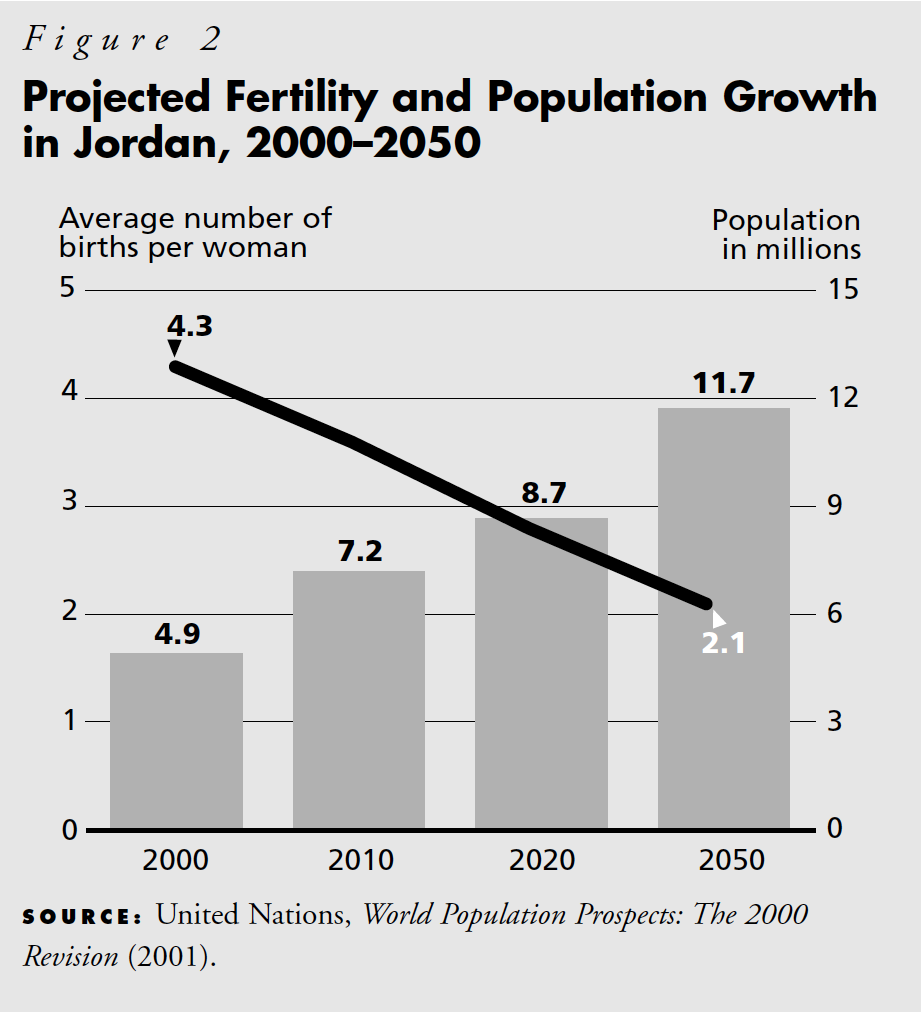 Source: United Nations, World Population Prospects: The 2000 Revision (2001).
Household Demand
Household demand for water is affected by a variety of factors, such as household size, households’ distance from the source of water, how regularly water is accessible, and people’s consumption patterns. MENA’s growing population, together with higher per capita income, greater urbanization, and greater access to running water, has been driving up the region’s domestic demand for fresh water.
Urbanization
Nearly 60 percent of MENA’s population lives in urban areas. Cities are growing faster than the countries as a whole, as population growth in rural areas feeds a pool of potential rural-to-urban migrants. In nine MENA countries, more than three-quarters of the population lives in cities (see Table 1). Greater population density may enable communities to invest in more efficient and cost-effective water management, but people who live in cities tend to use more water than those living in rural areas.
Rapid urbanization can hinder the development of adequate infrastructure, such as effective distribution methods, sewage systems, and regulatory mechanisms.
Balancing Water Scarcity and Human Demand
MENA countries have increasingly been adopting new strategies for balancing their scarce water resources and growing demand for fresh water, although their options may be dictated by a number of different factors. For example, low-income countries, such as Yemen, would not be able to purchase the high-tech equipment available to high-income countries, such as Saudi Arabia. Even for high-income countries, purely technological solutions relieve only some of the demand for water. In the long term, slowing population growth in the region and creating effective policies and programs for improved water management are key to the region’s sustainable development.
Strategies for Increasing Supply
Most governments have traditionally focused on increasing access to fresh water by locating, developing, and managing new sources, despite the high costs often involved. As new natural sources of water become scarcer and more expensive, however, MENA countries are turning to other options, such as desalination and treatment and reuse of wastewater, while continuing to use older methods.
Qanats and Rainwater Harvesting Qanats, or chain wells, a traditional method for bringing water to the surface, consist of a series of horizontal tunnels bored into a cliff or mountainous area. These interconnected tunnels are sloped, allowing water to drain out and create an oasis in an otherwise arid area. The largest number of qanats are found in Iran. Rainwater harvesting, another ancient method for collecting water from roofs, cisterns, and other sources, diverts runoff into ponds and reservoirs for agricultural use. In Egypt, Bedouin farmers have rehabilitated degraded agricultural land by storing runoff water in wadis (dry riverbeds that become ponds after heavy rains) and by constructing earthen dikes.5
Sequential Water Use Sequential water use involves capturing and treating water that has been used in one sector so that it can be directed to other uses. Domestic use requires the cleanest water, so the ideal order is for water to be used in the household first, then in industry, then in agriculture.6 Urban wastewater, often referred to as “brown water,” can be treated and channeled from towns and cities onto nearby farms, increasing crop yields and decreasing the need for chemical fertilizers. For example, most of Israel’s sewage is purified and used to irrigate farm land.7 Wastewater from Tunis is used to irrigate citrus and olive orchards near the city, as well as golf courses, hotel gardens, and certain crops.8
Desalination Extracting salt from seawater is extremely expensive. Desalination provides a clean and reliable source of water, but it uses large quantities of heat and has some negative environmental consequences. Sixty percent of the world’s desalination capacity lies in the oil-rich Gulf states; 30 percent of the world’s total is in Saudi Arabia, which has facilities on the coasts of both the Red Sea and the Gulf of Aden. Since the 1950s, Kuwait has been the pioneer in developing desalination to supply fresh water for domestic use.
Trading Water There are a number of ways to transport water from one region to another, including shipping it by boat, transporting it via pipeline, towing it in large water bags (Medusa bags), and carrying it overland in vehicles. Importing water could help MENA governments meet the increased demand, reducing the potential incentive for people to migrate. But the ecological impacts of major water transfer schemes can be significant: Pumping water from one basin to another area may seriously affect local ecosystems and hydrology.9
Strategies for Managing Demand
Successful policies and programs for managing water supplies might involve strategies for promoting more desirable patterns and levels of water use. Options include reallocating water away from agriculture, increasing irrigation efficiency, instituting voluntary conservation measures, involving communities in water management plans, and finding more effective distribution mechanisms.
Water Reallocation For most MENA countries, reallocating water away from agriculture and toward the domestic and industrial sectors may be a critical, although controversial, way to adjust to water scarcity. Such policies can satisfy the needs of growing urban populations, but they can also threaten food security and the livelihood of farmers. Moreover, such shifts may be politically sensitive, especially where local tribes control water resources, and may raise legal issues.
Less Water-Intensive Crops A number of MENA countries rely heavily on their own production of cereals, which have a low return per unit of land and water. Switching to less water-dependent crops, selling them in the international market, and importing cereals could help conserve water. But while the strategy may make economic sense, countries often feel that it is strategically important and a matter of national pride to produce their own cereals.
Efficient Technologies Better technologies may help reduce long-term costs and improve efficiency. Studies have shown, for example, that drip irrigation cuts water use by between 30 percent and 70 percent and increases crop yields by between 20 percent and 90 percent, compared with traditional irrigation. Drip systems deliver water directly to plants’ roots, through a network of perforated plastic tubing installed on or below the soil surface.10Another successful technique, fertigation, involves applying fertilizer to irrigation water through the use of computer-controlled drip techniques. It economizes on water and fertilizer use, and limits soil salinization and groundwater pollution.11 Israeli farmers, who use highly efficient drip-irrigation techniques, have more than doubled their food production in the last 20 years without increasing their use of water.12
Distribution Efficiencies Other measures for improving distribution, such as repairing leaking distribution systems and sewer pipes, expanding central sewage systems, metering water connections, and rationing and restricting water use, can also play important roles. For example, Jordan’s construction codes mandate that buildings be constructed in accordance with water conservation specifications.13
Public Education and Community Involvement Involving communities in adopting new strategies can increase acceptance of new water systems. Communities can be taught to maintain and operate water systems, and can help determine what type of system best suits local conditions. In Tunisia, for example, there are nearly 2,500 water associations that are managing drinking and irrigation water systems.14 Water conservation measures that rely on the community are often more effective when they provide income for the community. In Jordan, for example, the Business and Professional Women’s Organization trains poor women to demonstrate and sell water conservation devices, such as shut-off nozzles for hoses, aerators for faucets, and waterless soap.
Conservation Countries are adopting a variety of ways to encourage voluntary conservation, including plans integrating religious messages with conservation practices. In 1998, for example, the Gulf states asked local religious leaders to devote their Friday speeches to the theme of Islam and water conservation for World Water Day. The Israeli Water Commission has estimated that implementing voluntary conservation measures could reduce the country’s domestic use by 55 million cubic meters a year.15 Many conservation messages have also been incorporated into school curricula throughout the region.
Economic Considerations MENA governments have traditionally subsidized the cost of providing safe water to citizens, but they are increasingly looking for ways to pass part of the cost on to consumers. Possible strategies include imposing water tariffs; charging for extracting water; pricing water at cost; offering conservation subsidies; and charging more during certain times of the day or seasons of the year.16 International research shows that households, who receive most of the benefit from piped water, are willing to pay 3 percent to 5 percent of their income for access to clean water.17 Water-use restrictions, pricing policies, wastewater quality requirements, and impact fees can motivate industrial and commercial users to reduce their water use. In one Jordanian steel mill, for example, daily water demand fell from 450 cubic meters to 20 cubic meters when cooling water was recycled.18 Such incentives can help discourage industrial water pollution and agricultural inefficiencies, but they may be difficult to implement and enforce.19
Additional Strategies
Some strategies can relieve water scarcity in the short term. Other strategies address more systemic issues that help achieve long-term goals. These longer-term strategies include implementing legal and institutional reforms, increasing regional cooperation (see Box 1), and slowing population growth.
Instituting Legal and Institutional Reforms Complicated systems of water rights, land rights, social and civic institutions, and legal regimes can sometimes undermine water management; reform could improve how water resources are regulated.20 Such changes may involve legal and institutional reforms, reorganizing the public and private sectors, and nongovernmental organizations’ participation.21 Jordan, for example, placed all responsibility for resources planning and monitoring under the control of the Ministry of Water and Irrigation.22 Previously, several agencies had overseen water use, leading to short-term planning, sporadic enforcement of water resources laws, and limited surveillance of water pollution.
Slowing Population Growth The 1994 United Nations International Conference on Population and Development (ICPD) provided an opportunity for countries to examine their population challenges and discuss possible solutions for achieving socially equitable, sustainable development for each country. The ICPD Programme of Action focuses on human development, providing a framework for slowing population growth and improving people’s lives. It calls for a wide range of investments to improve health, education, and rights Ñ particularly for women and girls Ñ and to provide reproductive health information and services to help people achieve their desired family size.
Conclusions
The challenge of addressing freshwater shortages in MENA is exacerbated by the region’s ongoing population pressures. Tapping new sources of water to meet the increased demand for fresh water would relieve some of the region’s shortages, but as new sources of water become more expensive, they become less accessible to low-income countries, given those nations’ limited financial and technical opportunities. At the same time, these low-income countries are often experiencing the fastest population growth in the region.
Regional cooperation and political, legal, and institutional support are critical for enabling countries to address their freshwater shortages. Sound government policies regarding water allocation, distribution, and use can help countries to adopt better strategies to manage their scarce freshwater resources. Conservation is important in balancing the region’s freshwater shortages and increased demand. Slower population growth would provide time for better water conservation and management strategies to be developed and would allow freshwater resources to be used more efficiently.
References
- Peter H. Gleick, The World’s Water 2000-2001: The Biennial Report on Freshwater Resources (Washington, DC: Island Press, 2000).
- Malin Falkenmark and Carl Widstrand, “Population and Water Resources: A Delicate Balance,” Population Bulletin 47, no. 3 (Washington, DC: Population Reference Bureau, 1992).
- Doris Koehn, “Water and Environment for the Middle East and North Africa” (presentation at the sixth joint Middle East Institute and World Bank Annual Conference, Washington, DC, May 15, 2001).
- Farnazeh Roudi, “Population Trends and Challenges in the Middle East and North Africa” (Washington, DC: Population Reference Bureau, 2001).
- Mamdouh Nasr, “Assessing Desertification and Water Harvesting in the Middle East and North Africa: Policy Implications,” ZEF-Discussion Papers on Development Policy, no. 10 (Bonn, Germany: Center for Development Research, University of Bonn, 1999).
- Falkenmark and Widstrand, “Population and Water Resources: A Delicate Balance.”
- D. Hinrichsen et al., “Solutions for a Water-Short World,” Population Reports, series M, no. 14 (Baltimore: Johns Hopkins University School of Public Health, Population Information Program, 1998).
- Gleick, The World’s Water 2000-2001.
- Personal correspondence with Alex de Sherbinin, Feb. 22, 2002.
- Sandra Postel, Pillar of Sand: Can the Irrigation Miracle Last? (New York: W.W. Norton & Company, 1999).
- Committee on Sustainable Water Supplies in the Middle East et al., Water for the Future: The West Bank and Gaza Strip, Israel, and Jordan (Washington, DC: National Academy Press, 1999).
- Robert Engelman and Pamela LeRoy, “Sustaining Water: Population and the Future of Renewable Water Supplies” (Washington, DC: Population Action International, 1993).
- Rick Bossi, “Changing Water Usage Behavior in Jordan,” Academy News: Newsletter of the Academy for Educational Development (Fall 2001).
- World Bank, “Tunisia-Water Sector Investment Loan,” accessed online at www.worldbank.org/pics/pid/tn35707.txt, on May 10, 2002.
- Committee on Sustainable Water Supplies in the Middle East et al., Water for the Future.
- Ruth Meinzen-Dick and Mark Rosengrant, Overcoming Water Scarcity and Quality Constraints (Washington, DC: International Food Policy Research Institute, 2001).
- World Resources Institute et al., World Resources Report: A Guide to the Urban Environment (New York: Oxford University Press, 1996).
- Water Authority of Jordan, written communication, 1994.
- Arab Centre for the Studies of Arid Zones and Drylands, “Alternative Policy Study: Water Resource Management in West Asia,” accessed online at http://grid2.cr.usgs.gov/geo2000/ aps-wasia/population, on April 17, 2002.
- David B. Brooks et al., eds., Management of Water Demand in Africa and the Middle East (Ottawa, Canada: International Development Research Centre, 1997).
- Arab Centre for the Studies of Arid Zones and Drylands, “Alternative Policy Study: Water Resource Management in West Asia.”
- European Commission et al., MENA/MED Water Initiative: Second Regional Seminar on Policy Reforms in Water Resources ManagementÑSummary Report (Amman, Jordan: European Commission, European Investment Bank, and the World Bank, 1999).
- World Bank, “Nile Basin Initiative: Overview,” accessed online at www.worldbank.org/afr/nilebasin/overview.htm, on May 10, 2002.
- Munthur J. Haddadian, “Water Challenges in the Near East: A Looming Crisis?” (presentation at the sixth joint Middle East Institute and World Bank Annual Conference, Washington, DC, May 15, 2001).
- Jeremy Berkoff, A Strategy for Managing Water in the Middle East and North Africa(Washington, DC: World Bank, 1994).
Thanks are due to Nancy Yinger, Lori Ashford, Katie Igrec, Buffy Bauman, and Lisa Colson, of PRB; Malin Falkenmark, Stockholm International Water Institute; Vahid Alavian, World Bank; Sandra Postel, Global Water Policy Project; and Alex de Sherbinin, Center for International Earth Science Information Network, Columbia University, all of whom reviewed drafts and provided useful comments. This work has been funded by the Summit Foundation, with additional support from the Ford Foundation.
* As defined here, the Middle East and North Africa region includes Algeria, Bahrain, Egypt, Iran, Iraq, Israel, Jordan, Kuwait, Lebanon, Libya, Morocco, Oman, Palestine, Qatar, Saudi Arabia, Syria, Tunisia, Turkey, the United Arab Emirates, and Yemen.
Box 1
The Challenge of Regional Cooperation As demand for fresh water increases, so does the competition over water resources. The most significant river basins of the region, the Jordan, Nile, and Euphrates-Tigris, are subjects of contention among the countries that share their banks. The Nile, for example, runs through nine countries before reaching Egypt. The Nile Basin Initiative, a cooperative agreement to achieve sustainable development through equitable use of the river’s water resources, was begun in 1959 by Egypt and Sudan. The initiative, which is now supported by all 10 countries that share the basin, includes implementation of a basin-wide program of research, capacity, and technical assistance, and preparation of cooperative sub-basin investment programs in the Eastern Nile and the Equatorial Lakes regions.23
Intergovernmental activities to settle conflicts over water, however, have had only mixed success. Many agreements governing rivers in MENA are incomplete or inequitable. Most such agreements focus on managing remaining supply, rather than on factors such as water quality. Furthermore, many agreements do not include all the nations that share a common basin. Syria and Iraq, for example, have made an agreement for managing the Euphrates River, but Turkey has yet to join. Jordan and Syria signed an agreement regarding the Yarmouk River in 1987, with Israel joining in 1994, but the Palestinian Authority has not yet aigned.24 The principle of equity in sharing water resources is important in establishing agreements among countries. Allocation of shared water resources has been one of the most contentious issues in the Israeli-Palestinian negotiations.
It is more difficult to reach agreements on shared underground water sources than on rivers. As demand for fresh water grows, countries are increasingly tapping into groundwater reserves. If developed, the aquifers could be shared by several countries, but such deals are a new area for international agreements and are fraught with potential for conflicts.25
Related Posts
Lesson Plans on Human Population and Demographic Studies
Find out the answers to these questions and more. The sections listed below explore eight elements of population dynamics.

Report. Population Trends and Challenges in the Middle East and North Africa
(2001) The people of the Middle East and North Africa (MENA) have long played an integral, if sometimes volatile, role in the history of human civilization.
Population Trends and Challenges in the Middle East and North Africa
(2001) The people of the Middle East and North Africa (MENA) have long played an integral, if sometimes volatile, role in the history of human civilization.