
Report. Reflections From Five Years of Research on FGM/C
Population Reference Bureau (PRB) is a core partner on the Population Council-led consortium Evidence to End FGM/C: Research to Help Girls and Women Thrive—a UKAID-funded research program to help end female genital mutilation/cutting (FGM/C) within one generation. PRB’s role is to build the consortium’s capacity for research uptake and to develop innovative tools and products to improve how researchers communicate their findings about FGM/C to key decisionmakers.
From 2015 to 2019, the African-led consortium developed innovative research methods and uncovered new evidence about the practice and how it is changing—focusing on families and communities, and health and legal systems—in eight countries: Burkina Faso, Egypt, Ethiopia, Kenya, Nigeria, Senegal, Somalia, and Sudan. Its aim was to bring clarity to a complex field and to converge on findings and recommendations for ending the practice in diverse communities. The program’s many resources, tools, and guides are available to researchers, program planners and managers, and funders to support abandonment efforts.
Uniquely, the consortium:
- Used a theory of change and an understanding of local and national needs to guide the program.
- Strengthened the capacity of early- to mid-career African researchers in anglophone, francophone, and Arabic-speaking regions.
- Examined FGM/C within the wider context of girls’ and women’s rights.
- Engaged with stakeholders before, during, and after the research to ensure the evidence would inform policies, programs, and investments.
- Communicated evidence to diverse audiences in-person and online using the latest platforms and technologies.
The consortium owes its successes to the innovative research methods, new evidence uncovered, and strong partnerships forged. Going forward, such partnerships among capable institutions with well-established national, regional, and global networks will be key to facilitating how such evidence moves policy and program actions forward.
Related Posts
Beyond the Headlines: As China and India Age, Young Africa Has Potential to Power Global Workforce
In this webinar, we examine data on the growth of sub-Saharan Africa’s working-age population and discuss its potential to power the global workforce.

Lesson Plans on Human Population and Demographic Studies
Find out the answers to these questions and more. The sections listed below explore eight elements of population dynamics.

Report. Population Trends and Challenges in the Middle East and North Africa
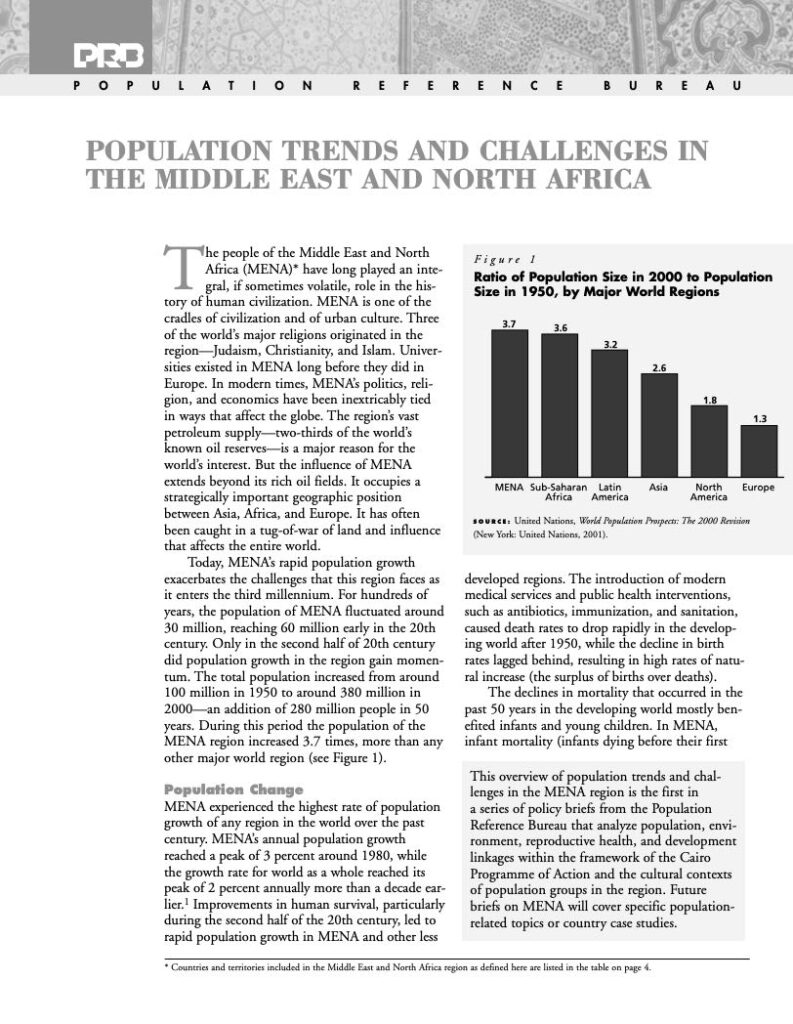
(2001) The people of the Middle East and North Africa (MENA) have long played an integral, if sometimes volatile, role in the history of human civilization.
Population Trends and Challenges in the Middle East and North Africa
(2001) The people of the Middle East and North Africa (MENA) have long played an integral, if sometimes volatile, role in the history of human civilization.