
South Korea's Demographic Dividend
(November 2012) The countries known as the “Asian Tigers” are good examples of the advantages to be gained when changes in fertility can be a springboard for economic growth. (The Asian Tiger countries are Hong Kong, Indonesia, Malaysia, Singapore, South Korea, Taiwan, and Thailand.)
South Korea made a rapid transition from high to low fertility, while at the same time experiencing an annual growth in per capita gross domestic product of 6.7 percent between 1960 and 1990. South Korea’s success was the result of addressing population issues, while also investing in reproductive health programs, education, and economic policies to create infrastructure and manufacturing.
The demographic dividend is the accelerated economic growth that begins with a decline in a country’s mortality and fertility and the subsequent change in the age structure of the population. With fewer births each year, a country’s young dependent population grows smaller in relation to the working-age population. With fewer people to support, a country has a window of opportunity for rapid economic growth if the right social and economic policies are developed and investments are made.
A Quick Fertility Transition
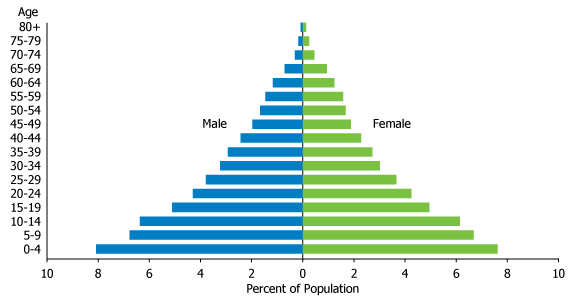
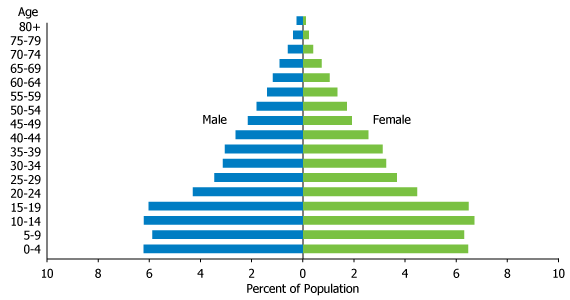
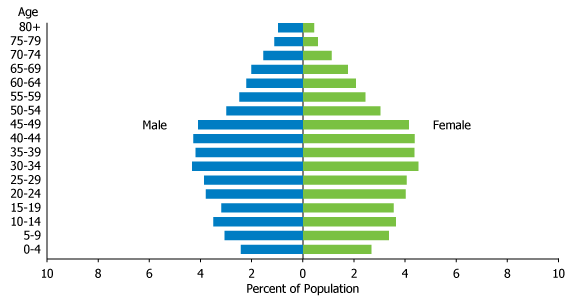
The three population pyramids illustrate how quickly the fertility transition in South Korea took place. Between 1950 and 1975, fertility began to drop from 5.4 children per woman to 2.9, indicating the transition was well underway. However, by 2005, the pyramid indicates that South Korea’s age structure was that of a mature population, with fertility dropping to 1.2 children per woman.
Figure 1
South Korea’s Age and Sex Structure, 1950
 <
<
Source: United Nations Population Division, World Population Prospects: The 2010 Revision (New York: United Nations, 2011).
Figure 2
South Korea’s Age and Sex Structure, 1975
Source: United Nations Population Division, World Population Prospects: The 2010 Revision (New York: United Nations, 2011).
Figure 3
South Korea’s Age and Sex Structure, 2005
Source: United Nations Population Division, World Population Prospects: The 2010 Revision (New York: United Nations, 2011).
Behind this transition was an aggressive population policy, widely implemented throughout the public and private sectors. Although the government invested in health centers to provide a range of services including family planning, use of the centers was relatively low. However, field workers visited homes and provided family planning information and methods—a more effective strategy for reaching women than clinic-based services. The family planning program encouraged acceptance of family planning and invested in training providers, information and education, and contraceptive supplies. The government set a target of 45 percent of married couples using family planning. The creation of mothers’ clubs also contributed to the implementation of the policy in 19,000 villages. A contributing factor to reducing fertility was that people saw that having fewer children improved family life.
Shifting the Education Strategy
To set the course for the demographic dividend, the government also focused on education. Between the 1950s and 1960s, South Korea’s education strategy shifted from one of compulsory primary education, which served only about 54 percent of school-age children, to a “production-oriented” education that would provide people with the knowledge and skills they needed to achieve economic development. The shift in focus and increased commitment to education contributed to 97 percent of school-age children attending school in 1990. Relatively fewer children attending school, more disposable income at the household level, and a sustained investment in education contributed to a better-educated population, which in turn contributed to rapid economic development through a skilled labor force.
Comprehensive Economic Plans
At the same time, South Korea’s economic plans were comprehensive and evolved over many years. Following the Korean War, South Korea’s economy was based on farming and fishing—and neither industry was sufficiently strong. Normalizing relations with Japan led to infusions of investment capital that strengthened the fledgling agricultural and fishing industries, as well as manufacturing and shipping. The South Korean government also addressed unemployment through a rural construction program that provided minimum wages for workers involved in the construction of infrastructure, including dams and roads, as well as erosion control and reforestation. This effort focused on creating a “self-help” attitude that contributed to both the development of a national infrastructure and economic growth. The war in Vietnam reinforced manufacturing opportunities, as well as opportunities for South Korean firms to win infrastructure projects in Vietnam. Over time, South Korea also established chemical, iron, and steel industries that contributed to improvements in balance of trade. South Korea was rapidly increasing the capital (investment) per workers at more than 8 percent per year—a trend that lasted from 1965 to 1991.
Well-Timed Changes Led to Demographic Dividend
South Korea’s rapid demographic transition was a by-product of two well-timed changes. On the one hand, deliberate population policies contributed to slower population growth, which helped create an age structure that facilitated the beginning of South Korea’s demographic dividend. At the same time, rapid socioeconomic change affected savings, investment, and the roles of women. The foresight to develop and implement such policies, plus the right economic and social conditions, enabled South Korea to experience a demographic dividend that has since become the goal of other countries.
James N. Gribble is vice president of International Programs at the Population Reference Bureau.
References
- Andrew Mason, “Population and the Asian Economic Miracle,” Asian-Pacific Population and Policy (October 1997).
- In-Joung Whang, “Integration and Coordination of Population Polices in Korea,” Asian Survey 14, no. 11 (1974): 985-99; Princeton N. Lyman, “Economic Development in South Korea: Prospects and Problems,” Asian Survey 6, no. 7 (1966): 381-88; and T.C. Rhee, “South Korea’s Economic Development and its Social-Political Impact,” Asian Survey 13, no. 7 (1973): 677-90.
- United Nations Population Division, World Population Prospects: The 2010 Revision (New York: United Nations, 2011).
- Whang, “Integration and Coordination of Population Policies in Korea.”
- Whang, “Integration and Coordination of Population Policies in Korea”; and Mason, “Population and the Asian Economic Miracle.”
- Whang, “Integration and Coordination of Population Policies in Korea”; and Rhee, “South Korea’s Economic Development and its Social-Political Impact.”
- Rhee, “South Korea’s Economic Development and Its Social-Political Impact.”
- Mason, “Population and the Asian Economic Miracle.”
Related Posts
Webinar: Bridging Research and Policies: Enhancing Budgeting Processes for Africa's Demographic Dividend
PRB hosted a high-level webinar with budget experts, parliamentarians, and national directors to discuss the importance of the Demographic Dividend Sensitive Budgeting approach in enhancing budgeting processes across Africa.

Family Planning and the Gendered Impacts of Crises on Women: An Effective Tool Across Sectors to Support Women’s Empowerment and Build Resilience to Shocks
Holistic integrated solutions are key to address the interlinkages of the gendered impacts of crises.
Lesson Plans on Human Population and Demographic Studies
Find out the answers to these questions and more. The sections listed below explore eight elements of population dynamics.

Health Sector Reform: How It Affects Reproductive Health
(June 2003) Many less developed countries are reforming their health systems in an effort to achieve public health goals more affordably and effectively.
Report. Health Sector Reform: How It Affects Reproductive Health
This report also in French and Spanish. (June 2003) Many less developed countries are reforming their health systems in an effort to achieve public health goals more affordably and effectively.