
Sustaining Success: PACE Insights on Family Planning Policy and Program Priorities
Over the last two decades, many sub-Saharan African countries have realized remarkable increases in the use of modern contraception. More women and couples are using effective methods to choose when and how many children to have—benefiting their health, their children’s health, and the economic prospects for their families. Examples include Malawi, where the rate of married women using modern contraception more than doubled from 26 percent to 58 percent between 2000 and 2015-16; and Ethiopia, where the rate more than quintupled from 6 percent to 35 percent between 2000 and 2016.1
As the COVID-19 pandemic unfolds, many countries are experiencing both demand and supply disruptions in access to essential services like family planning and reproductive health. Moreover, many leaders will likely face difficult choices balancing their budgets against competing health priorities. Overcoming these challenges to sustain and accelerate progress in expanding access to voluntary family planning will make high impact, cost-effective strategies more important than ever. Fortunately, a large body of research identifying best practices in family planning programs exists, led by the Family Planning High Impact Practices initiative.
High Impact Practices (HIPs) are a set of evidence-based family planning practices vetted by experts against specific criteria and documented in an easy-to-use format. HIPs help programs focus resources for greatest impact. Learn more at www.fphighimpactpractices.org.
Since launching in 2015, the Policy, Advocacy, and Communication Enhanced for Population and Reproductive Health project (PACE) has delivered high-quality, evidence-based resources to help decisionmakers implement best practices. The PACE resources synthesized in this article highlight how building government commitment, reducing inequity, responding to the needs of youth, partnering with community leaders, and ensuring quality of care including contraceptive method choice contribute to increasing use of modern contraception in sub-Saharan Africa.
Modern Contraceptive Use Has Increased Across a Range of Sub-Saharan African Countries, From 2000 to 2018
There was an issue displaying the chart. Please edit the chart in the admin area for more details.- Demographic and Health Surveys.
- The DHS Program, “Kenya.”
- Toshiko Kaneda, Charlotte Greenbaum, and Kelley Kline, 2020 World Population Data Sheet (Washington, DC: Population Reference Bureau, 2020).
- Family Planning 2020, “Ethiopia: Commitment Maker Since 2012,” Aug. 19, 2020.
- Ethiopia Demographic and Health Surveys, 2000 and 2016.
- Senegal Demographic and Health Surveys, 2000 and 2018.
Source: Demographic and Health Surveys, various years.
Targeted Advocacy Strategies Are Effective in Building Government Commitment
PACE policy advocacy activities helped secure budget commitments and contributed to an enabling environment for family planning policies and programs. In Kenya, PACE advocates tailored their strategies to secure commitment from decisionmakers at different levels of the devolved government. At the national level, communication activities made the case for how family planning contributes to the country’s development goals. At the subnational level, evidence-based advocacy and accountability efforts targeting county leaders have increasingly yielded budget lines to support local family planning programs. The resulting strong government commitment has been a driving force in dramatic growth in the share of married women using modern contraceptive methods, rising from 32 percent to 53 percent in just over a decade (2003-2014) after years of stagnation.2 For countries like Kenya, with a high modern contraceptive prevalence rate (mCPR), continued commitment to strengthening the quality and reach of family planning programs is critical to sustaining progress.
Source: “Family Planning and Kenya’s Progress Towards the Sustainable Development Goals,” National Council for Population and Development and Population Reference Bureau, Video, 2017.
See Also:
- The Role of Political Will and Commitment in Improving Access to Family Planning in Africa
- Galvanizing Commitment: Creating a Supportive Environment for Family Planning Programs
- Demographic and Health Surveys.
- The DHS Program, “Kenya.”
- Toshiko Kaneda, Charlotte Greenbaum, and Kelley Kline, 2020 World Population Data Sheet (Washington, DC: Population Reference Bureau, 2020).
- Family Planning 2020, “Ethiopia: Commitment Maker Since 2012,” Aug. 19, 2020.
- Ethiopia Demographic and Health Surveys, 2000 and 2016.
- Senegal Demographic and Health Surveys, 2000 and 2018.
Reducing Family Planning Inequities Requires a Systematic Approach
Ensuring equitable access to modern contraception, especially for the poorest communities, is one of the most entrenched challenges in providing all women with the ability to plan and space their pregnancies. A systematic approach to addressing inequity can minimize this barrier. Data from Malawi illustrates this; the country stands out in sub-Saharan Africa for having one of the narrowest gaps in the mCPR between the richest and poorest groups of women in 2015-16. Over the previous decade, the Government of Malawi invested in task shifting—allowing lower-level health providers to administer modern contraceptive methods—as well as used program and survey data to systematically identify and address barriers that the poorest women might face in accessing family planning care. Rapid increases in mCPR for all women in Malawi during this period were achieved in part by Malawi’s efforts to close the gap between the wealthiest group of women and the poorest group of women, which fell by half between 2000-2015/16. PACE analysts argued that the increases in mCPR for all women show that the family planning program was effective in reaching poor and rural women with voluntary family planning and increasing their use of modern contraceptive methods.
Modern Contraceptive Prevalence Rate and Demand Satisfied for Modern Methods, Malawi
| Survey | Total % mCPR | Richest % mCPR | Poorest % mCPR | Total % Demand Satisfied | Richest % Demand Satisfied | Poorest % Demand Satisfied |
| 1992 | 7 | 17 | 4 | 15 | 28 | 8 |
| 2000 | 26 | 26 | 20 | 43 | 57 | 34 |
| 2004 | 28 | 28 | 22 | 45 | 57 | 37 |
| 2010 | 42 | 48 | 35 | 58 | 65 | 51 |
| 2015-16 | 58 | 61 | 53 | 75 | 77 | 71 |
Source: Kaitlyn Patierno, Imelda Feranil, and Meghan Reidy, “Enhancing Family Planning Equity for Inclusive Economic Growth and Development” (Washington, DC: Population Reference Bureau, 2018).
See Also:
- Fostering Economic Growth, Equity, and Resilience in Sub-Saharan Africa: The Role of Family Planning
- Under-Served and Over-Looked: Prioritizing Contraceptive Equity for the Poorest and Most Marginalized Women and Girls
- Discussion Paper on Equity for the HIP Partnership
- Demographic and Health Surveys.
- The DHS Program, “Kenya.”
- Toshiko Kaneda, Charlotte Greenbaum, and Kelley Kline, 2020 World Population Data Sheet (Washington, DC: Population Reference Bureau, 2020).
- Family Planning 2020, “Ethiopia: Commitment Maker Since 2012,” Aug. 19, 2020.
- Ethiopia Demographic and Health Surveys, 2000 and 2016.
- Senegal Demographic and Health Surveys, 2000 and 2018.
Responding to the Needs of Youth Is Essential For Reproductive Health Programs
Across sub-Saharan African, 43 percent of the population is under age 15.3 Family planning programs must respond to the unique needs of this large cohort of youth in order to be effective in enabling all women and couples to delay, plan, and space their pregnancies. Understanding youth fertility intentions—such as their desire for when and how many children to have—can help to better meet the contraceptive needs of this large cohort. Compared to older women, youth often use contraceptive methods for shorter periods and discontinue use for reasons other than wanting to become pregnant. Youth often cite side effects, as well as stigma from community members and health providers as reasons for discontinuing contraceptive use, even if they wish to avoid a pregnancy. In many places, youth face additional barriers in accessing long-acting reversible contraceptives (LARCs), which are some of the most effective modern methods of contraception.
The Government of Ethiopia recognized this gap and made a number of policy commitments to address the family planning and reproductive health needs of youth, including pilot programs to increase uptake of LARCs among this population.4 Although unmet need for family planning among young married women who wish to delay or space their next pregnancy remains high, Ethiopia has made dramatic progress. The use of modern contraception among married youth ages 15 to 19 increased from 3 percent to 32 percent between 2000 and 2016.5 Expanding contraceptive choice for youth through policy actions—specifically to ensure LARCs are available and accessible—can better meet their contraceptive needs and prolong their use of modern methods.
Family Planning Users Ages 15 to 19 Are More Likely to Discontinue for Reasons Other Than the Desire to Get Pregnant
There was an issue displaying the chart. Please edit the chart in the admin area for more details.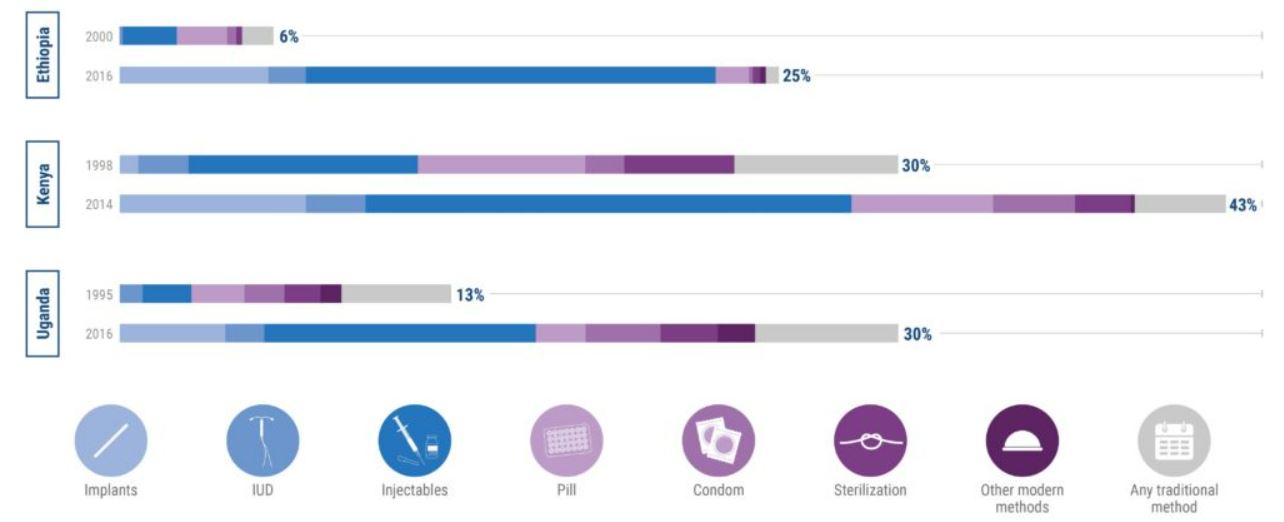
- Demographic and Health Surveys.
- The DHS Program, “Kenya.”
- Toshiko Kaneda, Charlotte Greenbaum, and Kelley Kline, 2020 World Population Data Sheet (Washington, DC: Population Reference Bureau, 2020).
- Family Planning 2020, “Ethiopia: Commitment Maker Since 2012,” Aug. 19, 2020.
- Ethiopia Demographic and Health Surveys, 2000 and 2016.
- Senegal Demographic and Health Surveys, 2000 and 2018.
Source: Ann Blanc et al., “Patterns and Trends in Adolescents’ Contraceptive Use and Discontinuation in Developing Countries and Comparisons With Adult Women,” International Perspectives on Sexual and Reproductive Health 35, no. 2 (2009): 63-71.
See Also:
- Youth Family Planning Policy Scorecard
- Adding it Up: Investing in Adolescents’ Sexual and Reproductive Health in Low- and Middle-Income Countries
- Adolescent-Friendly Contraceptive Services: Mainstreaming Adolescent-Friendly Elements into Existing Contraceptive Services
Partnering With Community Leaders Can Counter Misconceptions
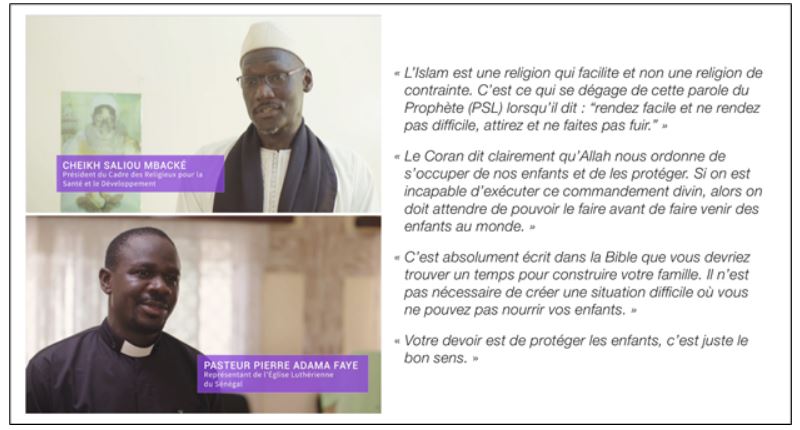
Community leaders, including religious leaders, often play a pivotal role in shaping the decisions women and couples make for their families. PACE recognizes partnering with religious leaders can help family planning programs respond to misconceptions that religion may prohibit the use of modern contraception. In fact, many religious leaders agree that family planning can boost health and well-being among their communities. In Senegal, an interfaith group of religious leaders has spoken out about how family planning supports religious doctrine for family health. Religious and local leaders’ commitment is one factor in building community support for contraceptive use in Senegal, where married women’s use of modern contraception has increased from 10 percent to 25 percent between 2005 and 2018.6 As trusted advisors, community and faith leaders can have significant positive impact on contraceptive uptake and continuation to meet women’s and couples’ preferences.
- Demographic and Health Surveys.
- The DHS Program, “Kenya.”
- Toshiko Kaneda, Charlotte Greenbaum, and Kelley Kline, 2020 World Population Data Sheet (Washington, DC: Population Reference Bureau, 2020).
- Family Planning 2020, “Ethiopia: Commitment Maker Since 2012,” Aug. 19, 2020.
- Ethiopia Demographic and Health Surveys, 2000 and 2016.
- Senegal Demographic and Health Surveys, 2000 and 2018.
Source: Population Reference Bureau, Senegal ENGAGE: Religion and Family Health, ENGAGE Multimedia Presentation, 2019.
See Also:
- Engaging Faith Leaders in Family Planning
- Religion, Women’s Health, and Rights: Points of Contention and Paths of Opportunities
- Community Group Engagement: Changing Norms to Improve Sexual and Reproductive Health
Ensuring Method Choice Can Increase and Prolong Contraceptive Use
Prioritizing quality of care in programs is essential to respond to the family planning needs of women and couples and sustain increases in the use of modern contraceptive methods across sub-Saharan Africa. All of the strategies described here are facets of high-quality family planning programs. In addition, quality of care in service delivery includes ensuring that clients have access to a full range of contraceptive choices.
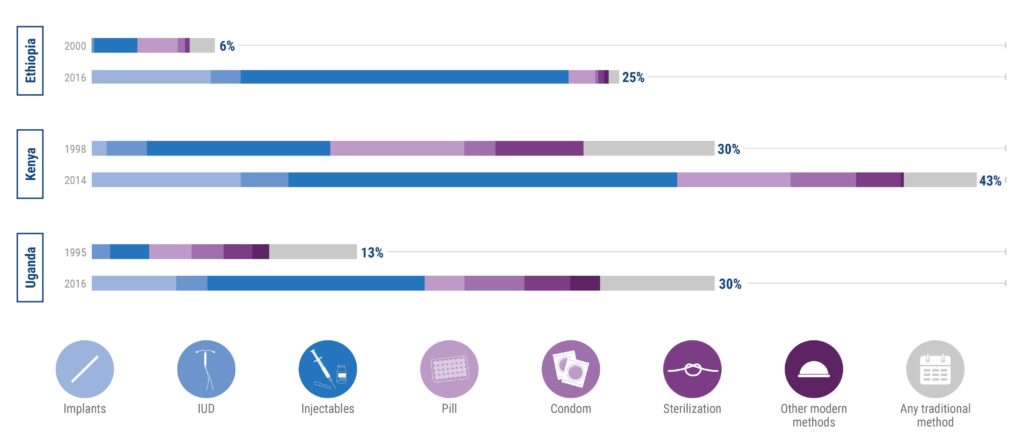
Yet in many countries, the majority of contraceptive users rely on only one or two modern methods, which may indicate that users lack access to a full range of choices. In Uganda, PACE analysis of contraceptive switching behavior and reasons for discontinuing contraceptive use showed that “concern about health or side effects” was the primary reason for discontinuing a modern method. With the majority of the population relying on implants and injectables, women who preferred a different method may not have had access to another option. Expanding the number of modern contraceptive methods available to users requires policy changes to remove legal barriers to method choice, improve the quality of contraceptive counseling, and allocate domestic resources for contraceptive supplies. These investments can support greater use of modern contraception and for longer periods of time.
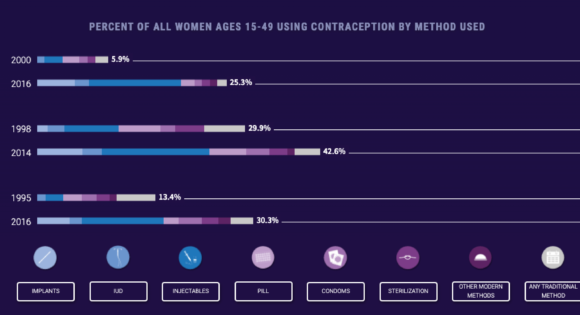
Percent of All Women Ages 15-49 Using Contraception by Method Used
Source: Toshiko Kaneda and Charlotte Greenbaum, 2019 Family Planning Data Sheet (Washington, DC: Population Reference Bureau, 2019).
See Also:
- Expanding Contraceptive Choice: A Family Planning Evidence Brief
- How Balanced Is the Method Mix in Low- and Middle-Income Countries?
- Mobile Outreach Services: Expanding Access to a Full Range of Contraceptive Choices
Sustaining Success in Family Planning Programs
By building government commitment, intentionally tackling inequity, identifying and responding to the needs of youth, partnering with community leaders, and ensuring method choice within high-quality service delivery, family planning programs can increase and prolong gains in the use of modern contraception. Prioritizing these strategies when making difficult choices about family planning program investments will benefit the health and well-being of families across the continent. PACE resources and country partners can offer evidence-based guidance as advocates and decisionmakers work to sustain success in increasing the use of modern contraception across sub-Saharan Africa.
This web article was written by Marissa Pine Yeakey, PRB consultant, with contributions from PRB colleagues Eve Brecker, Barbara Seligman, Kaitlyn Patierno, Toshiko Kaneda, Elizabeth Leahy Madsen, Heidi Worley, and Anneka Van Scoyoc.
- Demographic and Health Surveys.
- The DHS Program, “Kenya.”
- Toshiko Kaneda, Charlotte Greenbaum, and Kelley Kline, 2020 World Population Data Sheet (Washington, DC: Population Reference Bureau, 2020).
- Family Planning 2020, “Ethiopia: Commitment Maker Since 2012,” Aug. 19, 2020.
- Ethiopia Demographic and Health Surveys, 2000 and 2016.
- Senegal Demographic and Health Surveys, 2000 and 2018.
Related Posts
Family Planning and the Gendered Impacts of Crises on Women: An Effective Tool Across Sectors to Support Women’s Empowerment and Build Resilience to Shocks
Holistic integrated solutions are key to address the interlinkages of the gendered impacts of crises.
Research Identifies New Strategies to Reduce Undercount of Young Children in U.S. 2020 Census
PRB identifies factors predicting where children under age 5 are more likely to be missed in the 2020 Census and develops a new undercount risk measure for young children.

Health Sector Reform: How It Affects Reproductive Health
(June 2003) Many less developed countries are reforming their health systems in an effort to achieve public health goals more affordably and effectively.
Report. Health Sector Reform: How It Affects Reproductive Health
This report also in French and Spanish. (June 2003) Many less developed countries are reforming their health systems in an effort to achieve public health goals more affordably and effectively.