
Texas Abortion Ban Linked to Rise in Severe Complications From Pregnancy Loss

When Texas enacted a total abortion ban in 2022, it changed the legal landscape for pregnancy care. Because the medications and procedures used to treat miscarriage are also used in abortion care, the policy may have influenced how clinicians manage pregnancy complications.
Recent research suggests Texas’s policy shift was associated with more severe outcomes for pregnant people. The U.S. Supreme Court’s Dobbs v. Jackson Women’s Health Organization decision in June 2022 overturned Roe v. Wade, allowing the state’s total abortion ban to take effect in August 2022. From July 2022 to September 2023, blood transfusions during pregnancy loss—an indicator of life-threatening hemorrhage—increased 15% above expected levels.
Amanda Nagle at the University of Texas at Austin and colleagues analyzed statewide records from Texas hospitals, emergency departments, and ambulatory surgical facilities from January 2017 through September 2023.
“This is one of the first peer-reviewed studies to quantitatively measure changes in pregnancy loss health after Dobbs v Jackson Women’s Health Organization,” Nagle said.
Pregnancy loss is common—and can become dangerous quickly
Pregnancy loss—including miscarriage, ectopic pregnancy, molar pregnancy, and stillbirth—affects about 1 in 5 recognized pregnancies in the United States. In Texas alone, an estimated 100,000 miscarriages occur each year.
Many cases resolve without serious complications. But some can deteriorate rapidly. Heavy bleeding, infection, or a ruptured ectopic pregnancy can become life-threatening, making timely treatment essential.
Blood transfusions increased after total ban
The researchers identified 320,696 pregnancy loss-related visits in Texas facilities during the study period. Of these, 7,408 visits (2.3%) involved a blood transfusion. Most patients were ages 20 to 35, and Medicaid was the most common payer.
The study examined trends across three periods:
- Pre-ban period (January 2017 through September 2021, excluding COVID-19 period)
- Six-week abortion ban period (October 2021 through June 2022)
- Total abortion ban period (July 2022 through September 2023)
Transfusion levels did not change significantly during the six-week ban. During the total ban period, however, the trend shifted. Based on pre-ban trends, the researchers expected to see 335 transfusions on average per quarter. The actual figure, 386, translates to about 51 additional transfusions per quarter and a 15% increase over expectations.
Legal and clinical differences may help explain this shift
The study cannot determine why transfusions increased, but researchers note important differences between Texas’s two abortion bans.
The earlier six-week ban, implemented in September 2021, was enforced through private civil lawsuits with penalties of at least $10,000. The total ban, enacted after Dobbs, prohibits abortion at any gestational age except when the pregnant person’s life is at risk. Physicians who violate the law face felony charges, fines of up to $100,000, and potential life imprisonment.
The stricter penalties may lead providers to act more cautiously in complex cases, the researchers warn. The total ban may also require more documentation before treatment can proceed. Texas clinicians must confirm gestational age and document the absence of fetal cardiac activity to establish that a pregnancy is not viable. In urgent situations, meeting these documentation requirements could delay care.
Implications reach beyond Texas
The findings add to a growing body of evidence that abortion bans may affect not only abortion access but also the care patients receive when a pregnancy ends unexpectedly. Recent studies suggest these changes may contribute to higher rates of complications such as sepsis, as well as increases in infant and pregnancy-associated deaths.
Even modest increases in severe complications can affect many families and strain health systems. As other states enforce abortion bans with limited exceptions, more research is needed to understand how abortion policy may shape pregnancy loss care and maternal health outcomes nationwide.
References
Amanda Nagle, Goleen Samari, Lauren Thaxton, and Alison Gemmill, “Blood Transfusions for Pregnancy Loss in Texas Before and After Abortion Bans, 2017–2023,” American Journal of Public Health 115, no. 11 (November 2025): 1887–94.
Related Posts
Family Planning and the Gendered Impacts of Crises on Women: An Effective Tool Across Sectors to Support Women’s Empowerment and Build Resilience to Shocks
Holistic integrated solutions are key to address the interlinkages of the gendered impacts of crises.

Health Sector Reform: How It Affects Reproductive Health
(June 2003) Many less developed countries are reforming their health systems in an effort to achieve public health goals more affordably and effectively.
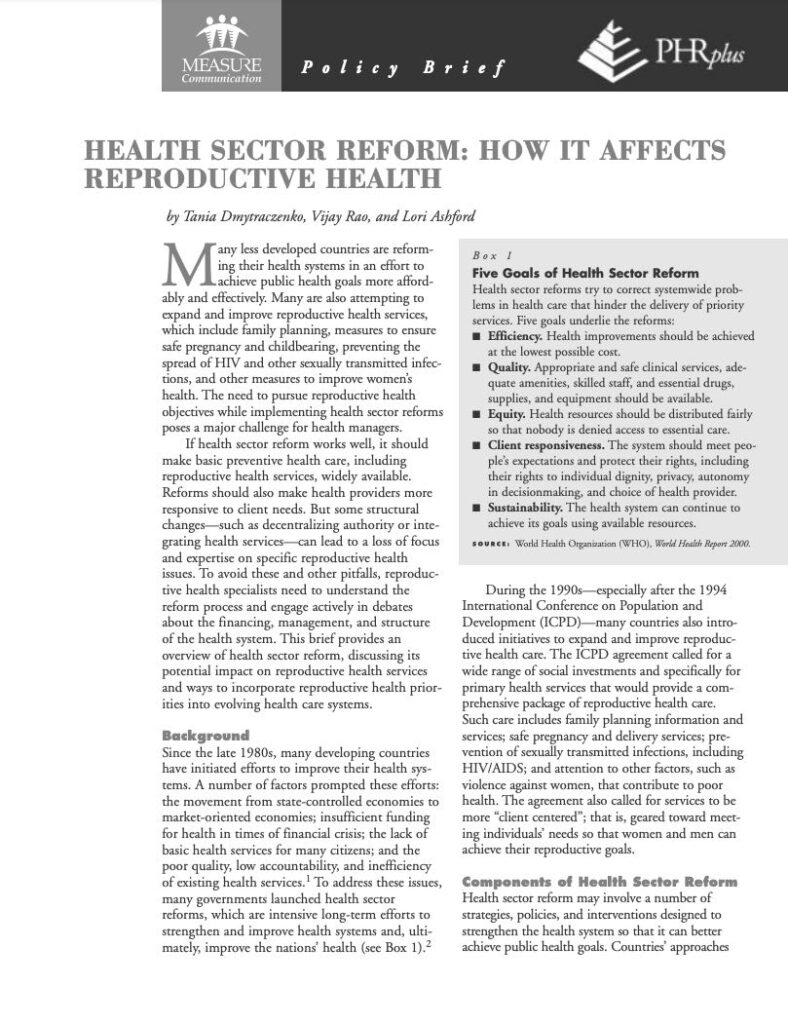
Report. Health Sector Reform: How It Affects Reproductive Health
This report also in French and Spanish. (June 2003) Many less developed countries are reforming their health systems in an effort to achieve public health goals more affordably and effectively.
Report. Reproductive Health in Policy & Practice: Case Studies From Brazil, India, Morocco, and Uganda
To assess how the Programme of Action, agreed upon at the 1994 International Conference on Population and Development (ICPD), is being implemented, senior researchers in Brazil, India, Morocco, and Uganda conducted country case studies.
Reproductive Health in Policy & Practice: Case Studies From Brazil, India, Morocco, and Uganda
To assess how the Programme of Action, agreed upon at the 1994 International Conference on Population and Development (ICPD), is being implemented, senior researchers in Brazil, India, Morocco, and Uganda conducted country case studies.