
The Effect of Girls' Education on Health Outcomes: Fact Sheet
Many studies have shown the benefits that education has for girls and women. The studies link education with reduced child and maternal deaths, improved child health, and lower fertility. Women with at least some formal education are more likely than uneducated women to use contraception, marry later, have fewer children, and be better informed on the nutritional and other needs of children.
Key Facts
Fertility: Girls’ education helps women control how many children they have. Increasing girls’ participation in school over time decreases fertility rates.
- In Mali, women with secondary education or higher have an average of 3 children while those with no education have an average of 7 children.1
- A 35-year study in Guatemala found a link between the years girls spent in school and the timing of childbearing. For each additional year a young woman spent in school, the age at which she had her first child was delayed approximately six to 10 months.2
Maternal Health: Increasing girls’ access to education improves maternal health.
- In Burkina Faso, mothers with secondary education are twice as likely to give birth more safely in health facilities as those with no education.3
- It has been estimated that an additional year of schooling for 1,000 women helps prevent two maternal deaths.4
Child Survival: Increasing girls’ education has positive effects on infant and child health.
- A child born to a mother who can read is 50 percent more likely to survive past the age of 5 than a child born to an illiterate woman.5
- In Indonesia, child vaccination rates are 19 percent when mothers have no education. This figure increases to 68 percent when mothers have at least secondary school education.6
- In Bangladesh and Indonesia, the odds of having a child who is shorter than average for its age decreases by around 5 percent for every additional year of formal education a mother has.7
HIV/AIDS: Education decreases a girl’s or woman’s risk for contracting HIV or transmitting HIV to her baby.
- Women in 32 countries who remained in school after primary school were five times more likely to know basic facts about HIV than illiterate women.8
- According to the 2010 Education for All Global Monitoring Report, in Malawi, only 27 percent of women without any education know that HIV transmission risks can be reduced by taking drugs during pregnancy, but that figure rises to 59 percent for women with secondary education.9
- A study in Zambia finds that HIV spreads twice as fast among uneducated girls.10
- A study in Uganda demonstrated that each additional year of education for girls reduces their chances of contracting HIV by 6.7 percent.11
Income Potential: Education boosts women’s earning power.
- A single year of primary school has been shown to increase women’s wages later in life by 10 percent to 20 percent, while the returns to female secondary education are between 15 percent and 25 percent.12
References
- UNESCO, Education Counts: Towards the Millennium Development Goals (Paris: UNESCO, 2010), accessed at http://unesdoc.unesco.org/images/0019/001902/190214e.pdf, on July 20, 2011.
- Jere Behrman et al., “What Determines Post-School Skills? Impact of Pre-School, School Years and Post-School Experiences in Guatemala,” cited in World Development Report 2007: Development and the Next Generation (Washington, DC: World Bank, 2006): 147.
- UNESCO, EFA Global Monitoring Report: Reaching the Marginalized (Paris: UNESCO, 2010), accessed at http://unesdoc.unesco.org/ images/0018/001866/186606E.pdf, on July 15, 2011.
- Lawrence H. Summers, “Educating All the Children,” Policy Research Working Papers Series (Washington, DC: World Bank, 1992).
- UNESCO, Education Counts.
- UNESCO, Education Counts.
- Richard D. Semba et al., “Effect of Parental Formal Education on Risk of Child Stunting in Indonesia and Bangladesh: A Cross-Sectional Study,” The Lancet 371, no. 9609 (2008): 322-28.
- Jan Vandemoortele and Enrique Delamonica, “Education Vaccine Against HIV/AIDS,” Current Issues in Comparative Education 3, no. 1 (2000).
- UNESCO, Education Counts.
- Vandemoortele and Delamonica, “Education Vaccine Against HIV/AIDS.”
- Damien De Walque, How Does the Impact of an HIV/AIDS Information Campaign Vary With Educational Attainment? Evidence From Rural Uganda (Washington, DC: The World Bank, 2004).
- George Psacharopoulos and Harry Anthony Patrinos, “Returns to Investment in Education: A Further Update,” Education Economics 12, no. 2 (2004): 111-34.
Related Posts
Family Planning and the Gendered Impacts of Crises on Women: An Effective Tool Across Sectors to Support Women’s Empowerment and Build Resilience to Shocks
Holistic integrated solutions are key to address the interlinkages of the gendered impacts of crises.
Research Identifies New Strategies to Reduce Undercount of Young Children in U.S. 2020 Census
PRB identifies factors predicting where children under age 5 are more likely to be missed in the 2020 Census and develops a new undercount risk measure for young children.
Health Sector Reform: How It Affects Reproductive Health
(June 2003) Many less developed countries are reforming their health systems in an effort to achieve public health goals more affordably and effectively.
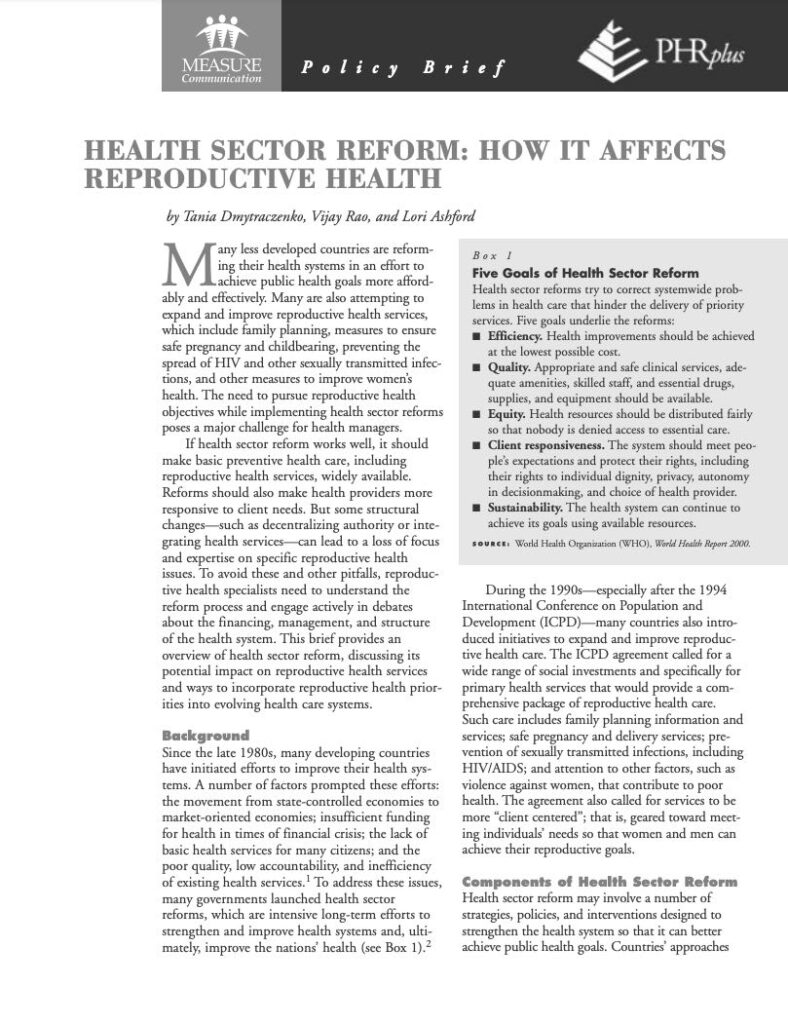
Report. Health Sector Reform: How It Affects Reproductive Health
This report also in French and Spanish. (June 2003) Many less developed countries are reforming their health systems in an effort to achieve public health goals more affordably and effectively.