
Toolkit: Supply Chain: Getting Contraceptives to Users
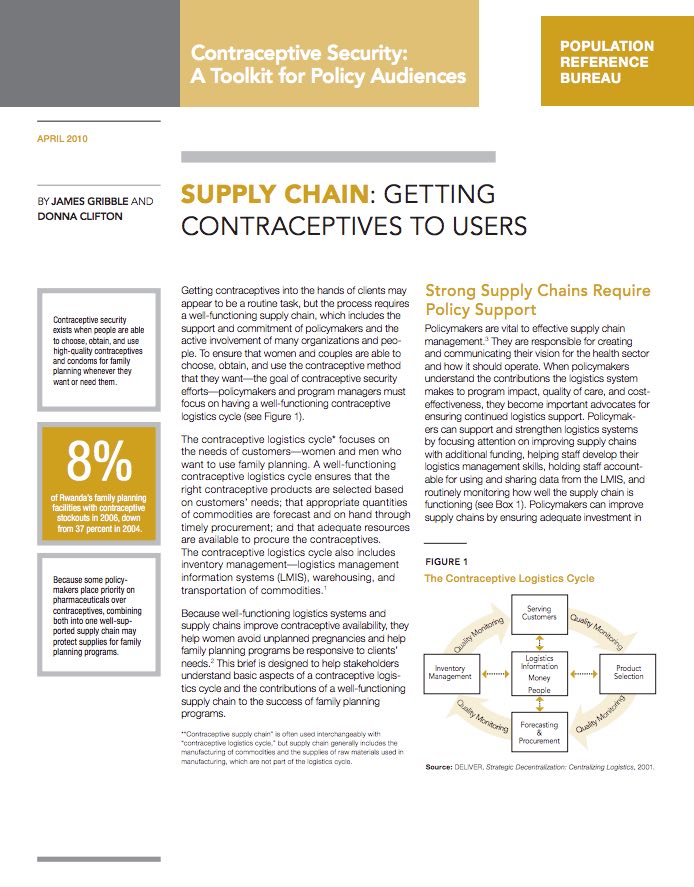
(May 2010) Getting contraceptives into the hands of clients may appear to be a routine task, but the process requires a well-functioning supply chain, which includes the support and commitment of policymakers and the active involvement of many organizations and people. To ensure that women and couples are able to choose, obtain, and use the contraceptive method that they want—the goal of contraceptive security efforts—policymakers and program managers must focus on having a well-functioning contraceptive logistics cycle.
Supply Chain: Getting Contraceptives to Users aims to help stakeholders understand basic aspects of a contraceptive logistics cycle and the contributions of a well-functioning supply chain to the success of family planning programs. It is one of seven PRB policy briefs that make up Contraceptive Security: A Toolkit for Policy Audiences, a series designed to explain different aspects of contraceptive security to policymakers, program managers, media, and civil society.
The other briefs in the toolkit are:
- Contraceptive Security For Policy Audiences: An Overview (PDF: 558KB)
- Planning for Contraceptive Security: Start With SPARHCS (PDF: 699KB)
- Financing Contraceptives: A New Funding Environment (PDF: 694KB)
- Procuring Contraceptives: Options for Countries (PDF: 647KB)
- Policy Environment: Understanding the Context for Contraceptive Security (PDF: 653KB)
- Priority Actions and Recommendations for Contraceptive Security (PDF: 374KB)
James Gribble is vice president for International Programs at the Population Reference Bureau. Donna Clifton is senior program associate at PRB.
Related Posts
Beyond the Headlines: As China and India Age, Young Africa Has Potential to Power Global Workforce
In this webinar, we examine data on the growth of sub-Saharan Africa’s working-age population and discuss its potential to power the global workforce.

Lesson Plans on Human Population and Demographic Studies
Find out the answers to these questions and more. The sections listed below explore eight elements of population dynamics.

Report. Population Trends and Challenges in the Middle East and North Africa
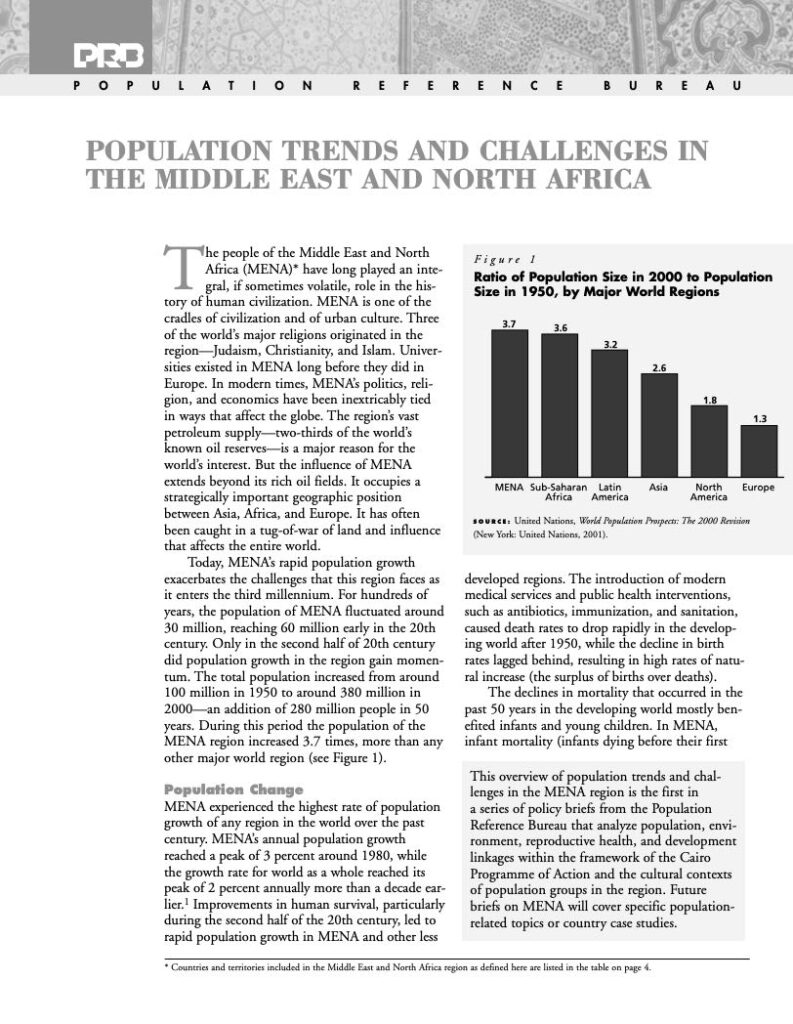
(2001) The people of the Middle East and North Africa (MENA) have long played an integral, if sometimes volatile, role in the history of human civilization.
Population Trends and Challenges in the Middle East and North Africa
(2001) The people of the Middle East and North Africa (MENA) have long played an integral, if sometimes volatile, role in the history of human civilization.