Women Prevail Against Violence
(January 2008) Mama Joyce and Josephine are unlikely heroines. Mama Joyce, who lives in Mwanza, Tanzania, gave birth to 10 children with her husband, who brought home a second wife and the HIV virus. Josephine lives in Kampala, Uganda, and was pulled out of school, married off at 18, and stuck in a violent marriage when her family could not repay the “bride price.” Both women were brought low by abusive husbands who beat them, took away their dignity and choices, and left them with AIDS.
But both women have emerged as heroines, as captured in “SASA! A Film About Women, Violence and HIV/AIDS,” produced by the Uganda-based NGO Raising Voices (www.raisingvoices.org) and The People’s Picture Company (www.theppcinc.com). This powerful film tells the story of how these courageous women triumphed over gender-based violence and HIV/AIDS and gained power that helped them organize, become activists in their communities, and build meaningful and rewarding lives.
The film’s director and co-producer, Chanda Chevannes, recently presented the film at an Interagency Gender Working Group meeting in Washington, D.C. The film has already garnered awards at human rights festivals around the world.
Violence Against Women Is Often the Norm
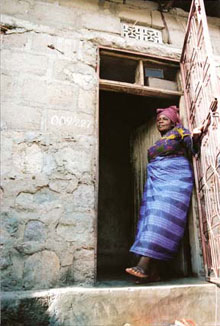
When conducting in-country interviews, Chevannes recalls that she was “surprised by the fact that violence against women, and especially domestic violence, is often seen as ‘normal’ in the region.”
When she asked women who had been infected with HIV by their partners to describe their relationships, they usually mentioned some form of violence. “Time and time again, almost every woman who came forward had a story of violence—physical, emotional, economic, or sexual—and many times all four,” says Chevannes.
“This initial experience really drove the realization home for me that, for many women in sub-Saharan Africa, violence is part of an intimate relationship. It is often not even seen as ‘violence’. ”
Violence and HIV/AIDS are well-documented realities in this part of the world, especially for women. More than two-thirds of all HIV-positive people live in sub-Saharan Africa and more than three-quarters of all AIDS deaths occurred there in 2007. And women and girls are unfortunately well-represented in this hellish fraternity—they make up almost 60 percent of adults living with HIV in this region.1
How HIV and Gender-Based Violence Are Connected
The link between HIV and gender-based violence has already been shown. Studies from Rwanda, Tanzania, and South Africa indicate that the risk for HIV among women who have experienced violence may be up to three times higher than among those who have not.2 Violence not only increases the vulnerability of women and girls, making them afraid to ask partners to use a condom or to stop extramarital relationships, it can also prevent them from getting counseling and treatment.
And there is much evidence of violence against women in Uganda and Tanzania. According to a groundbreaking WHO Multi-Country Study published in 2005, an average of one in two women in Tanzania has ever experienced physical or sexual violence at the hands of a partner (41 percent of women in Dar es Salaam and 56 percent in the Mbeya district in the south).3
In Uganda, according to the 2006 Demographic and Health Survey, six in 10 women said they had ever experienced physical violence. More than half of these women had experienced physical violence in the past 12 months. And physical violence is higher among women in Uganda’s rural areas than among women in urban areas (61 percent compared with 54 percent).4
Working to Change a Social Norm
This “normalization of violence” is one of the things Raising Voices hopes to change with this film (see box). The name of the film, Sasa, is Kiswahili for “now.” But it also is an acronym described in the screening guide that accompanies the film to promote cultural change:
- Start thinking about violence against women and HIV/AIDS as interconnected issues and foster power within yourself to address these issues.
- Awareness. Raise awareness about how communities accept men’s use of power over women, fueling the duel pandemics of violence against women and HIV/AIDS.
- Support the women, men, and activists directly affected by or involved in these interconnected issues, by joining your power with others’.
- Action. Take action. Use your power to prevent violence against women and HIV/AIDS.
How SASA Is Being Used to Promote Cultural Change
- In grassroots communities in small video halls.
- At screenings and discussions during large public events.
- In trainings with communities and service providers.
- In clinic/hospital waiting rooms.
- In religious communities.
- In support groups for positive living.
- In presentations to donors and policymakers.
- In awareness-raising for staff of HIV/AIDS organizations who have not traditionally focused on violence against women.
- In decisionmaking bodies. Dora Byamkama, a member of the East African Legislative Assembly who is featured in the film, is planning to show it in the legislature to push for a new HIV/AIDS bill.
- At film festivals and during campaigns. It was recently shown in Rwanda during the “16 Days of Activism Against Gender Violence.”
Lori Michau, co-producer of the film and co-director of Raising Voices, says that she hopes the film will help people see and understand the link between violence against women and HIV/AIDS. “This is still a very new idea to many people and we created the film to raise awareness about the connection.” For women living with violence, the film demonstrates that even HIV-positive women who have experienced violence can still do much to raise awareness, help others, and take action to prevent violence in other women’s lives.
Community support, in particular, offers hope that violence as a social norm can be changed. The film features many people who are working to change the role of women, the acceptance of violence, and the spread of AIDS. They include a female AIDS activist and a male teacher from Tanzania as well as a female member of Parliament and a religious leader from Uganda. All of them are working to change the social dynamic that accepts violence against women as “normal” and that leads the way to increased HIV infection levels.
Community support transformed Mama Joyce and Josephine’s stories from tragedy to triumph. After losing her husband and his second wife to AIDS, Mama Joyce was initially afraid to go for HIV testing. After attending a seminar given by a local NGO, Kivulini Women’s Rights Organization, she decided to become a community educator and to learn her HIV status. Joyce now visits neighbors with AIDS and leads group discussions. She is raising her children in a nonviolent household, teaching them that violence does not solve problems. She says, “My life is good now. This work of mine makes me very happy. Now I know that I am valued in my community.”
New Beginnings
Josephine, who spent months bedridden with an AIDS-related illness, has now remarried. Her new husband, Charles, speaks with regret in the film about how he was violent with his previous wife when he discovered that they were HIV positive. When Chevannes visited Josephine and Charles’ home, she was impressed that they are now living in an equitable, nonviolent relationship. “They discuss important issues like finances and sex, cook together,” she says, “and are active in community education work and in AIDS support services.”
Josephine now works as an “aromatherapy assistant” and gives massages to other HIV-positive members of the community when no one else—not even family members—will touch them. In fact, in one of the most poignant scenes, Josephine massages an HIV-positive woman who has skin lesions all over her back. “The way you touch that person, it strengthens her heart and gives her hope,” she says.
“I am strong in my heart,” Josephine says. “I feel I have power.”
Charlotte Feldman-Jacobs is a senior policy analyst at the Population Reference Bureau and co-chair of the Interagency Gender Working Group’s Gender-Based Violence Task Force.
Suggested Resources
- For more information about the film and the training guide, or to order a copy, go to:
www.raisingvoices.org/women/Sasa_film.php - “Using Community Theater and Peer Education to Discuss HIV Risk Behaviors and Gender-Based Violence in Dar es Salaam, Tanzania,” at www.igwg.org/articles/usingcommunity.htm
- “Long-Held Assumptions Pose Obstacles in the Fight Against Domestic Violence,” at
www.igwg.org/articles/longheldassumptns.htm
References
- UNAIDS, 2007 AIDS Epidemic Update, accessed online at www.unaids.org, on Dec. 18, 2007.
- UNAIDS, Global Coalition on Women and AIDS, Stop Violence Against Women, Fight AIDS, Issue 2 (2005). Citing amfAR, “Gender-Based Violence and HIV Among Women: Assessing the Evidence,” Issue Brief no. 3 (June 2005).
- World Health Organization (WHO), WHO Multi-Country Study on Women’s Health and Domestic Violence Against Women: Country Fact Sheets, accessed online at www.who.int, on Dec. 18, 2007.
- Macro International Inc., Uganda, Demographic and Health Survey, 2006 (Calverton, MD: Macro International Inc., 2007).
Related Posts
Research Identifies New Strategies to Reduce Undercount of Young Children in U.S. 2020 Census
PRB identifies factors predicting where children under age 5 are more likely to be missed in the 2020 Census and develops a new undercount risk measure for young children.

Children's Environmental Health: Risks and Remedies
(2002) Overall child mortality declined significantly in the 1990s, but environmental hazards still kill at least 3 million children under age 5 every year.