
Youth Revolt in Egypt, a Country at the Turning Point
(February 2011) Egyptians know some dates by heart: July 26, 1952, marks the overthrow of Egypt’s last monarch; Oct. 6, 1973, is the date of the country’s attack to reclaim the Sinai Peninsula. Now another date can be added to that list: Jan. 25, 2011, the first day of antigovernment protests that led to President Hosni Mubarak’s resignation 18 days later. Mubarak ruled Egypt for nearly 30 years, during which the country’s population grew by 90 percent—from 45 million to 85 million according to UN estimates, despite concerted government campaigns to slow population growth. The demographic strength of Egypt is undeniable, not just in absolute numbers but in its age distribution. Egypt is experiencing a “youth bulge”: One in five Egyptians is between ages 15 and 24, and one-half of the population is below age 25 (see figure), a powerful engine of renewal for the country.
Egypt’s Population Pyramid, 2010
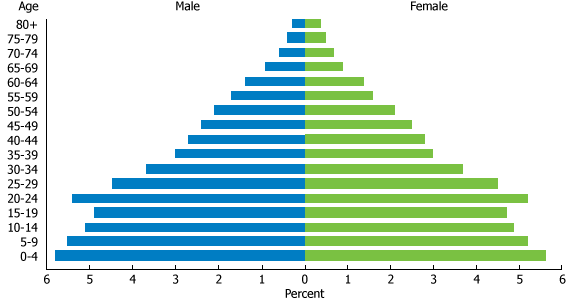
Source: UN Population Divison, http://esa.un.org/unpp/.
Youth as the Drivers of Change
Egyptians of all ages and walks of life participated in the protests, unified in aspirations and demands including political freedom, better wages, and better working conditions. But it was the astonishing numbers of young people participating in demonstrations that gave the uprising its momentum, and were key to sustaining it, as hundreds of thousands gathered in Tahrir (Liberation) Square in Cairo and other cities across the country. Egypt’s youth are the faces behind this leaderless revolution; the revolt, in large part, was spurred by their finesse in using social media to organize and make their voices heard.
Young people arguably have the most at stake in the outcome of this revolution. The results have immediate impact and future implications in how they construct their lives. Recent studies show the frustrations young Egyptians feel at the stagnancy of their lives. They are a generation waiting for better access to quality education, secure employment, and the financial stability necessary to get married and start their own families.
High Unemployment and Lack of Appropriate Education Frustrate Youth
At least 90 percent of the unemployed in Egypt are youth; the situation is particularly tough for young women looking for a job. In the Population Council’s 2009 survey conducted among youth in Egypt, 30 percent of males ages 15 to 29 said they were looking to migrate, mostly to an oil-rich Gulf state and largely because they did not expect to find work at home; 70 percent of unemployed youth said that they were jobless because there was simply no work available.1 More than 40 percent thought personal connections were more important than personal skills in securing a job, one reflection of the society-wide corruption that ignited the protests.
Studies of the school-to-work transition in Egypt show that young people face serious challenges in finding employment—not only because of the scarcity of jobs relative to the number of new entrants in the job market, but also because of their lack of appropriate education.2 While enrollment in secondary and higher education has reached unprecedented levels for both girls and boys, it has not translated into higher employment rates and wages for young people. This is in part because Egypt’s educational system has been geared toward preparing students to serve in the public sector, which used to be—but is no longer—the primary employer of new graduates. Much of the material taught in the public school system has become obsolete, at odds with the demand for modern skills and critical thinking. Only about 50 percent of higher education students who participated in the 2009 youth survey believed that their education prepared them for the labor market. Overhauling Egypt’s public education system is essential in order to prepare its young labor force for the country’s evolving market economy, one that is adopting new technologies and increasingly connected to global financial and commercial networks.
Significant segments of Egypt’s population have yet to benefit from, and have been unable to contribute to, their country’s economic growth. A recent report by the Egyptian Council of Ministers shows that the number of Egyptians living below the poverty line has risen from 17 percent in 2000 to 22 percent in 2010, with people living in rural areas making up about 80 percent of the poor.3 More than one-half of the population still lives in rural areas and accounts for the majority of the country’s illiterate population, estimated to be in the millions.4 This educational deficit is also marked by a pronounced gender gap: Two-thirds of illiterate youth are female.
Continuing Gender Bias and Rising Age of Marriage
Gender biases exist throughout Egyptian society. According to the 2009 youth survey, girls were more likely than boys to cite their families’ inability to afford education as the reason they were not in school; and girls were also more likely than boys to attribute their nonattendance to parental unwillingness—33 percent versus 18 percent, respectively. Almost one-fifth (19 percent) of girls reported customs and tradition as a reason for never attending school. In a 2010 index by the World Economic Forum, the country ranked 125 out of 130 countries in increasing magnitude of gender-based disparities measured in four key areas—educational attainment, economic participation and opportunity, health and survival, and political empowerment. In fact, almost all countries of the Middle East and North Africa region score high in the Global Gender Gap Index.
One rite of passage expected of both young men and women is marriage and children. Marriage is the gateway to adulthood and greater independence in a society where it is socially unacceptable for single young people—particularly young women—to live on their own. Therefore, matrimony and starting a family are key milestones on the road to full social inclusion. But an increasing number of Egyptians remain unmarried throughout their 20s and well into their 30s, commonly for economic reasons. Unemployment, along with the high costs of marriage and housing, are often cited as the main reasons for the rising age at marriage in Egypt.
Marriage is a considerable economic burden on families, since they have to finance costly celebrations, dowries, jewelry, housing, and furniture.5 The average cost of marriage in Egypt is around the same amount as the country’s per capita annual income—US$5,460 in 2008. In a typical marriage in Egypt, the families of the future married couple, in addition to the groom himself, each contribute one-third of the cost. For an urban, upper-class groom, the costs amount to an average of 52 months of earnings, compared with 24 months for prospective husbands in rural areas.
Such grievances, both political and personal, are well-known to Egyptian youth: According to the 2009 national survey, they ranked poverty reduction, economic growth, health, and educational reform among the most pressing national priorities (see table). But for all these concerns and grievances, until the moment they packed the streets on Jan. 25, such a revolt was scarcely imaginable. Young people in Egypt had largely unplugged from their country; survey results showed that only 12 percent of eligible youth were registered to vote, less than 50 percent even talked about politics, and less than 5 percent participated in any sort of organized activity.
But as the last few weeks’ incredible upheaval has demonstrated, youth participation is integral to changing a country’s status quo. Egypt is grappling with education, employment, poverty reduction, gender equality, environment, and health. For all the sacrifices in the streets, building a better country is the biggest challenge yet.
Percent of Young People Reporting on Issues Very Important for Egypt, 2009
| Social Issue Reported as Very Important | Percent Ages 15-29 |
|---|---|
| Poverty Reduction | 92 |
| Fighting Rising Prices | 90 |
| Fighting Corruption | 88 |
| Reforming the Education System | 86 |
| Strong Defense Forces | 86 |
| Reforming the Health Care System | 85 |
| A High Level of Economic Growth | 78 |
| Protecting Freedom of Speech | 75 |
| Protection of Political Rights | 64 |
| People Have a Larger Role in Government | 63 |
| Political Leaders With Stronger Religious Beliefs | 53 |
Source: Population Council, Survey of Young People in Egypt (December 2010).
Farzaneh Roudi-Fahimi is program director of the Middle East and North Africa Program at PRB. Shereen El Feki is a writer, broadcaster, academic, and vice chair of the Global Commission on HIV and the Law, representing the Arab region. Tyjen Tsai is writer/editor at PRB.
References
- Population Council, Survey of Young People in Egypt (Cairo: Population Council, December 2010).
- Ragui Assaad, “Unemployment and Youth Insertion in the Labor Market in Egypt,” Egyptian Center for Economic Studies (ECES) Working Paper 118 (2007).
- “Council of Ministers: 16.3 Million Egyptians Live Under the Poverty Line,” Al Masry Al Youm, Dec. 30, 2010 (in Arabic); and “Poor Arabs in 2011: Between Hope of Recovery and Fear of More Suffering,” Al Shorouk, Dec. 30, 2010 (in Arabic).
- UN Development Programme and the Institute of National Planning (Egypt), Egypt Human Development Report 2010 (Cairo: UN Development Programme and the Institute of National Planning, 2010).
- Diane Singerman, “The Economic Imperatives of Marriage: Emerging Practices and Identities Among Youth in the Middle East,” Wolfensohn Center for Development at the Brookings Institution and Dubai School of Government, The Middle East Youth Initiative Working Paper, no. 6 (September 2007).
Related Posts
Webinar: How Women Became America’s Safety Net (PRB Book Talk)
A conversation with author Jessica Calarco on her new book, Holding It Together

Research Identifies New Strategies to Reduce Undercount of Young Children in U.S. 2020 Census
PRB identifies factors predicting where children under age 5 are more likely to be missed in the 2020 Census and develops a new undercount risk measure for young children.

Health Sector Reform: How It Affects Reproductive Health
(June 2003) Many less developed countries are reforming their health systems in an effort to achieve public health goals more affordably and effectively.
Report. Health Sector Reform: How It Affects Reproductive Health
This report also in French and Spanish. (June 2003) Many less developed countries are reforming their health systems in an effort to achieve public health goals more affordably and effectively.