
20th-Century U.S. Generations
Population Bulletin, Vol. 64, No.1
Governments formulate laws and policies about child and health care and Social Security based on the life choices they expect us to make. Private businesses make plans based on the life choices they expect from us as employees and customers. The 2008 U.S. presidential election clearly demonstrated that individual choices and expectations vary considerably across U.S. generations. Generational differences in demographic experiences provide some clues about the sources of the generational divide seen in some political, social, and consumption choices.
U.S. Generations at Age 30 (with projections for births after 1978)
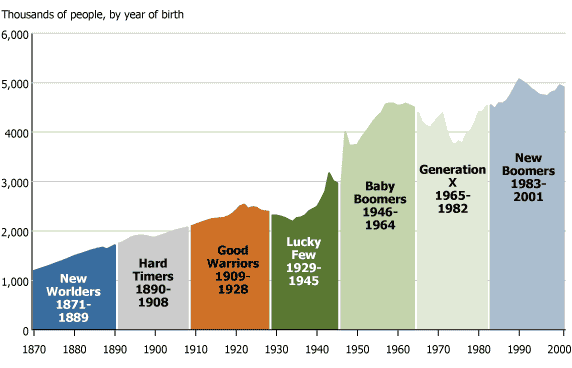 Source: U.S. Census Bureau.
By virtue of when they were born, members of each generation live through unique times shaped by unexpected historical events, changing political climates, and evolving socioeconomic conditions. Generations also come in different sizes and changing mixtures of ethnicity, helping to shape the choices individuals will make in life. A generational perspective offers fresh insights into contemporary society by emphasizing both the distinctiveness of each generation in its particular historical context and the persistence of such distinctions across an individual’s life. When different generations respond in unique ways to common problems and choices, businesses, governments, and we as individuals need to recognize and understand such distinctions. This Population Bulletin highlights contrasting American generations of the 20th century, showing how each one influenced and reacted to the social and economic landscape over which we all must travel during our lives.
Elwood Carlson is the Charles B. Nam Professor in Sociology of Population at Florida State University. His research concentrates on generational cycles in populations, social determinants of infant and reproductive health, and working-age mortality, using evidence from Europe and the Middle East as well as American society.
Related Posts
Family Planning and the Gendered Impacts of Crises on Women: An Effective Tool Across Sectors to Support Women’s Empowerment and Build Resilience to Shocks
Holistic integrated solutions are key to address the interlinkages of the gendered impacts of crises.
Research Identifies New Strategies to Reduce Undercount of Young Children in U.S. 2020 Census
PRB identifies factors predicting where children under age 5 are more likely to be missed in the 2020 Census and develops a new undercount risk measure for young children.

Lesson Plans on Human Population and Demographic Studies
Find out the answers to these questions and more. The sections listed below explore eight elements of population dynamics.

Health Sector Reform: How It Affects Reproductive Health
(June 2003) Many less developed countries are reforming their health systems in an effort to achieve public health goals more affordably and effectively.
Report. Health Sector Reform: How It Affects Reproductive Health
This report also in French and Spanish. (June 2003) Many less developed countries are reforming their health systems in an effort to achieve public health goals more affordably and effectively.