
Empowering Women for a Healthier Future in Nigeria With Self-Injectable Contraception

Injectables are among the most popular modern contraceptive methods among married women in Nigeria, with use more than tripling since 1990. A new self-injectable contraceptive—DMPA-SC, or subcutaneous depot medroxyprogesterone acetate—gives women and youth the choice to easily and discreetly self-inject in their homes or other convenient locations rather than travel to a health care clinic to have the shot administered—a sometimes difficult and costly process. This new self-injectable method encourages continued method use and promises to reach new users.
PRB partnered with the Association for Reproductive and Family Health (ARFH) in Nigeria to create a video and series of state-specific policy briefs that highlight DMPA-SC’s potential to overcome the barriers women face and increase access to family planning methods, especially in hard-to-reach areas, through community-based distribution. This suite of products supports ARFH’s Resilient & Accelerated Scale-up of DMPA-SC/Self-injection in Nigeria (RASuDiN) project, which aims to expand the family planning method mix by increasing use, acceptance, availability, and accessibility of DMPA-SC. Both sets of products call on Ministries of Health in ten states (Anambra, Delta, Enugu, Kwara, Lagos, Niger, Ogun, Oyo, Plateau, and Rivers) to complement the Federal Ministry of Health’s efforts to introduce and scale up DMPA-SC by acting to make this new method fully available in communities in all local government authorities.

Breaking Barriers: Women in Nigeria Take Charge of Their Health
Related Posts
Research Identifies New Strategies to Reduce Undercount of Young Children in U.S. 2020 Census
PRB identifies factors predicting where children under age 5 are more likely to be missed in the 2020 Census and develops a new undercount risk measure for young children.

Health Sector Reform: How It Affects Reproductive Health
(June 2003) Many less developed countries are reforming their health systems in an effort to achieve public health goals more affordably and effectively.
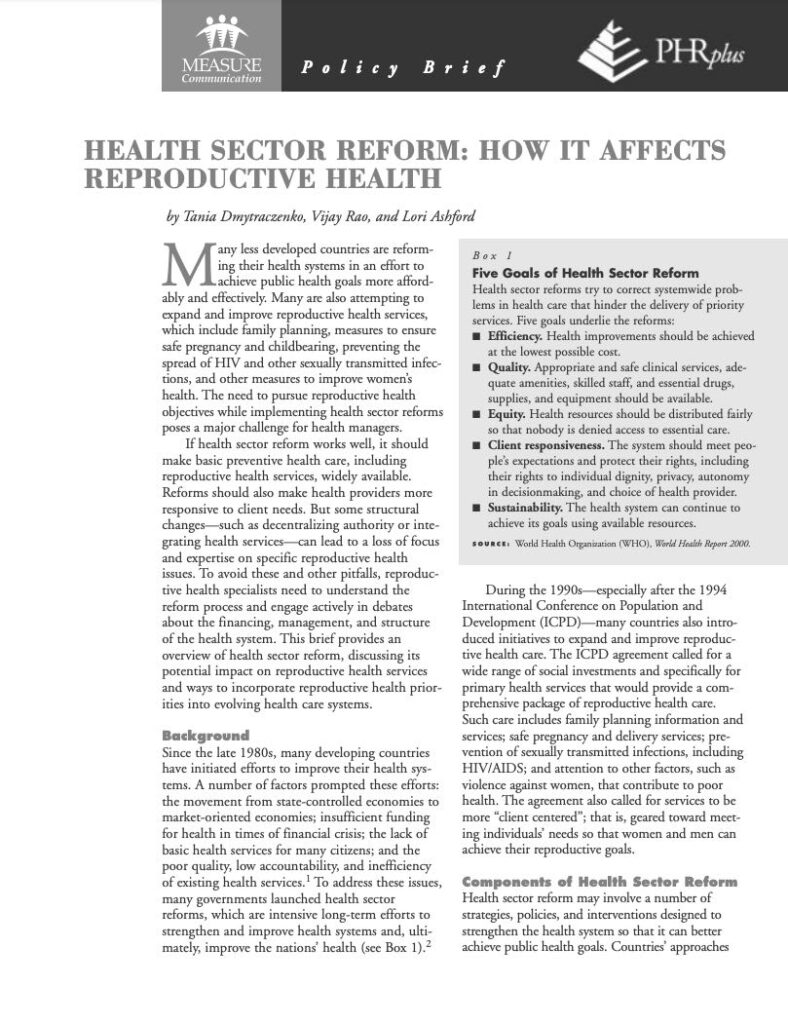
Report. Health Sector Reform: How It Affects Reproductive Health
This report also in French and Spanish. (June 2003) Many less developed countries are reforming their health systems in an effort to achieve public health goals more affordably and effectively.