
Digital Health Family Planning Resources
The Digital Health Resource Library provides a list of key resources to enhance information sharing and learning across family planning stakeholders supporting digital health tools in low- and middle-income countries (LMICs). Featured resources include policy documents, reports, resource guides, and websites that describe the planning, implementation, policy, governance, and evaluation aspects of digital health programming in LMICs.

A Vision for Action in Digital Health (2020-2024)
Addresses challenges facing digital health technologies, including fragmentation, sustainability, and interoperability. Outlines a systems-level approach to supporting partner countries in adopting digital health solutions.
Classifications of Digital Health Interventions v1.0
Categorizes ways in which digital and mobile technologies are being used to support health system needs. Designed primarily for public health audiences.
Digital Adaptation Kit (DAK) for Family Planning
Focuses on family planning and aim to provide a common language for various audiences to promote understanding of digital systems within a defined health program area.
Digital Health Atlas (DHA)
Open-source web platform designed to help governments, technologists, implementers, and donors coordinate, strengthen, and scale digital health activities globally.
Digital Health Compendium
A collection of case studies across a range of digital health technologies enhancing family planning programs mainly in sub-Saharan Africa, but also globally.
Digital Heath Platform Handbook
Designed to help countries create and implement a platform to serve as the underlying infrastructure for an interoperable and integrated national digital health system.
Digital Implementation Investment Guide (DIIG)
Step-by-step guidance for governments and technical partners for planning, costing, and implementing interventions within a digital health enterprise.
Family Planning High Impact Practices (HIPs)
A set of evidence-based family planning practices vetted by experts and documented in an easy-to-use format. Designed to build consensus around family planning solutions.
Global Digital Health Index
An interactive digital resource that tracks, monitors, and evaluates the use of digital technology for health across countries.
Global Digital Health Network
Consists of more than 3,900 participants across 117 countries that engage in information sharing and provide leadership in digital solutions for global public health.
Global Digital Health Resources and Maturity Models
Details six digital health resources and maturity models that are considered essential tools in the global effort to strengthen health data systems.
Global Goods Guidebook
Focuses on global software goods, exploring the concept of shelf readiness and highlighting adaptations for COVID-19.
Global Strategy on Digital Health (2020-2025)
Describes the WHO’s global digital health approach, designed for use by all member states, including those with limited access to digital technologies, goods, and services.
Health Information Systems (HIS) Interoperability Maturity Toolkit
Aims to enable the exchange of data between disparate health information systems to overcome barriers to data quantity, quality, and accessibility.
Health Information System (HIS) Stages of Continuous Improvement Toolkit
Designed to help countries and organizations holistically assess, plan, and prioritize interventions and Investments to strengthen a health information system.
mHealth Compendium Volumes 1-6
Created to help USAID missions, governments, and health implementing organizations access information on a range of mHealth example programs.
Monitoring and Evaluation Digital Health Interventions
Provides step-by-step guidance to improve the quality and value of monitoring and evaluation efforts for digital health interventions. Intended for implementers and researchers.
National eHealth Strategy Toolkit
A framework for the development of a national eHealth vision, action plan, and monitoring approach. Can be applied by governments developing or revitalizing a national strategy.
Principles for Digital Development
Nine living guidelines intended to help digital development practitioners integrate established best practices into technology-enabled programs.
Results From a Content Analysis of Family Planning Digital Platforms
Describes the results of a content analysis of family planning digital platforms, including a quality assessment of 11 implemented tools that showed promise for scale.
Related Posts
- Interactive
resource
Research Identifies New Strategies to Reduce Undercount of Young Children in U.S. 2020 Census
PRB identifies factors predicting where children under age 5 are more likely to be missed in the 2020 Census and develops a new undercount risk measure for young children.

- Past Presentation
resource
PRB Discuss Online: A Call to Action: Increasing Global Investments in Youth
(2010) With almost half of the world's population under age 25, investments in young people are vital to improve economic and social outcomes and achieve the Millennium Development Goals (MDGs).
- Training Tool
resource
PRB Discuss Online: Finding Ways to Improve Child Health
(2008) Each year, nearly 10 million children die, mostly from preventable and treatable causes. Millions of children in low-income countries suffer from long-term illnesses, malnutrition, and injuries that limit their life options.
- Training Tool
resource
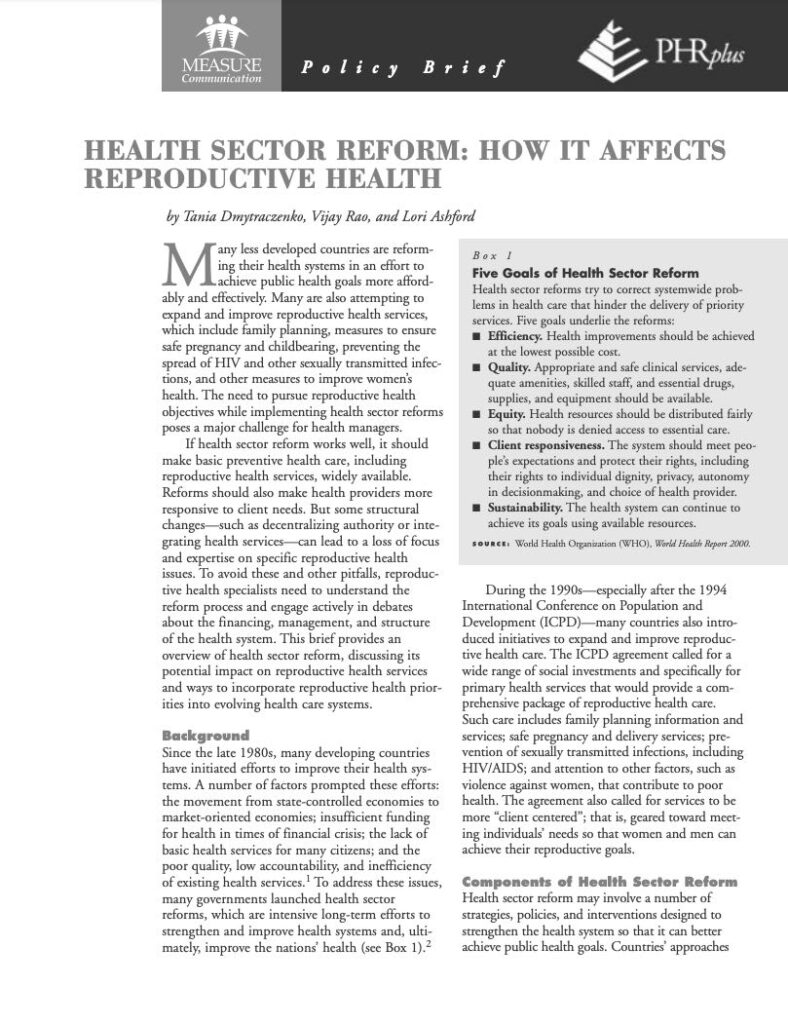
Health Sector Reform: How It Affects Reproductive Health
(June 2003) Many less developed countries are reforming their health systems in an effort to achieve public health goals more affordably and effectively.
- Article
resource
Report. Health Sector Reform: How It Affects Reproductive Health
This report also in French and Spanish. (June 2003) Many less developed countries are reforming their health systems in an effort to achieve public health goals more affordably and effectively.

- Training Tool
resource
Small Successes, Big Ideas — Jamaica's Adolescent Reproductive Health Focus
(2003) The successes are real, but they're small compared to the task: reaching the half-million adolescents who form some 20 percent of this island's 2.5 million population and enabling them to adopt healthier sexual lifestyles.