
The Health and Life Expectancy of Older Blacks and Hispanics in the U.S.
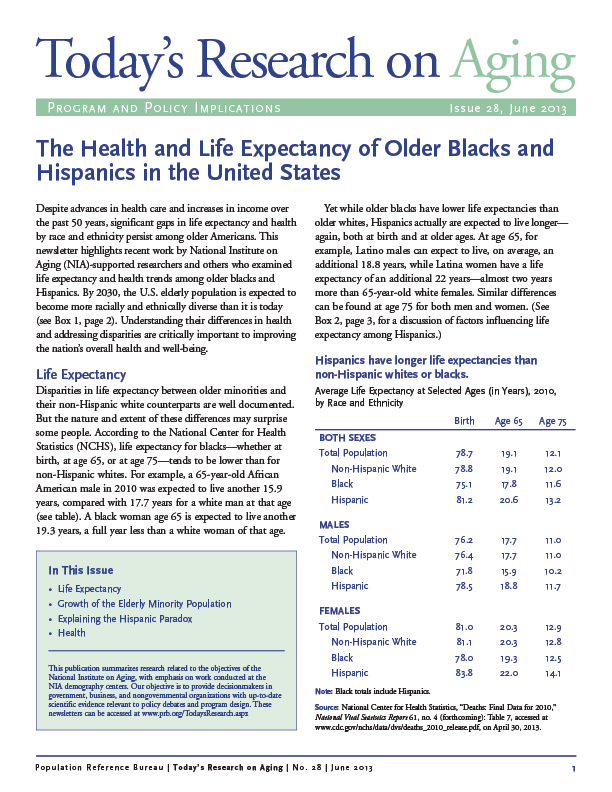
Despite advances in health care and increases in income over the past 50 years, significant gaps in life expectancy and health by race and ethnicity persist among older Americans. This newsletter examines life expectancy and health trends among older blacks and Hispanics. By 2030, the U.S. elderly population is expected to become more racially and ethnically diverse than it is today. Understanding their health differences and addressing disparities are critically important to improving the nation’s overall health and well-being.
The older minority population has grown 48 percent since 2000, which is four times the growth rate of the older non-Hispanic white population. Of the 41.4 million persons ages 65 and over in 2011, 8.5 million—slightly more than one in five—were members of minority groups (identifying as anything other than “white alone, not Hispanic” on census forms). Put another way, minorities accounted for nearly one-half of the 6.3 million Americans added to the ages-65-and-older population between 2000 and 2011.
While Hispanics surpassed African Americans as the country’s largest minority group a number of years ago, blacks still outnumber Hispanics among the 65-and-older population. However, the older Hispanic population has grown nearly three times as fast as the older black population since 2000—and the number of older Asian Americans grew even faster.
The aging of the post-World War II baby boom (born 1946 to 1964) will contribute to a sharp rise in the elderly population in the coming years. According to Census Bureau projections, older Americans ages 65 and older are expected to number 73 million by 2030, when the youngest baby boomers will have turned 65. Of these, 20 million will be members of minority groups, which is more than double the current number of minority elderly. And by 2030, Hispanics (projected to reach 8 million) will surpass blacks (projected to reach 7.5 million) as the largest minority group among older Americans, while the number of older Asian Americans will likely approach 3.5 million.
The publication explores racial and ethnic differences in disability, cognitive functioning, depression, cancer prevalence, and end-of-life health care decisions.
Kelvin Pollard is a senior demographer at the Population Reference Bureau; Paola Scommegna is a senior/writer editor at PRB.
Related Posts
Census Issues, Impact of Dobbs Decision, and Population Aging Among Highlights of 2024 Population Association of America Conference
PRB staff offer summaries of new research and insightful sessions at the annual demography meeting.
How Accurate Was the 2020 Census—and Why Should You Care?
Significant undercounts in the 2020 Census could have serious consequences for underrepresented groups and individual states.
Understanding and Comparing Population Projections in Sub-Saharan Africa
The release of a new set of population projections by the Institute for Health Metrics and Evaluation (IHME) in July 2020 was greeted with extensive coverage in the media and stimulated fresh debate among demographers about calculation and communication of projections.

How Will We Measure the Accuracy of the 2020 Census?
Getting an accurate 2020 Census count is important because census numbers impact daily life in the United States in many ways.