Project: PACE: Policy, Advocacy, and Communication Enhanced for Population and Reproductive Health
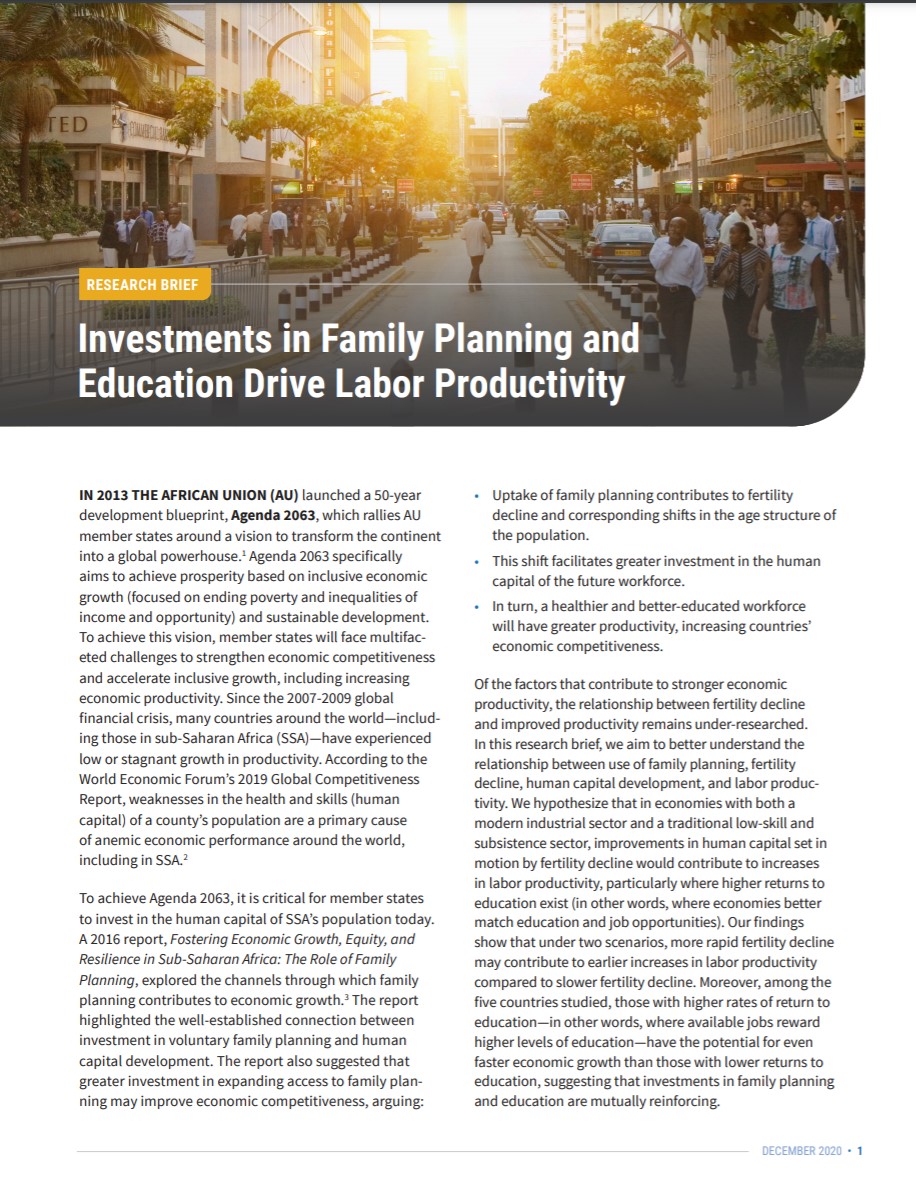
Policy Brief. Investments in Family Planning and Education Drive Labor Productivity
In this research brief, we aim to better understand the relationship between use of voluntary family planning, fertility decline, human capital development, and labor productivity. To assess the relationship between family planning, fertility decline, and labor productivity, we applied the Canning-Karra-Wilde (CKW) macrosimulation model in five countries in SSA: Ghana, Kenya, Nigeria, Uganda, and Zambia.
View Details
Array
(
[ID] => 19771
[id] => 19771
[title] => prb-family-planning-and-labor-market-policy-brief-2
[filename] => prb-family-planning-and-labor-market-policy-brief-2.pdf
[filesize] => 1209760
[url] => https://www.prb.org/wp-content/uploads/2020/12/prb-family-planning-and-labor-market-policy-brief-2.pdf
[link] => https://www.prb.org/resources/policy-brief-investments-in-family-planning-and-education-drive-labor-productivity/prb-family-planning-and-labor-market-policy-brief-2/
[alt] =>
[author] => 15
[description] =>
[caption] =>
[name] => prb-family-planning-and-labor-market-policy-brief-2
[status] => inherit
[uploaded_to] => 9414
[date] => 2021-04-02 03:35:34
[modified] => 2021-04-02 03:35:34
[menu_order] => 0
[mime_type] => application/pdf
[type] => application
[subtype] => pdf
[icon] => https://www.prb.org/wp-includes/images/media/document.png
)
Download
(1.2 MB)