
493 Search Results Found For : "population"
9 Billion World Population by 2050
(2000) The current period of rapid population growth will continue for at least another 50 years, according to the 2000 World Population Data Sheet of the Population Reference Bureau. By 2050, the world is expected to add 3 billion more people to reach a total of 9 billion.
21st Century Will Transform World Population
(2001) It is now clear that the 21st century will feature a major transformation in world population.
Fiche de données sur la population mondiale 2010
(2010) De nombreux pays font face à une diminution de leur population en âge de travailler (généralement considérée comme étant les personnes âgées de 15 à 64 ans).
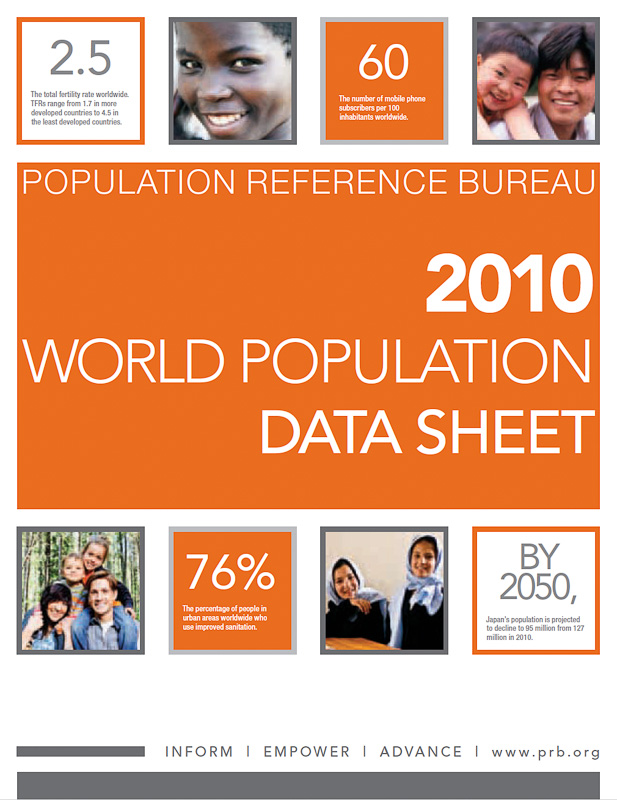
2010 World Population Data Sheet
Many countries are facing a shrinking pool of their working-age populations, often considered to be ages 15 to 64, to support the population ages 65+, jeopardizing pension guarantees and long-term health care programs for the elderly.
View Details
Array
(
[ID] => 4879
[id] => 4879
[title] => World-Population-Data-2010-English
[filename] => World-Population-Data-2010-English.pdf
[filesize] => 828159
[url] => https://www.prb.org/wp-content/uploads/2010/07/World-Population-Data-2010-English.pdf
[link] => https://www.prb.org/resources/2010-world-population-data-sheet/world-population-data-2010-english/
[alt] =>
[author] => 15
[description] =>
[caption] =>
[name] => world-population-data-2010-english
[status] => inherit
[uploaded_to] => 4869
[date] => 2020-11-24 03:16:23
[modified] => 2020-11-24 03:16:23
[menu_order] => 0
[mime_type] => application/pdf
[type] => application
[subtype] => pdf
[icon] => https://www.prb.org/wp-includes/images/media/document.png
)
Download
(0.8 MB)
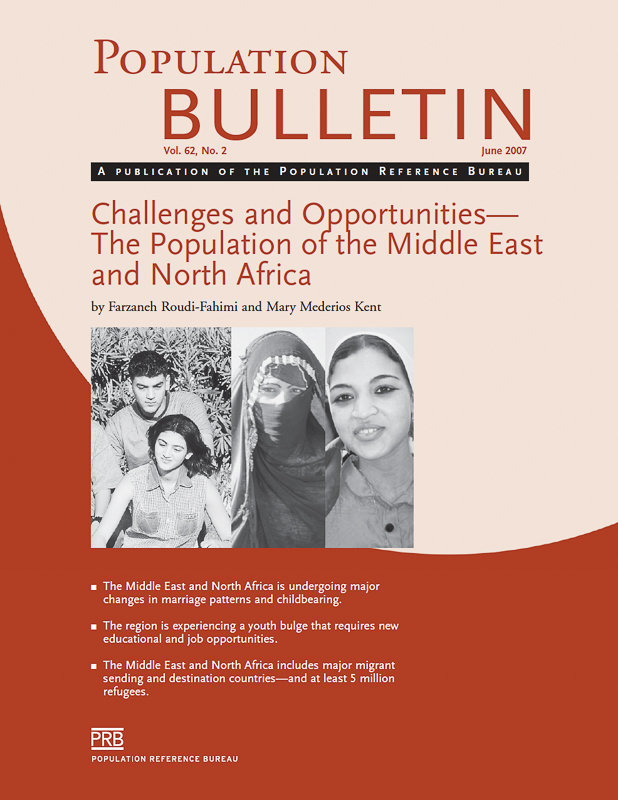
Population Bulletin, vol. 62, no. 2: Challenges and Opportunities—The Population of the Middle East and North Africa
Vol. 62, No. 2: (2007) The countries of the Middle East and North Africa (MENA) continue to fascinate and concern the rest of the world. With two-thirds of the world’s known petroleum reserves, the region’s economic and political importance far outweighs its population size.
View Details
Array
(
[ID] => 4449
[id] => 4449
[title] => population-bulletin-2007-62-2-MENA
[filename] => population-bulletin-2007-62-2-MENA.pdf
[filesize] => 810624
[url] => https://www.prb.org/wp-content/uploads/2020/11/population-bulletin-2007-62-2-MENA.pdf
[link] => https://www.prb.org/resources/population-bulletin-challenges-and-opportunities-the-population-of-the-middle-east-and-north-africa/population-bulletin-2007-62-2-mena/
[alt] =>
[author] => 15
[description] =>
[caption] => Population Bulletin, Vol 62, No. 2. Challenges and Opportunities—The Population of the Middle East and North Africa. June 2007
[name] => population-bulletin-2007-62-2-mena
[status] => inherit
[uploaded_to] => 4448
[date] => 2020-11-18 00:52:37
[modified] => 2020-11-18 00:53:25
[menu_order] => 0
[mime_type] => application/pdf
[type] => application
[subtype] => pdf
[icon] => https://www.prb.org/wp-includes/images/media/document.png
)
Download
(0.8 MB)
America’s Aging Population
Population Bulletin, Vol. 66, No. 1: In 2011, the oldest baby boomers—Americans born between 1946 and 1964—will start to turn 65.
View Details
Array
(
[ID] => 6304
[id] => 6304
[title] => Population-Bulletin-2011-66-1-aging-u-s
[filename] => Population-Bulletin-2011-66-1-aging-u-s.pdf
[filesize] => 2429721
[url] => https://www.prb.org/wp-content/uploads/2011/02/Population-Bulletin-2011-66-1-aging-u-s.pdf
[link] => https://www.prb.org/resources/americas-aging-population/population-bulletin-2011-66-1-aging-u-s/
[alt] =>
[author] => 15
[description] => Population Bulletin, Vol. 66, No. 1
[caption] => This PRB Population Bulletin examines the current and future U.S. population ages 65 and older and considers the costs and implications of America's aging population.
[name] => population-bulletin-2011-66-1-aging-u-s
[status] => inherit
[uploaded_to] => 5729
[date] => 2020-12-03 18:26:28
[modified] => 2020-12-03 18:26:54
[menu_order] => 0
[mime_type] => application/pdf
[type] => application
[subtype] => pdf
[icon] => https://www.prb.org/wp-includes/images/media/document.png
)
Download
(2.4 MB)
Four Scenarios for U.S. Population Growth
(2009) The U.S. population is projected to increase over the next four decades, but according to new supplemental projections from the U.S. Census Bureau, the rate of increase depends largely on future trends in international migration.
What Drives U.S. Population Growth?
(2002) The U.S. population is growing as fast as or faster than any other more developed country. Between 1990 and 2000, nearly 33 million people were added to the U.S. population—a group nearly as large as Argentina's population, and the greatest 10-year increase ever for the country.
View Details
Array
(
[ID] => 8424
[id] => 8424
[title] => Population-bulletin-2002-57-4WhatDrivesUSPopulation
[filename] => Population-bulletin-2002-57-4WhatDrivesUSPopulation.pdf
[filesize] => 552750
[url] => https://www.prb.org/wp-content/uploads/2002/12/Population-bulletin-2002-57-4WhatDrivesUSPopulation.pdf
[link] => https://www.prb.org/resources/what-drives-u-s-population-growth/population-bulletin-2002-57-4whatdrivesuspopulation/
[alt] =>
[author] => 15
[description] => Population Bulletin, Vol 57, no. 4: What Drives U.S. Population Growth?
[caption] => Population Bulletin, Vol 57, no. 4: What Drives U.S. Population Growth?
[name] => population-bulletin-2002-57-4whatdrivesuspopulation
[status] => inherit
[uploaded_to] => 7785
[date] => 2020-12-17 03:47:36
[modified] => 2020-12-17 03:54:52
[menu_order] => 0
[mime_type] => application/pdf
[type] => application
[subtype] => pdf
[icon] => https://www.prb.org/wp-includes/images/media/document.png
)
Download
(0.5 MB)