492 Search Results Found For : "population"


Health Care Challenges for Developing Countries with Aging Populations

(April 2006) Populations in developing countries will be aging rapidly in the coming decades: The number of older persons (those age 65 or older) in less developed countries is expected to increase from 249 million to 690 million between 2000 and 2030.
View Details

Project: IDEA: Informing Decisionmakers to Act

Highlights From 2014 World Population Data Sheet

Narrated by Jeff Jordan, PRB's president, this short video illustrates the 2014 World Population Data Sheet's main findings about world population, infant and maternal health, poverty, and the environment.

View Details

Fact Sheet: Population and Food Security: Africa’s Challenge

Food security is at the top of the list of Millennium Development Goals (MDGs) with the goal of eradicating poverty and hunger.

View Details

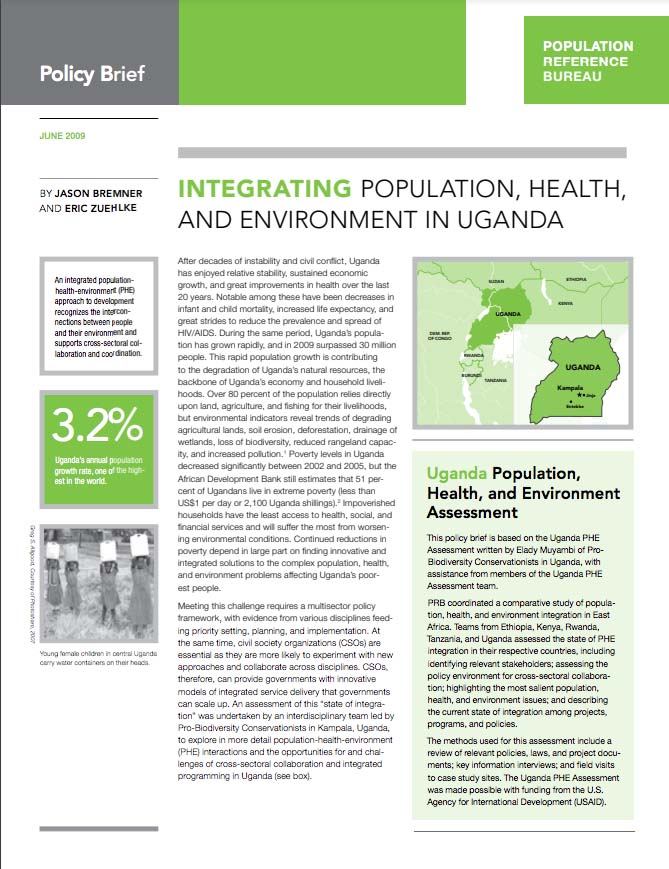
Policy Brief. Integrating Population, Health, and Environment in Uganda

(2009) After decades of instability and civil conflict, Uganda has enjoyed relative stability, sustained economic growth, and great improvements in health over the last 20 years.

View Details Array ( [ID] => 12953 [id] => 12953 [title] => 07132009-phe-uganda [filename] => 07132009-phe-uganda.pdf [filesize] => 442600 [url] => https://www.prb.org/wp-content/uploads/2021/01/07132009-phe-uganda.pdf [link] => https://www.prb.org/resources/integrating-population-health-and-environment-in-uganda/07132009-phe-uganda/ [alt] => [author] => 15 [description] => [caption] => [name] => 07132009-phe-uganda [status] => inherit [uploaded_to] => 12948 [date] => 2021-01-20 13:46:10 [modified] => 2021-01-20 13:46:10 [menu_order] => 0 [mime_type] => application/pdf [type] => application [subtype] => pdf [icon] => https://www.prb.org/wp-includes/images/media/document.png ) Download (0.4 MB)

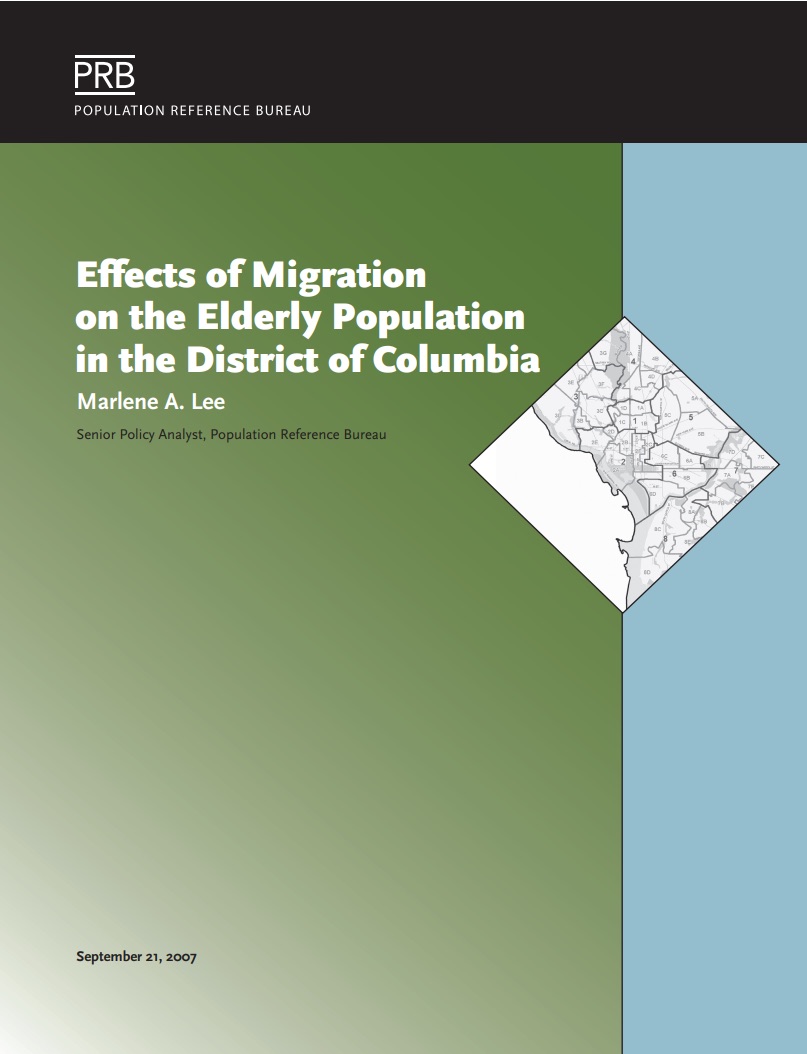
Effects of Migration on the Elderly Population in the District of Columbia

(2007) By 2030, the population of the Washington, DC metropolitan area will increase by more than 2 million, and the population age 65 and older will double.

View Details Array ( [ID] => 13916 [id] => 13916 [title] => elderly-migration-washington-dc [filename] => elderly-migration-washington-dc.pdf [filesize] => 954276 [url] => https://www.prb.org/wp-content/uploads/2007/11/elderly-migration-washington-dc.pdf [link] => https://www.prb.org/resources/effects-of-migration-on-the-elderly-population-in-the-district-of-columbia/elderly-migration-washington-dc-2/ [alt] => [author] => 15 [description] => [caption] => [name] => elderly-migration-washington-dc-2 [status] => inherit [uploaded_to] => 13913 [date] => 2021-01-25 03:01:04 [modified] => 2021-01-25 03:01:04 [menu_order] => 0 [mime_type] => application/pdf [type] => application [subtype] => pdf [icon] => https://www.prb.org/wp-includes/images/media/document.png ) Download (0.9 MB)

Project: PACE: Policy, Advocacy, and Communication Enhanced for Population and Reproductive Health

Population Growth Concentrated Among the Poorest Communities

As sub-Saharan African countries strive to grow their economies, it is critical that they consider their age structures—or more particularly, the age structures of their richest and poorest populations, which are determined largely by fertility rates.

View Details

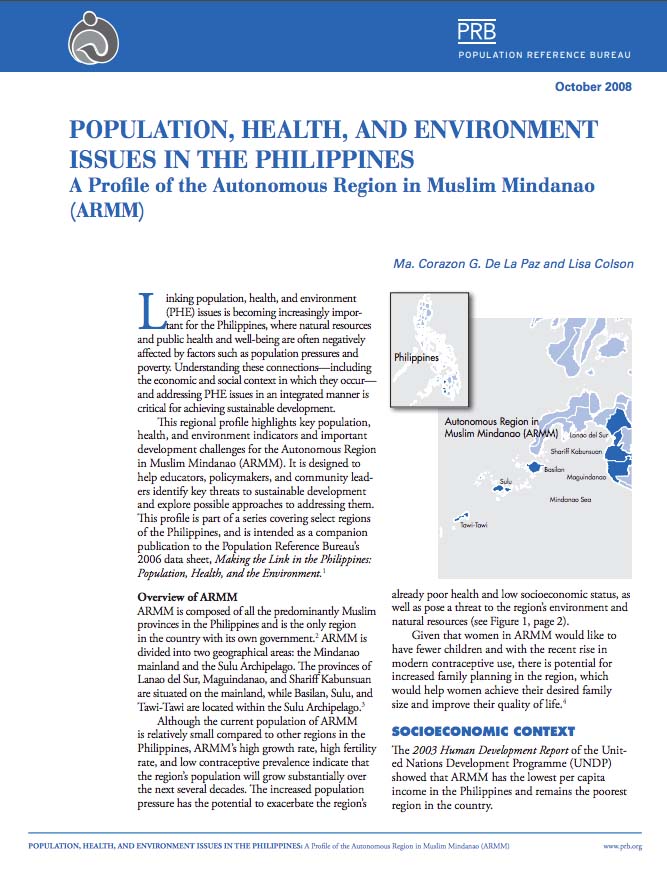
Population, Health, and Environment Issues in the Philippines: A Profile of Autonomous Region in Muslim Mindanao (ARMM)

(2008) Linking population, health, and environment (PHE) issues is becoming increasingly important for the Philippines, where natural resources and public health and well-being are often negatively affected by factors such as population pressures and poverty.

View Details Array ( [ID] => 12888 [id] => 12888 [title] => 10222008-pheregionalprofiles_armm [filename] => 10222008-pheregionalprofiles_armm.pdf [filesize] => 1404924 [url] => https://www.prb.org/wp-content/uploads/2021/01/10222008-pheregionalprofiles_armm.pdf [link] => https://www.prb.org/resources/population-health-and-environment-issues-in-the-philippines-a-profile-of-autonomous-region-in-muslim-mindanao-armm/10222008-pheregionalprofiles_armm/ [alt] => [author] => 15 [description] => [caption] => [name] => 10222008-pheregionalprofiles_armm [status] => inherit [uploaded_to] => 12884 [date] => 2021-01-20 12:08:06 [modified] => 2021-01-20 12:08:06 [menu_order] => 0 [mime_type] => application/pdf [type] => application [subtype] => pdf [icon] => https://www.prb.org/wp-includes/images/media/document.png ) Download (1.4 MB)

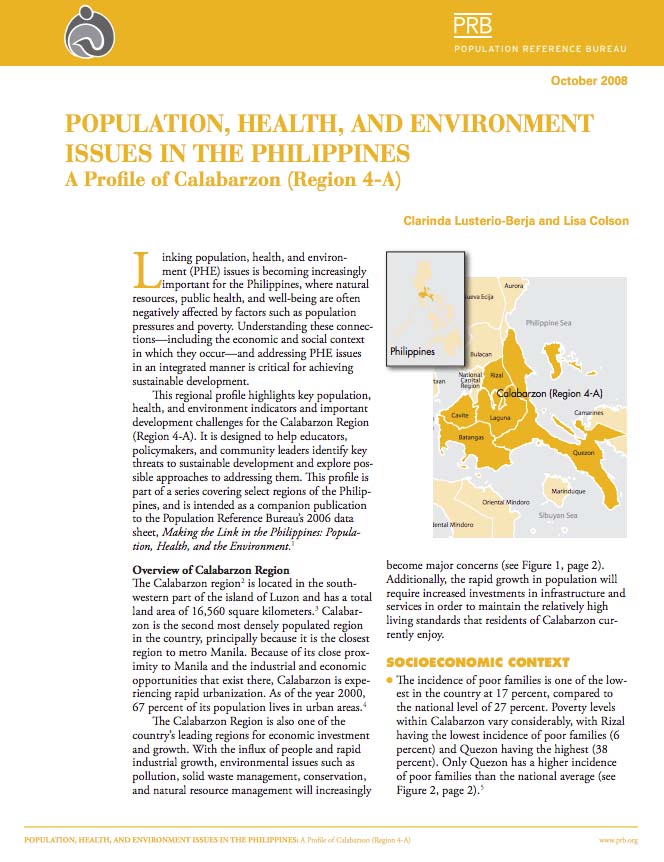
Population, Health, and Environment Issues in the Philippines: A Profile of Calabarzon Region

2008) Linking population, health, and environment (PHE) issues is becoming increasingly important for the Philippines, where natural resources and public health and well-being are often negatively affected by factors such as population pressures and poverty. Understanding these connections—including the economic and social context in which they occur—and addressing PHE issues in an integrated manner is critical for achieving sustainable development.

View Details Array ( [ID] => 12881 [id] => 12881 [title] => 10152008-pheregionalprofiles_calabarzon [filename] => 10152008-pheregionalprofiles_calabarzon.pdf [filesize] => 908482 [url] => https://www.prb.org/wp-content/uploads/2021/01/10152008-pheregionalprofiles_calabarzon.pdf [link] => https://www.prb.org/resources/population-health-and-environment-issues-in-the-philippines-a-profile-of-calabarzon-region/10152008-pheregionalprofiles_calabarzon/ [alt] => [author] => 15 [description] => [caption] => [name] => 10152008-pheregionalprofiles_calabarzon [status] => inherit [uploaded_to] => 12879 [date] => 2021-01-20 11:57:57 [modified] => 2021-01-20 11:57:57 [menu_order] => 0 [mime_type] => application/pdf [type] => application [subtype] => pdf [icon] => https://www.prb.org/wp-includes/images/media/document.png ) Download (0.9 MB)