
Are Americans 'Underbabied'?
Earlier this month, Dr. Mehmet Oz introduced a new demographic buzzword into the public conversation. Is there any truth to this concern?
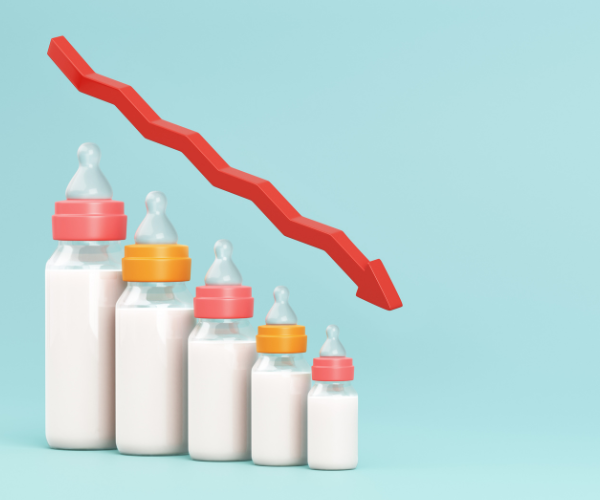
Earlier this month, Dr. Mehmet Oz introduced a new demographic buzzword: “underbabied.” At a White House event launching a new website for mothers, Oz, Administrator for the U.S. Centers for Medicare & Medicaid Services, defined the term as the condition of having fewer children than one would ideally want, or none at all.
While it’s true that U.S. fertility rates have fallen sharply over the past two decades, it’s not because of a lack of desire, nor, despite some claims, due to widespread biological infertility. Instead, the major drivers are socioeconomic: delayed childbearing, economic insecurity, changing social conditions, and a growing gap between the families people say they want and the families they feel they can actually support. People aren’t rejecting parenthood—the conditions for it keep getting harder.
Demographic anxiety has led to policy responses narrowly focused on increasing births that disproportionately target women. These responses threaten to make things worse, driving fertility down further while ignoring the real issue at hand: whether people have the rights, systems, and support they need to build the families they want.
Is Fertility Falling?
The impetus for Oz’s comments isn’t surprising, but the phenomenon of declining fertility isn’t new. As in much of the world, fertility in the U.S. has been declining for decades, with occasional interruptions like the post–World War II baby boom. After stabilizing through much of the 1990s and early 2000s, it dropped again after the Great Recession in 2008. Today, the total fertility rate (TFR) stands at 1.6 children per woman, the lowest ever recorded.
Part of this reflects what demographers call a tempo effect: People are having children later in life, and biological fertility declines with age. Some of what appears to be decline is, at least partially, a delay. Fertility rates among teenagers and women in their early 20s have dropped sharply, while rates among women in their 30s and early 40s have risen.
Completed fertility provides useful context here. The TFR is a “period” measure—not a count of how many children women actually have over their lifetimes, but a projection of what would happen if today’s birth rates held constant. Completed fertility, which tracks actual lifetime childbearing, tells a steadier story. American women born between 1959 and 1987 had between 2 and 2.2 children on average. Many women still ultimately had around two children, even as the timing shifted.
Is Infertility Causing America to be ‘Underbabied’?
Following Oz, Secretary of Health and Human Services Robert F. Kennedy Jr. pointed to infertility as a potential explanation for the “fertility crisis.” But this conflates two related yet distinct concepts: fertility (population-level childbearing) and fecundity (the biological capacity to conceive and carry a pregnancy to live birth). That conflation is increasingly common—among politicians, media, and even some researchers.
There is no strong evidence that declining fecundity is driving global trends. Nor is there clear or consistent evidence that infertility—defined as not becoming pregnant after 12 months of unprotected intercourse—has been rising globally over time. Part of the challenge is methodological: Data are limited, definitions vary, and studies are often difficult to compare across settings and populations. However, greater awareness, diagnosis, and access to care may be contributing to the perception of an increase. And while more people experience difficulty conceiving as childbearing is delayed to older ages, this doesn’t account for the scale or pattern of overall fertility decline.
Why Are People Delaying and Having Fewer Children?
Demographers analyze fertility through three lenses: preferences (the number of children people would ideally like to have), intentions (the number of children people realistically plan for, given their circumstances), and behaviors (the actual number of children people end up having). In the U.S., preferences have remained relatively stable; most people still want children. But intentions and outcomes are increasingly shaped by constraints.
Some of the delay reflects positive social changes: Teen pregnancy has fallen to historic lows, maternal and child health outcomes have improved, and women are spending more time in education and participating more fully in the labor force. But delay is also driven by barriers. Four recent studies point to a consistent set of hurdles: high housing costs, expensive childcare, economic insecurity, delays in forming stable partnerships, and broader uncertainty about the future. Even the perception of financial insecurity—independent of actual income—significantly increases the likelihood of postponing or avoiding pregnancy. Shifting priorities also play a role, with more people placing greater value on careers, leisure, and personal fulfillment over marriage and larger families.
These findings suggest that interventions focused solely on increasing births are likely to have limited impact. Policies that work to reduce the gap between fertility preferences and reproductive behaviors—through investments in affordable childcare, flexible work arrangements, affordable housing, paid parental leave, and greater gender equality in caregiving—are more likely to make a difference. They likely won’t push fertility back over “replacement level,” but they can expand choice, improve well-being, and make it easier for people to build the families they want.
Pronatalist Policies Have Mixed Results—and Real Risks
How fertility is framed shapes the policies it produces, and those policies directly affect health and rights. The evidence for birth-focused interventions is mixed, while the risks of coercion and harm are well documented.
Recently, politicians have proposed expanding access to infertility treatment. But while assisted reproductive technologies (ART) do play an important role for individuals, their effect at the population level is modest. In Europe, ART accounts for about 3% to 4% of births and is linked to only small increases to overall fertility. Rigorous studies linking national ART and birth registry data remain limited to a few countries. In Czechia, ART was associated with an increase in the TFR from 1.65 to 1.71 in 2020; in Australia, an average annual gain of 0.08 from 2010 to 2017. In both cases, these modest gains reflected reductions in involuntary childlessness—not increases in desired family size. ART helps people have the children they already intend to have, but it doesn’t change reproductive intention, and its reach is constrained by limited and unequal access and age-related limits on effectiveness.
Restrictive policies show similar limitations—and carry serious costs. Romania’s abortion ban in 1966 briefly doubled births, but unsafe abortions, maternal deaths, and numbers of abandoned children surged alongside them, and once restrictions were lifted, fertility returned to low levels. A similar pattern emerged in the U.S. in the aftermath of the 2022 Dobbs decision, which overturned federal abortion protections. States that enacted abortion bans saw modest birth increases (about 2% to 3% more above projected trends), but total births continued to fall in most of those states, suggesting a temporarily slowing, not a reversal. Limiting reproductive rights harms health and freedom without addressing why families have fewer children.
Cash incentives and tax breaks tend to produce only modest, short-term increases in births, often shifting the timing of childbearing rather than increasing completed family size. Paid parental leave and expanded childcare programs show similarly limited effects on fertility, with most gains coming from people deciding to have an additional child rather than a surge in first-time parents. These policies still matter—for reducing stress, improving well-being, and expanding choices for families. But more evidence is needed on whether universal, large-scale family supports can meaningfully narrow the gap between intended and actual births, particularly if implemented before fertility declines to very low levels.
Toward Structural Solutions, Not Demographic Panic
Historically, demographic panic has led to coercive, exclusionary, and xenophobic responses. It also risks misdirecting resources—away from genuine infertility research and toward politically motivated efforts to raise birth rates. Infertility is real and deserves legitimate scientific attention and investment: There are legitimate open questions about trends in sperm counts, environmental exposures, chronic disease, and conditions like endometriosis and PCOS. But treating demographic trends as proof of population-wide biological failure medicalizes what are fundamentally social and economic changes in family formation.
The evidence suggests that fertility decline is not driven by a mass rejection of parenthood or a collapse in biological capacity. Instead, it reflects a growing mismatch between aspirations and conditions. Most people still want children. What’s often missing is a sense that the timing is right, the future is secure, and the systems around them make it possible to combine work, family, and care.
Seen this way, “underbabied” describes not a failure of individuals, but a failure to align people’s aspirations with their lived realities. That reframing suggests a different goal: not chasing higher birth rates, but building a society in which people can make meaningful choices about parenthood—and feel able to act on them.
The debate over fertility decline raises broader questions about what kinds of lives people can build and what governments owe them in response. Many questions about how economic conditions, social change, environmental exposures, and policy shape fertility remain unresolved, and the evidence is often limited or inconsistent. That makes careful interpretation essential. Policies driven by demographic anxiety risk narrowing reproductive autonomy while overlooking the structural conditions that shape family formation in the first place.
Related Posts
Adolescents and Youth Are Key to Fully Achieving Universal Health Coverage
In 2021, adolescents and youth between ages 10 and 24 are estimated to make up approximately 24% of the world’s population.

Aging and Health in China: What Can We Learn From the World’s Largest Population of Older People?
The United Nations projects that there will be 366 million older Chinese adults by 2050, which is substantially larger than the current total U.S. population of 331 million.