
Unpacking 5 Common Assumptions About Infertility in an Era of Fertility Decline

Global fertility rates are falling, fueling alarm about the social and economic implications of population aging. In the global conversation on fertility, two distinct phenomena are increasingly getting muddled: fertility decline and infertility.
Conflating these concepts has real consequences for policy and advocacy—and for people these efforts are meant to serve. Here, we unpack five common assumptions at the intersection of fertility decline and infertility, offering a clear, evidence-based resource to help civil society, service delivery, and advocacy organizations make sense of the data, navigate the broader discourse, and advance a holistic agenda for sexual and reproductive health and rights (SRHR).
Assumption 1: Infertility Is Increasing Globally
There is no clear or consistent evidence that infertility—defined as not becoming pregnant after 12 months of unprotected sex—is increasing globally over time.1,2 This is in part because data are limited and not comparable across settings.
The most comprehensive global analysis to date, from the World Health Organization (WHO), estimates that infertility affects approximately one in six people at some point in their lives3. This analysis does not establish a consistent increase in infertility rates. Other analyses point to regional and country variations but also fail to establish trends.4 A central challenge is data: Definitions, sources, and methods vary too much across settings to support reliable comparisons.
Much of the perception that infertility is rising is not due to a documented increase in prevalence, but rather to other positive developments in public health, including better measurement, diagnosis, and awareness of the issue.5,6 However, one real trend is worth noting separately: People in many places are having children at later ages—and because individual fertility declines with age, more may experience difficulty conceiving.7 This raises the visibility and lived experience of infertility without necessarily shifting prevalence at the population level.
Assumption 2: Infertility Is Driving Widespread Fertility Decline
Infertility is not a primary driver of declining fertility rates.8 Falling fertility rates are largely explained by social and economic factors that shape whether and when people have kids—better access to contraception, increased education and employment opportunities, rising cost of living, and more—rather than the biological inability to conceive.9,10
At the same time, delayed childbearing can influence both infertility and fertility decline, as postponing pregnancy increases exposure to age-related declines in fertility.11 Despite this trend, comprehensive global reviews find no clear evidence that infertility is increasing,12,13 which reinforces the understanding that infertility is unlikely to be a primary driver of the widespread decline in fertility rates.
Assumption 3: Contraceptive Use Causes Infertility
The evidence is unambiguous: Contraceptive use does not cause infertility.14 Certain methods can have longer return to fertility/ovulation after discontinuation of use,15,16,17 which should be clearly addressed in counseling.
Among contraceptive methods, only male and female sterilization are regarded as permanent (i.e., ending the possibility of natural conception). No other methods result in permanent infertility.18 Clinical evidence consistently shows that fertility returns once people stop using contraceptives, regardless of method. A comprehensive, systematic review of over 14,000 women found that around 83% who’d previously used contraception became pregnant within 12 months of stopping—a rate in line with couples who have never used hormonal contraception or only used barrier methods, such as condoms.19
The time it takes for fertility to return after stopping contraception varies by method. People who use oral contraceptives or hormonal IUDs typically resume ovulation quickly, while those using injectables or implants may experience a short delay.20 The exception to this prompt return to fertility is injectable depot medroxyprogesterone acetate (DMPA) and norethisterone enanthate (NET-EN), which can postpone ovulation for up to a year because their effects last longer in the body.21,22,23 By 18 months, fertility outcomes are similar across all reversible contraceptive methods—and longer use does not extend the delay. Women should be informed that there can be a delay of up to one year in the return to ovulation after discontinuation of DMPA (given intramuscularly or subcutaneously) and NET-EN.
The persistence of this misconception, especially among young people, has real stakes. It shapes contraceptive choices in ways that can lead to unintended pregnancy or unmet need, underscoring why clear, evidence-based counseling on the return to fertility matters.24,25
Assumption 4: Infertility Is Solely a Women’s Issue
It isn’t—and the gap between perception and reality is wide. The male factor is the sole or contributing cause in nearly half of all couples experiencing infertility.26 Yet the burden of investigation, treatment, and social stigma continues to fall disproportionately on women.27,28
This has practical consequences. In many settings, men are only assessed after women have undergone extensive and costly testing, leaving treatable male conditions undiagnosed and delaying effective care.29 This gender bias has broader health implications: Male infertility is increasingly recognized as a marker of other underlying conditions, meaning a missed diagnosis can mean more than a missed treatment.30,31
Addressing infertility effectively requires treating it as a couple’s issue from the outset—with partners evaluated early, equally, and without the weight of gendered assumptions about who is responsible.
Assumption 5: Investing in Infertility Care Will Have a Significant Effect on Fertility Rates
Evidence suggests infertility treatment has a marginal demographic effect. Across Europe, assisted reproductive technologies (ART) accounts for about 3–4% of births overall, rising above 5% in several countries.32 Rigorous evidence that directly links national ART and birth registry data is limited to a few countries. In Czechia, ART was associated with a modest increase in the total fertility rate (TFR)—from 1.65 to 1.71 children per woman—in 2020.33 In Australia, ART contributed to an average annual increase of 0.08 in the TFR from 2010 to 2017.34 In both cases, this shift reflects a reduction in involuntary childlessness, not an increase in desired family size: Infertility care helps people have the children they already intend to have, not more children than they want.
The potential of ART to influence fertility rates is constrained by limited and inequitable access, age-related limits on effectiveness, and the simple fact that it does not change reproductive intentions.35
Integrating infertility services into family planning and broader SRH efforts is about helping individuals and couples realize their reproductive intentions, whether that means preventing, delaying, or achieving pregnancy. Infertility care is an essential component of a rights-based, holistic approach to SRHR that addresses the full continuum of reproductive care across the life course.
This approach must include investment in prevention. Sexually transmitted infections (STIs), particularly chlamydia and gonorrhea, are major preventable drivers of infertility worldwide, capable of causing lasting damage to the reproductive tract when left untreated. Preventing, testing, and treating STIs are therefore core components of infertility care, and belong squarely within an SRHR framework rather than a natalist one.
A Clear Case for Rights-Based Action
When infertility is conflated with fertility decline—or when individual reproductive health is subordinated to demographic goals—good policymaking and equitable care suffer.
Current evidence does not support the view that infertility is rising globally or that investing in infertility care will dramatically reverse fertility decline. What it does show is that infertility causes significant harm, disproportionately affecting those with the least access to care, and that current responses fall short. That gap is an opportunity for more effective, equitable, and rights-based action.
Implications for Policy and Practice
- Integrate. Infertility care belongs within comprehensive SRHR frameworks. The right to achieve a pregnancy—like the right to prevent one—is a fundamental component of reproductive autonomy, and addressing it as such supports the full continuum of reproductive care across the life course while also helping to mitigate the risk that SRH programs are politicized as only focused on pregnancy prevention.
- Apply evidence. The 2025 WHO Global Guideline on Infertility offers, for the first time, an evidence-based framework for the prevention, diagnosis, and treatment of infertility across resource settings—a practical tool for national health systems and a reference point for advocates pushing for the inclusion of infertility care in reproductive health frameworks.
- Be precise. Distinguish clearly between what is known and what isn’t. Avoid overstating demographic impacts, acknowledge data gaps, and advocate for more research—particularly on infertility prevalence, causes, and outcomes in low- and middle-income settings.
- Fill evidence gaps. To advance our understanding of infertility—its scale, patterns, causes, and trends—we need better data, including standardized measurement, country-level estimates, stronger trend data, and better coverage of underrepresented regions and groups.
- Protect rights. Ensure that growing attention to fertility does not undermine access to other critical SRHR services and priorities.
References
- World Health Organization, Infertility Prevalence Estimates, 1990–2021, 2023.
- C. M. Cox et al., “Infertility Prevalence and the Methods of Estimation From 1990 to 2021: A Systematic Review and Meta-Analysis,” Human Reproduction Open 2022, no. 4 (2022): hoac051.
- World Health Organization, Infertility Prevalence Estimates, 1990–2021.
- Cox et al., “Infertility Prevalence and the Methods of Estimation From 1990 to 2021.”
- Cox et al., “Infertility Prevalence and the Methods of Estimation From 1990 to 2021.”
- G. Mburu, J. Kiarie, and P. Allotey, “Infertility Services in the Context of Decreasing Total Fertility Rates,” Bulletin of the World Health Organization 104, no. 2 (2026): 121-23.
- Mburu, Kiarie, and Allotey, “Infertility Services in the Context of Decreasing Total Fertility Rates.”
- Mburu, Kiarie, and Allotey, “Infertility Services in the Context of Decreasing Total Fertility Rates.”
- Melissa S. Kearney and Phillip B. Levine, “Why Is Fertility So Low in High Income Countries?” Journal of Economic Literature (forthcoming).
- United Nations Population Fund, The Real Fertility Crisis—The Pursuit of Reproductive Agency in a Changing World, State of World Population 2025, 2025.
- Mburu, Kiarie, and Allotey, “Infertility Services in the Context of Decreasing Total Fertility Rates.”
- World Health Organization, Infertility Prevalence Estimates, 1990–2021.
- Cox et al., “Infertility Prevalence and the Methods of Estimation From 1990 to 2021.”
- Tilahun Girum and Achenef Wasie, “Return of Fertility After Discontinuation of Contraception: A Systematic Review and Meta-Analysis,” Contraception and Reproductive Medicine 3, no. 1 (2018): 9.
- Diana Mansour et al., “Fertility After Discontinuation of Contraception: A Comprehensive Review of the Literature,” Contraception 84, no. 5 (2011): 465-77.
- B. Erhardt-Ohren, S. Rosenblum, and N. Prata, “Return to Fertility Following the Discontinuation of Progestin-Only Contraceptives: A Narrative Review of the Evidence,” Gynecology and Obstetrics Clinical Medicine 6 (2026): e000192.
- A. Osoti et al., “Return to Fertility After Subcutaneous Depot Medroxyprogesterone Acetate: A Narrative Review,” BMJ Sexual and Reproductive Health 51, Suppl. 1 (2025): s52-9.
- World Health Organization, Selected Practice Recommendations for Contraceptive Use, 4th ed. (Geneva: WHO, 2025).
- Girum and Wasie, “Return of Fertility After Discontinuation of Contraception.”
- Mansour et al., “Fertility After Discontinuation of Contraception.”
- D. J. Taylor et al., “Ovulation Suppression Following Subcutaneous Administration of Depot Medroxyprogesterone Acetate,” Contraception: X 4 (2022): 100073.
- V. Halpern et al., “Suppression of Ovulation and Pharmacokinetics Following Subcutaneous Administration of Various Doses of Depo-Provera®: A Randomized Trial,” Contraception: X 3 (2021): 100070.
- J. Jain et al., “Pharmacokinetics, Ovulation Suppression and Return to Ovulation Following a Lower Dose Subcutaneous Formulation of Depo-Provera,” Contraception 70 (2004): 11-18.
- A. Watson et al., “Concern That Contraception Affects Future Fertility: How Common Is This Concern Among Young People and Does It Stop Them From Using Contraception?” Contraception: X 5 (2023): 100103.
- E. D. Berlan, “Healthcare Providers Need to Address Misconceptions Young Women Have Around IUDs and Their Fertility,” Evidence-Based Nursing 20, no. 4 (2017): 124.
- World Health Organization, “Guideline for the Prevention, Diagnosis and Treatment of Infertility,” 2025.
- Emmanuel Ekpor et al., “Experience of Infertility-Related Stigma in Africa: A Systematic Review and Mixed Methods Meta-Synthesis,” International Health 17, no. 6 (2025): 903-13.
- M. Taebi et al., “Infertility Stigma: A Qualitative Study on Feelings and Experiences of Infertile Women,” International Journal of Fertility and Sterility 15, no. 3 (2021): 189-96.
- L. Vignozzi, S. Cipriani, and D. Lippi, “Why Couple Infertility Is Historically a Female-Driven Problem?” Andrology 13, no. 4 (2025): 675-80.
- Vignozzi, Cipriani, and Lippi, “Why Couple Infertility Is Historically a Female-Driven Problem?”
- Peter N. Schlegel et al., “Diagnosis and Treatment of Infertility in Men: AUA/ASRM Guideline Part I,” Journal of Urology 205, no. 1 (2021): 36-43.
- Mburu, Kiarie, and Allotey, “Infertility Services in the Context of Decreasing Total Fertility Rates.”
- J. Kocourková, A. Šťastná, and B. Burcin, “The Influence of the Increasing Use of Assisted Reproduction Technologies on the Recent Growth in Fertility in Czechia,” Scientific Reports 13 (2023): 10854.
- Ester Lazzari, Edith Gray, and Georgina M. Chambers, “The Contribution of Assisted Reproductive Technology to Fertility Rates and Parity Transition: An Analysis of Australian Data,” Demographic Research 45, no. 35 (2021): 1081-96.
- Mburu, Kiarie, and Allotey, “Infertility Services in the Context of Decreasing Total Fertility Rates”; and B. C. J. M. Fauser et al., “Declining Global Fertility Rates and the Implications for Family Planning and Family Building: An IFFS Consensus Document Based on a Narrative Review of the Literature,” Human Reproduction Update 30, no. 2 (2024): 153-73.
Related Posts
Family Planning and the Gendered Impacts of Crises on Women: An Effective Tool Across Sectors to Support Women’s Empowerment and Build Resilience to Shocks
Holistic integrated solutions are key to address the interlinkages of the gendered impacts of crises.

Health Sector Reform: How It Affects Reproductive Health
(June 2003) Many less developed countries are reforming their health systems in an effort to achieve public health goals more affordably and effectively.
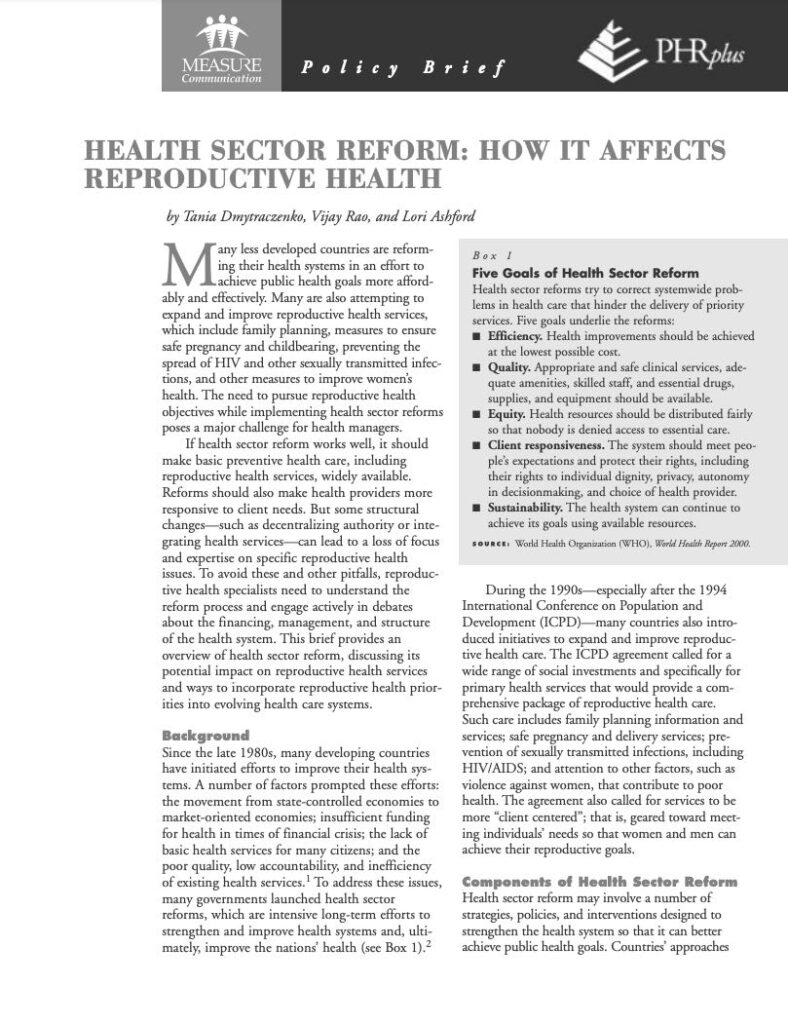
Report. Health Sector Reform: How It Affects Reproductive Health
This report also in French and Spanish. (June 2003) Many less developed countries are reforming their health systems in an effort to achieve public health goals more affordably and effectively.
Report. Reproductive Health in Policy & Practice: Case Studies From Brazil, India, Morocco, and Uganda
To assess how the Programme of Action, agreed upon at the 1994 International Conference on Population and Development (ICPD), is being implemented, senior researchers in Brazil, India, Morocco, and Uganda conducted country case studies.
Reproductive Health in Policy & Practice: Case Studies From Brazil, India, Morocco, and Uganda
To assess how the Programme of Action, agreed upon at the 1994 International Conference on Population and Development (ICPD), is being implemented, senior researchers in Brazil, India, Morocco, and Uganda conducted country case studies.