
Immigration Saved Hundreds of U.S. Counties From Population Loss -- -Duplicate-
Over 450 U.S. counties would have lost population between 2023 and 2024 without immigration, according to an analysis of new data from the U.S. Census Bureau.
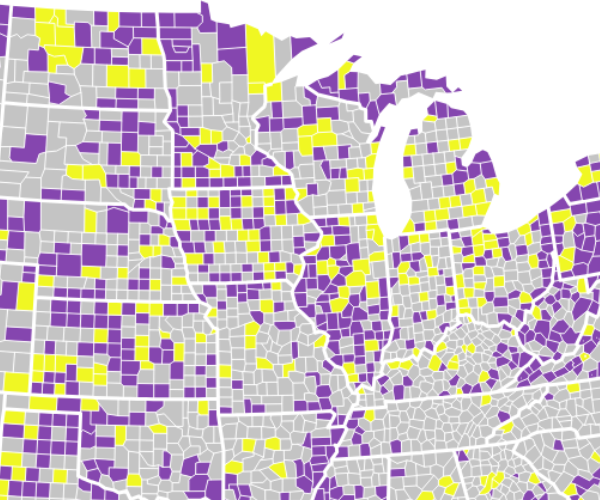
Without immigration, hundreds of counties across the United States would be shrinking, according to new Census Bureau population estimates.
Here’s a map showing the 452 U.S. counties (shaded yellow) that would have lost population between 2023 and 2024 without immigration. In another 822 counties (shaded purple), immigration helped offset population losses, so depopulation was not as severe as it would have been.
Note: Counties shaded in grey include 1,606 whose population increased independently of immigration, 255 whose population loss is partly due to immigration, and 3 whose population would have increased if net immigration had not declined.
Source: Analysis by PRB’s Mark Mather. Data from U.S. Census Bureau, County Population Totals and Components of Change: 2020-2024, March 13, 2025.
In effect, immigration is “propping up” the populations in many local communities. This isn’t a new trend, but it’s accelerated in recent years partly because of the shift toward smaller families. During the baby boom, the total fertility rate (TFR), or the average number of lifetime births per woman, peaked at over 3.5. But today, the TFR is just 1.6—the lowest level ever recorded in the United States.
For many counties, immigration was also key to offsetting losses from domestic migration. For example, Marion County, Indiana, had a net outflow of 10,500 domestic migrants between 2023 and 2024 but saw a net increase of 10,450 international migrants during the same period.
- U.S. Census Bureau, County Population Totals and Components of Change: 2020-2024, March 13, 2025.
Related Posts
Understanding and Comparing Population Projections in Sub-Saharan Africa
The release of a new set of population projections by the Institute for Health Metrics and Evaluation (IHME) in July 2020 was greeted with extensive coverage in the media and stimulated fresh debate among demographers about calculation and communication of projections.