
Sex Ratio at Birth Begins to Improve in India
The strong preference for sons is especially evident in some Indian states, but the practice of sex-selective abortion to ensure a male child has been documented in many parts of India and among Indians living abroad.2 But the news media have not reported new evidence that the situation in India has begun to improve. This improvement is due, in no small part, to efforts by the central and state governments to discourage the abortion of female fetuses, including the passage of the Pre-Natal Diagnostic Techniques (Regulation and Prevention of Misuse) Act In 1994, which outlawed the practice.
Sex-selective abortion has been primarily used by wealthier Indians who can afford the ultrasound fee of 500 rupees ($US12) to determine the sex of a fetus. The increasing availability of ultrasound has been linked to the sharp rise in the ratio of male births to female births in some parts of India in recent decades. Female infanticide continues to be practiced in the poorest areas, although its extent is unknown.
Son Preference Deeply Rooted
The preference for sons has deep roots in India for cultural and economic reasons. Once a daughter marries, she leaves the parental home to live with her in-laws. She is perceived to be of little economic benefit to her parents and will not support them in their old age. Having a girl is like “watering your neighbor’s garden,” according to a common Indian saying. A daughter’s wedding can be a financial drain for parents: The payment of a sometimes extravagant dowry to a groom’s parents remains virtually universal despite laws against dowry that date to 1961. Now-banned advertisements for sex determination tests, such as “Invest only Rs. 500 now and save your precious Rs. 50,000 later,” reminded parents of the future expense a daughter would bring.
A further motivation for a son over a daughter is the belief among Hindus that it is essential for a son to perform rituals at his parent’s cremation and at every death anniversary thereafter.
Worldwide, the normal sex ratio at birth (SRB) is about 105 male babies per 100 female babies. India measures the SRB in reverse of the usual standard, female births per 1,000 male births, making 950 a normal SRB in India. Although sex-selective abortion was widely known by the time of the 2001 Indian population census, the census results brought additional publicity to the issue when it showed the sex ratio of the total population ages 0 to 6 was just 927 girls per 1,000 boys, down from 945 in 1991. The situation had deteriorated to the point where one district, Fatehgarh Sahib in Punjab state, had a ratio of only 754 girls for every 1,000 boys under age 7. But the situation has changed since 2001.
Improvement Since 2001 Charted
India is virtually unique among developing countries in that it regularly publishes annual statistics on births and deaths from its Sample Registration System (SRS), a monthly survey of 1.3 million households. Following the 2001 census, the SRS began publishing sex ratios for births in the more populous states. The SRS data show that the sex ratio crisis has begun to improve or has at least stabilized in most of these states. The lowest SRBs are in two of India’s wealthiest states, Punjab and Haryana (which itself was once part of Punjab) in northwest India. Many of the earliest efforts to combat the crisis were focused on this area. In Punjab, the SRB has improved from 775 in 1999-2001 to 808 in 2004-2006, while in Haryana, it rose from 803 to 837 over the period (see figure). While still a long way from the desired 950, the data indicate that a slow reversal has begun.
Sex Ratio at Birth in Five States of India, 1999-2001 to 2004-2006
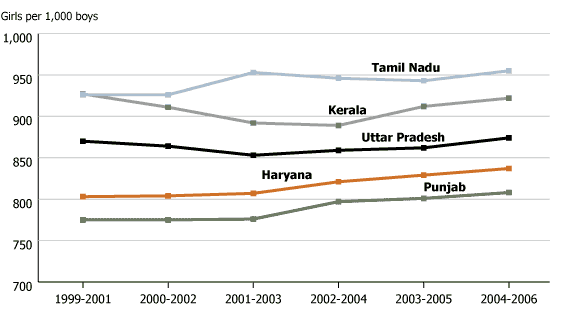
Note: The ratios are three-year averages. Source: India, Sample Registration System.
Ratios Vary Widely by State
Often, the combination of available family funds for an ultrasound test and low fertility will exacerbate the sex ratio problem. When couples limit their family to two children and they want to make sure that at least one is a boy, they may be more open to aborting a female fetus. The pressure to have a son is often felt most intensively by young wives, who want to please their husband’s family. Punjab—with India’s most unbalanced ratio of boys to girls—has a total fertility rate (TFR) is just 2.1 lifetime births per woman. The southern state of Kerala has had a sex ratio at birth below 900, suggesting a strong son preference. That state’s TFR is only 1.7. Its southern neighbor, Tamil Nadu, with the same TFR, has had an essentially normal SRB for some time. But Tamil Nadu has been particularly aggressive in promoting health, including combating sex-selective abortion. Tamil Nadu’s example shows that the practice can be controlled.
The somewhat higher sex ratios in relatively poor and higher TFR states such as Uttar Pradesh and Bihar (not shown) may largely reflect the fact that the average of over four children per woman in those states makes the birth of a son much more likely.
The problem of son preference is deep-seated in India as it is in several other Asian countries, notably China, South Korea, Taiwan, and Viet Nam. But South Korea’s sex ratio at birth has been improving since 1990 to the point where it is now approaching normal. It now appears that India has begun to make progress. but overturning some of that society’s most fundamental traditions will be no easy task.
O.P. Sharma is a PRB consultant in India. Carl Haub is a senior demographer at PRB, where he holds the Conrad Taeuber Chair of Population Information.
References
- “Indian Prime Minister Denounces the Abortion of Female Fetuses,” The New York Times, April 29, 2008.
- “UK Indian Women Aborting Girls,” BBC News, Dec. 3, 2007.
Related Posts
How Accurate Was the 2020 Census—and Why Should You Care?
Significant undercounts in the 2020 Census could have serious consequences for underrepresented groups and individual states.

Adolescents and Youth Are Key to Fully Achieving Universal Health Coverage
In 2021, adolescents and youth between ages 10 and 24 are estimated to make up approximately 24% of the world’s population.

How Will We Measure the Accuracy of the 2020 Census?
Getting an accurate 2020 Census count is important because census numbers impact daily life in the United States in many ways.

Aging and Health in China: What Can We Learn From the World’s Largest Population of Older People?
The United Nations projects that there will be 366 million older Chinese adults by 2050, which is substantially larger than the current total U.S. population of 331 million.