
O.P. Sharma
Former Deputy Director of Census Operations in India
Featured News & Insights
- Insights
post
India Releases Latest Census Results, Showing Population Catching Up to China
(2011) Together, China and India account for 37 percent of the world’s population. Both countries have conducted censuses over the past year, and when they report their census results, figures such as the widely accepted world population total are at risk of changing.
- Insights
post
Change Comes Slowly for Religious Diversity in India
(2009) Religious diversity has been a defining characteristic of India's population for centuries. The country has no official state religion, but religion plays a central role in Indian daily life through its temple ceremonies, festivals, pilgrimages, family religious traditions, and the like.
- Insights
post
Sex Ratio at Birth Begins to Improve in India
(2008) There has been increasing international news coverage of the excess of young boys in India resulting from the abortion of female fetuses.1
- Insights
post
Is Delhi India’s Largest City?
(November 2007) India is both a highly rural country, with the large majority of its population living in villages, and home to some of the world’s largest metropolitan areas.
- Insights
post
2001 Census Results Mixed for India's Women and Girls
(2001) At first glance, results from India's 2001 census seem encouraging. They show a decline in the population growth rate, an improvement in the ratio of men to women, and a remarkable increase in literacy, particularly for girls and women.
Featured Resources
- Article
resource
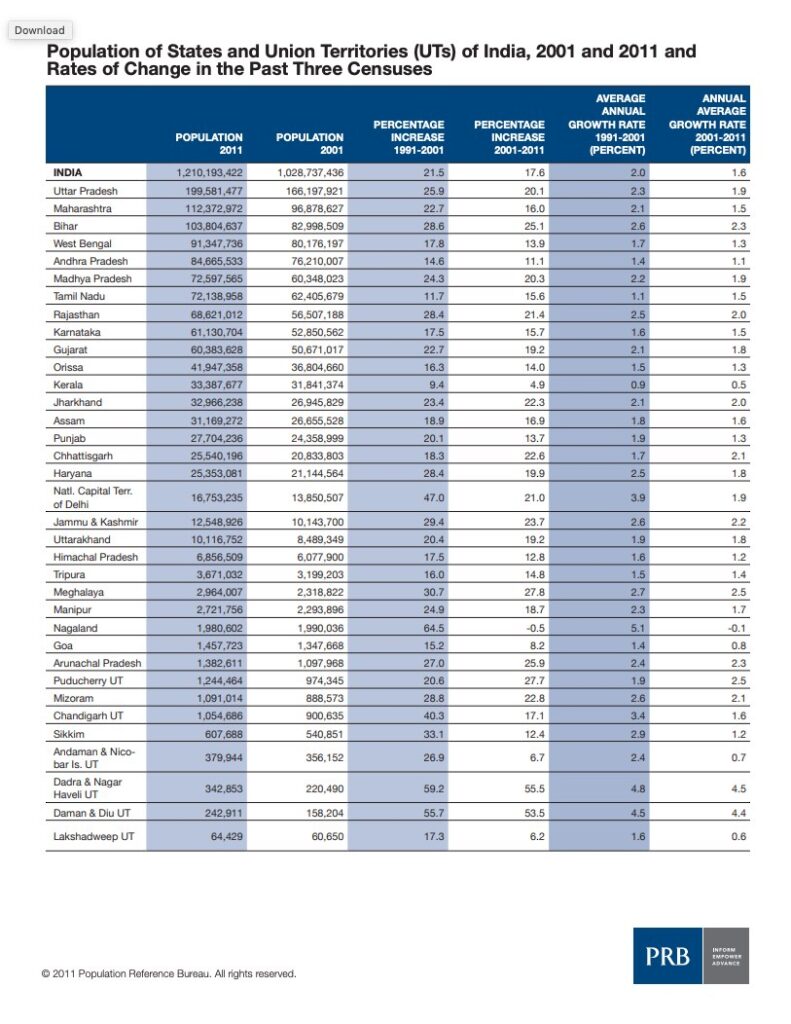
Table: Population of States and Union Territories (UTs) of India, 2001 and 2011 and Rates of Change in the Past Three Censuses
(2011) Together, China and India account for 37 percent of the world’s population. Both countries have conducted censuses over the past year, and when they report their census results, figures such as the widely accepted world population total are at risk of changing.

- Past Presentation
resource
What Is Poverty, Really? The Case of India
(2010) Countries struggle with measuring their poverty populations, a figure that often determines the distribution of public assistance funds to those in need.
- Report
resource
How People in India 'Really' Live
(2008) Media reports on the "exploding" middle class in India would lead any reader to believe that Indian society is undergoing a top-to-bottom transformation into a society of Western-style consumers.
- Training Tool
resource
India Proposes Retooled Population Policy
(2000) Fifty-three years after independence, India is still looking for a viable policy to control population growth. Although it was the first country to adopt a family planning program, in 1952, the country is still growing by 15.