
A Closer Look at How Kids and Moms Stay Connected Over Time
A new study finds that growing up doesn’t mean growing apart—at least not always. Instead of a single story of separation, researchers identified six distinct patterns for how mother-child relationships change across the 20s, showing that family ties are more dynamic than a simple drift from home.
Using data from about 2,300 young adults in the National Longitudinal Survey of Youth, Mieke Beth Thomeer at the University of Alabama at Birmingham and colleagues tracked how close young adults felt to their mothers—and how often they were in contact—at multiple points over time, accounting for factors like education, whether parents were married, and family background.
About one-third of mothers and their adult children maintain consistently high contact and closeness when the child is in their 20s. For the other two-thirds, the relationship shifts—sometimes toward less frequent contact, sometimes toward less emotional closeness, and sometimes back and forth between the two.
Growing Up Doesn’t Mean Letting Go
By separating how often young adults interact with their mothers from how close they feel, the study reveals that these two things don’t always move together.
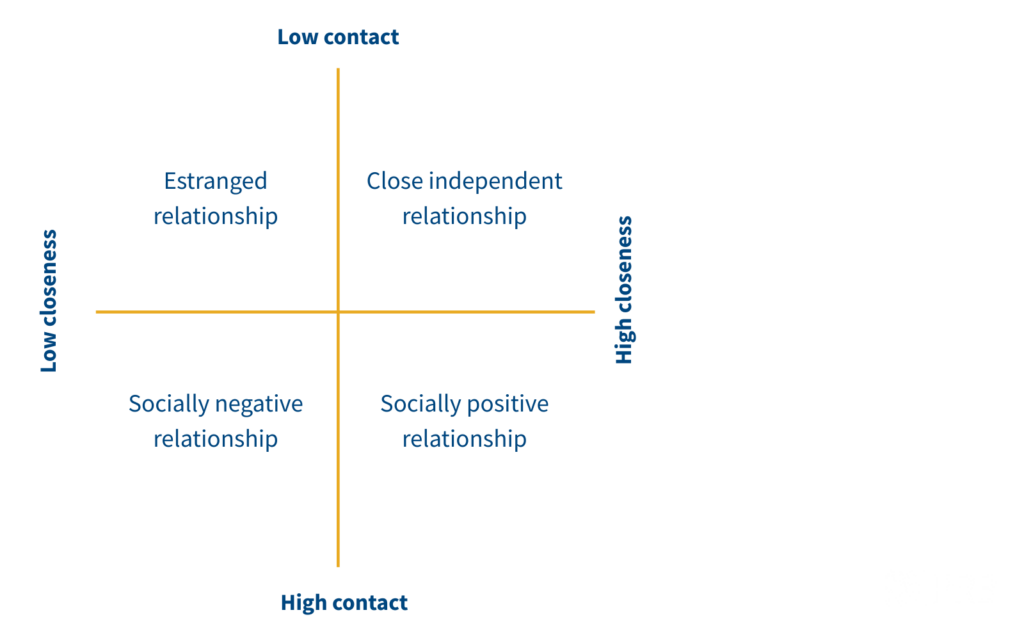
As shown in the figure, the researchers organized relationships along two dimensions: emotional closeness (high vs. low) and frequency of contact (high vs. low), producing four basic types at any given moment:
- Estranged (low closeness, low contact)
- Socially positive (high closeness, high contact)
- Close independent (high closeness, low contact)
- Socially negative (low closeness, high contact)
Figure. The 4 Types of Relationship Between Mother and Adult Child, by Emotional Closeness and Contact
Source: Mieke Beth Thomeer et al., “Dynamics of Adult Child-Mother Relationships in Emerging Adulthood by Gender and Race,” Social Psychology Quarterly 88, no. 3 (2025).
These categories position closeness and contact as distinct concepts—young adults can feel close even with less interaction or stay in frequent contact without emotional intimacy.
By tracking how respondents moved among these relationship types over time, the researchers identified six patterns:
- Only socially positive (33% of respondents): Consistently close and in contact throughout— the most stable and common pattern.
- Close independence (18% of respondents): High closeness but declining contact; many shift to less frequent interaction in their early 20s while remaining emotionally close.
- Mostly socially positive (15% of respondents): Largely stable and positive, with consistently high closeness and contact and little estrangement.
- Low closeness (14% of respondents): Mostly distant or strained, with relatively high levels of estrangement.
- Mixed (11% of respondents): Unstable, moving between close, distant, and estranged with no clear pattern.
- Decreased contact (9% of respondents): Start highly connected, then pull back contact but remain close, with some reconnecting later in their 20s.
About one-third of young adults remain consistently close to their mothers in both contact and emotional ties throughout their 20s. Others follow more gradual shifts—staying emotionally close but talking or visiting less often, or beginning as highly connected but pulling back before sometimes reconnecting. A smaller share experience persistent instability or low closeness.
Daughters Stay Close, Sons Drift More Often
Gender is one of the clearest predictors of how these relationships evolve. Daughters are more likely to be in stable, close patterns, while sons are more often drift toward distance or instability over time. These findings are consistent with decades of research showing that women tend to take on “kin-keeping” roles—maintaining communication and emotional ties within families.
Race Shapes How Families Stay Connected
Race also shapes these patterns. Black young adults are more likely to be in stable, close relationships with their mothers; white young adults more often follow paths marked by variable or reduced contact. The authors note this is consistent with prior research on stronger intergenerational ties in Black families, possibly reflecting broader structural and cultural factors contributing to more reliance on family for Black children and mothers compared to white children and mothers.
When race and gender are considered together, the differences become even clearer. Black women are more likely to remain stable, with close ties with their mothers, while white men are more likely to experience persistent distance or instability in their relationship with their mother. These differences hold after adjusting for gender and family background, suggesting that race and gender together shape how these relationships unfold in emerging adulthood.
Why These Findings Matter—and What Could Be Lost
These findings rely on the National Longitudinal Survey of Youth 1979 – Young Adult cohort, a long-running study sponsored by the U.S. Bureau of Labor Statistics and funded in part by the Eunice Kennedy Shriver National Institute of Child Health and Human Development. Following the same people over time makes it possible to track how relationships actually change—and how differences by gender and race emerge. As funding for long-term surveys grows less certain, so does the ability to understand how families and inequalities evolve across generations—and why those ties remain central long after childhood ends.
Reference
- Mieke Beth Thomeer et al., “Dynamics of Adult Child-Mother Relationships in Emerging Adulthood by Gender and Race,” Social Psychology Quarterly 88, no. 3 (2025).
Related Posts
As Dementia Rises, More Older Americans Are Getting Care at Home. It's Not Without Challenges.
Families face the financial burden of paying out-of-pocket for care not covered by Medicare and Medicaid and the emotional toll of day-to-day caregiving.

Webinar: How Women Became America’s Safety Net (PRB Book Talk)
A conversation with author Jessica Calarco on her new book, Holding It Together

The Demography of Dementia and Dementia Caregiving
Dementia is one of the nation’s most expensive old-age health conditions and the most time consuming for family caregivers.

Family Caregiving for Older People
(2016) In the United States, the vast majority of care that allows older people to live in their own homes is provided by family members who do not receive pay for their services.