497 Search Results Found For : "Low-priced"


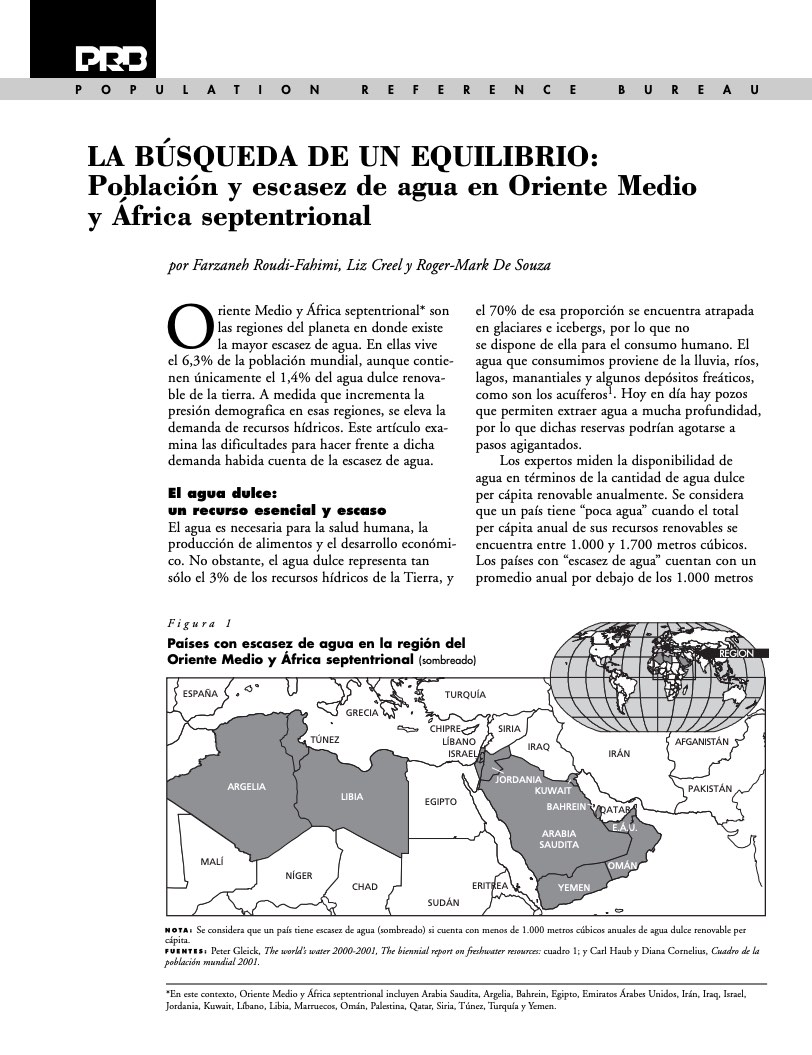
Report. Población y escasez de agua en Oriente Medio y África septentrional

(2002) The Middle East and North Africa (MENA)* is the most water-scarce region of the world. Home to 6.3 percent of the world's population, the region contains only 1.4 percent of the world's renewable fresh water.

View Details Array ( [ID] => 11898 [id] => 11898 [title] => MENAWater_SP [filename] => MENAWater_SP.pdf [filesize] => 523879 [url] => https://www.prb.org/wp-content/uploads/2021/01/MENAWater_SP.pdf [link] => https://www.prb.org/resources/report-population-and-water-scarcity-in-the-middle-east-and-north-africa/menawater_sp-2/ [alt] => [author] => 15 [description] => [caption] => [name] => menawater_sp-2 [status] => inherit [uploaded_to] => 11894 [date] => 2021-01-12 04:02:05 [modified] => 2021-01-12 04:02:05 [menu_order] => 0 [mime_type] => application/pdf [type] => application [subtype] => pdf [icon] => https://www.prb.org/wp-includes/images/media/document.png ) Download (0.5 MB)
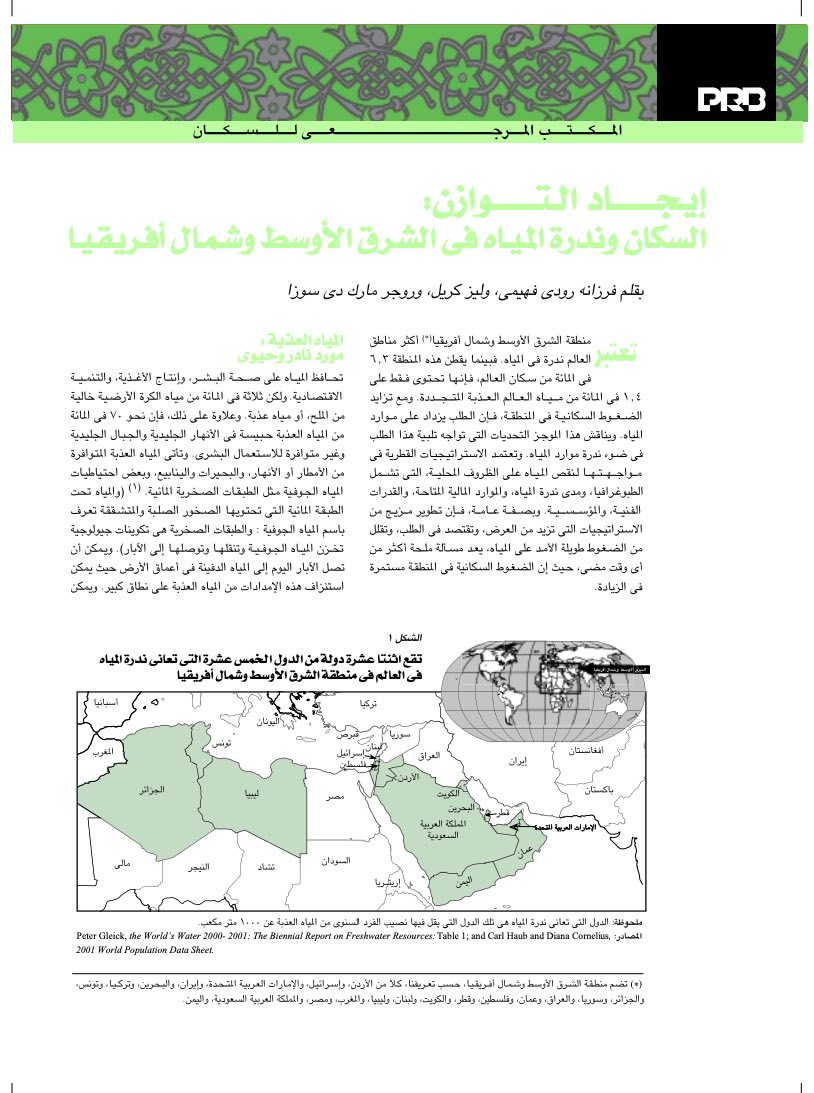
Report. Population and Water Scarcity in the Middle East and North Africa (Arabic)

(2002) The Middle East and North Africa (MENA)* is the most water-scarce region of the world. Home to 6.3 percent of the world's population, the region contains only 1.4 percent of the world's renewable fresh water.

View Details Array ( [ID] => 11899 [id] => 11899 [title] => FindingTheBalance_Arabic [filename] => FindingTheBalance_Arabic.pdf [filesize] => 1159342 [url] => https://www.prb.org/wp-content/uploads/2021/01/FindingTheBalance_Arabic.pdf [link] => https://www.prb.org/resources/report-population-and-water-scarcity-in-the-middle-east-and-north-africa/findingthebalance_arabic-2/ [alt] => [author] => 15 [description] => Population and Water Scarcity in the Middle East and North Africa [caption] => [name] => findingthebalance_arabic-2 [status] => inherit [uploaded_to] => 11894 [date] => 2021-01-12 04:02:08 [modified] => 2021-01-12 04:07:01 [menu_order] => 0 [mime_type] => application/pdf [type] => application [subtype] => pdf [icon] => https://www.prb.org/wp-includes/images/media/document.png ) Download (1.1 MB)

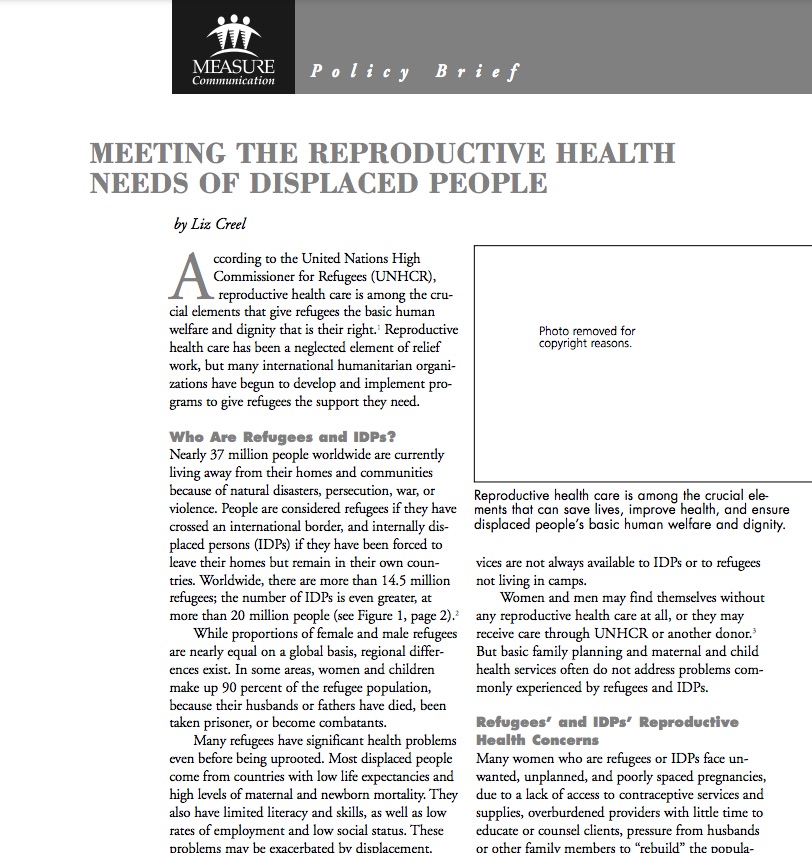
Meeting the Reproductive Health Needs of Displaced People

(2002) According to the United Nations High Commissioner for Refugees (UNHCR), reproductive health care is among the crucial elements that give refugees the basic human welfare and dignity that is their right.1

View Details Array ( [ID] => 18312 [id] => 18312 [title] => 07012002-MeetngReproHlthDispl_Eng [filename] => 07012002-MeetngReproHlthDispl_Eng.pdf [filesize] => 111626 [url] => https://www.prb.org/wp-content/uploads/2021/02/07012002-MeetngReproHlthDispl_Eng.pdf [link] => https://www.prb.org/resources/meeting-the-reproductive-health-needs-of-displaced-people/07012002-meetngreprohlthdispl_eng-2/ [alt] => [author] => 15 [description] => [caption] => [name] => 07012002-meetngreprohlthdispl_eng-2 [status] => inherit [uploaded_to] => 18310 [date] => 2021-02-21 16:17:49 [modified] => 2021-02-21 16:17:49 [menu_order] => 0 [mime_type] => application/pdf [type] => application [subtype] => pdf [icon] => https://www.prb.org/wp-includes/images/media/document.png ) Download (0.1 MB)

Why Concentrated Poverty Fell in the United States in the 1990s

( 2005) Concentrated poverty—often defined as the number of people living in neighborhoods with poverty rates exceeding 40 percent—fell substantially in the United States in the 1990s, according to a new report by the U.S. Census Bureau.

View Details

Diverse Factors Linked to Maternal Deaths in Zambia

(2003) Poor access to health facilities and low-quality health care delivery may be among the reasons that Zambia is facing increasing levels of maternal deaths.

View Details

Project: IDEA: Informing Decisionmakers to Act

2014 World Population Data Sheet

PRB’s World Population Data Sheet is an annual report on the world’s demographic, health, and environmental progress and challenges.

View Details

Life on Hold: How the Coronavirus Is Affecting Young People’s Major Life Decisions

(2020)The past two decades have been tumultuous for the United States. During the first 20 years of the 21st century, the nation experienced a major terrorist attack, a housing market meltdown, a severe economic recession, a significant downturn in the stock market, and a pandemic that led to the highest unemployment rate since the Great Depression.

View Details

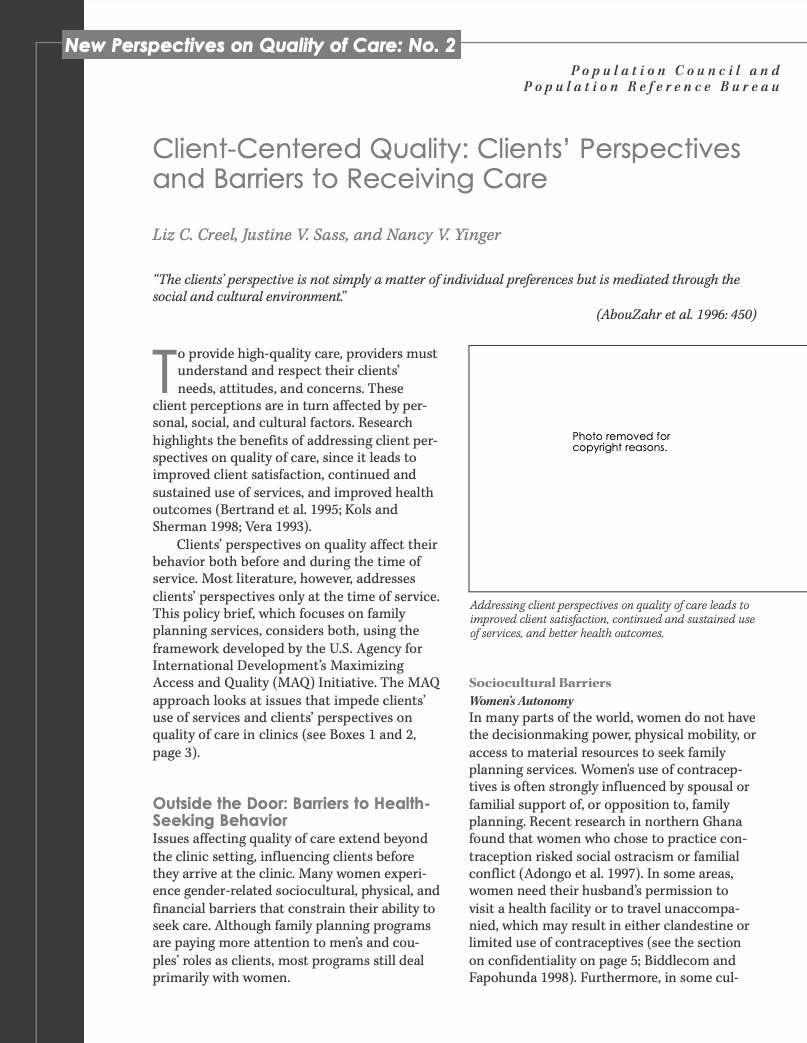
Client-Centered Quality: Clients’ Perspectives and Barriers to Receiving Care

To provide high-quality care, providers must understand and respect their clients' needs, attitudes, and concerns. These client perceptions are in turn affected by personal, social, and cultural factors.

View Details Array ( [ID] => 21533 [id] => 21533 [title] => NewPerspQOC-Clients [filename] => NewPerspQOC-Clients-1.pdf [filesize] => 217598 [url] => https://www.prb.org/wp-content/uploads/2002/07/NewPerspQOC-Clients-1.pdf [link] => https://www.prb.org/resources/client-centered-quality-clients-perspectives-and-barriers-to-receiving-care/newperspqoc-clients-2/ [alt] => [author] => 15 [description] => [caption] => [name] => newperspqoc-clients-2 [status] => inherit [uploaded_to] => 5043 [date] => 2021-05-03 12:33:16 [modified] => 2021-05-03 12:33:16 [menu_order] => 0 [mime_type] => application/pdf [type] => application [subtype] => pdf [icon] => https://www.prb.org/wp-includes/images/media/document.png ) Download (0.2 MB)

Project: Center for Public Information on Population Research (CPIPR)

New Studies Probe “Who Smokes and Why” to Bolster U.S. Prevention Efforts

To better design and target anti-smoking efforts, researchers are examining stress, genes linked to nicotine addiction, and neighborhood/family characteristics to identify who smokes today and why.

View Details