
Immigration Is Saving Fewer U.S. Counties From Population Loss
Without immigration as a buffer, the U.S. population could begin shrinking in 2033, the CBO projects.

As immigration slows, fewer U.S. counties are being protected from population decline. Net international migration prevented population loss in just 254 U.S. counties between 2024 and 2025—40% fewer counties than in the previous year.[1]
In 882 counties, immigration helped offset population losses, roughly the same number as the previous year. And 377 counties lost population despite immigration gains—up from 209 the prior year and the most since 2021 (Figure 1).
A dramatic slowdown in immigration explains the shift. The U.S. Census Bureau estimates that net international migration—which accounts for both arrivals and departures—fell 54% from 2024 to 2025—from about 2.7 million to 1.3 million.
Figure 1. Role of Net International Migration in U.S. County Population Change, 2020-2025
Number of Counties in Each Category
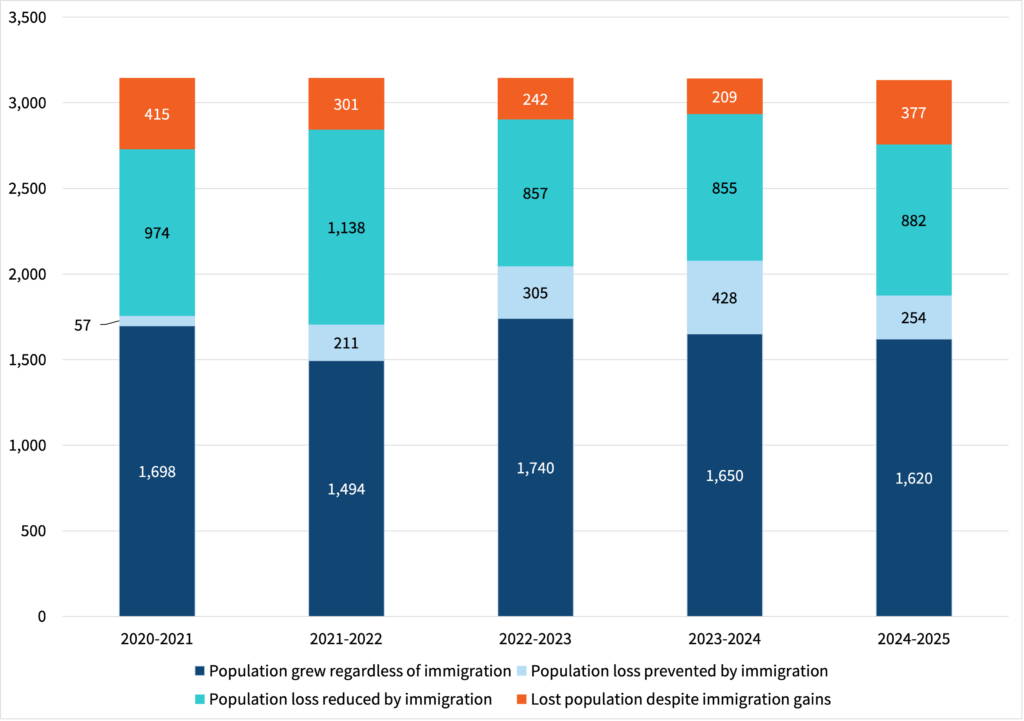
Note: There were also 2 counties in 2023-2024 and 11 counties in 2024-2025 that lost population because of negative net international migration.
Source: PRB analysis of data from the U.S. Census Bureau, County Population Totals and Components of Change: 2020-2025, May 22, 2026.
Over the same period, 13 states and the District of Columbia would have lost population without net international migration gains (Figure 2). Five other states—California, Hawaii, New Mexico, Vermont, and West Virginia—lost population from 2024 to 2025, but net immigration gains moderated the declines.
Figure 2. Role of Net International Migration in State Population Change, 2024–2025
Source: PRB analysis of data from the U.S. Census Bureau, County Population Totals and Components of Change: 2020-2025, May 22, 2026.
Immigration has been a key driver of U.S. population growth for decades, but if current trends persist, it’s not just states and counties that could experience population loss. The Congressional Budget Office (CBO) projects that the total U.S. population total could decline within the next 10 years.
“Without immigration, the population would shrink beginning in 2033, in part because fertility rates are projected to remain too low for a generation to replace itself,” the CBO researchers reported.
As fertility rates remain low and the population continues to age, immigration policy is likely to play an increasingly important role in shaping future population growth across the United States. If current demographic trends continue, population decline will become a reality for a growing number of U.S. communities. Immigration can help reverse that trend by bringing new workers, families, and the population momentum needed to support future growth.
Related Posts
Understanding and Comparing Population Projections in Sub-Saharan Africa
The release of a new set of population projections by the Institute for Health Metrics and Evaluation (IHME) in July 2020 was greeted with extensive coverage in the media and stimulated fresh debate among demographers about calculation and communication of projections.