
Unlocking Africa's Future
How smart budgeting can harness the demographic dividend

Africa’s rapidly increasing population is a dynamic force, positioning the continent to be a major driver of global population growth. By 2100, the working-age population (ages 15 to 64) in sub-Saharan Africa is projected to represent 37% of the global working-age population. This demographic shift presents an unparalleled opportunity for economic development, often referred to as the demographic dividend.
As we’ve previously written, harnessing this potential requires strategic, evidence-based policies and corresponding budgets so that spending contributes effectively to transforming the large, youthful population into a powerful engine for inclusive and sustainable economic development as they age. With a fundamental shift in national budgeting, governments can prioritize investments in human capital (like education and health) and productive sectors to maximize the potential of the growing working-age population and fully realize the demographic dividend rather than merely sustain existing patterns of consumption.
To achieve this shift, policymakers and researchers have collaborated to develop a set of innovative tools, most notably the Demographic Dividend Monitoring Index and Budgeting Sensitive to Demographic Dividend BSDD, which are currently the primary instruments used to help align national budgets with demographic realities and influence policy toward a more prosperous Africa.
Vision Alone Is Not Enough: Translating Aspirations Into Actionable Budget Decisions
Recognizing the continent’s immense demographic potential, the African Union (AU) has laid out a powerful vision in Agenda 2063: The Africa We Want. One of its core aspirations centers on harnessing the power of Africa’s population, especially youth and women. To turn this vision into reality, the AU developed the African Union Roadmap on Harnessing the Demographic Dividend Through Investments in Youth. This roadmap defines the demographic dividend as the economic benefit that arises when a country has a relatively large proportion of its population in the working-age group due to declining fertility rates and effectively invests in their health, empowerment, education, and employment. It emphasizes specific, crucial investments in education and skills, employment and entrepreneurship, gender equality and empowerment, and accountability.
While the AU roadmap provides a strong vision, vision alone is not enough. For countries to truly capture the demographic dividend, they need practical, operational tools that can translate this vision into tangible budget decisions. The challenge lies in moving from strategic documents and development plans to ensuring that national budgets, which are perhaps the most important instruments for economic and social development, are sensitive to demographic realities.
Traditional budgets are not able to consider crucial elements like the immense value of unpaid care work, many of the financial burdens on households, or the long-term benefits of investing in family planning and education. The way traditional budgets are structured also does not allow for disaggregated insights by age and sex. Without tools that highlight these connections, it is challenging to allocate resources strategically to maximize demographic potential.
Understanding the Types of Budgets in Africa
Public budgets in Africa are traditionally organized according to two main approaches: 1) program-based budgeting and 2) functional and economic classification. These two methods have different objectives and characteristics, and their articulation raises important issues for planning, monitoring, and the overall effectiveness of public action.
Program-based budgeting focuses on linking expenditures to performance objectives, often structured around specific programs managed by individual ministries, like a malaria prevention program in the Ministry of Health or an education program in the Ministry of Education. While it aims to enhance accountability and results, this approach can sometimes lead to siloes, making it difficult to see overall national priorities or the total investment in cross-cutting issues like health or education.
Functional and economic classification, on the other hand, groups expenditures by their purpose or type, regardless of which ministry implements them. For example, all spending related to health—whether from the Ministry of Health, the Ministry of Education (for programs such as school health), or military health services—would be grouped under the health function. This approach provides a more integrated view of national efforts for a given sector and is particularly valuable for evaluating the coherence, efficiency, and equity of public policies and their alignment with development priorities.
The key difference between the two approaches is that program-based budgeting looks at specific actions by ministries while functional budgeting focuses on the overall results for society. The latter is increasingly valued because it helps guide resource allocation based on the real needs of the population, especially women, youth, and dependents.
Demand-Driven Tools for Evidence-Based Budgeting
Recognizing the need to bridge the gap between demographic analysis and practical public budgeting, the Senegal-based Regional Consortium for Research in Generational Economics (CREG), in collaboration with the Sahel Women’s Empowerment and Demographic Dividend (SWEDD) project and the United Nations Economic Commission for Africa (ECA), developed a groundbreaking tool— Budgeting Sensitive to Demographic Dividend (BSDD) —and its measurement partner, theDemographic Dividend Monitoring Index.
These tools were born out of a direct request from policymakers themselves. At the National Transfer Accounts (NTA)-Africa 2019 Conference, discussions about incorporating the demographic dividend in Mali sparked a realization: If the budget process does not integrate the goal of achieving the demographic dividend, then it will not be successful. In Mali, the Director of Budget highlighted the need for a budget simulation tool to support arguments for proposed budget structures, making them more readily accepted by various departments. This response showed a genuine internalization of the process in Mali, with the Directorate of Budget financing missions to work on developing and testing the BSDD tool.
BSDD is a truly African tool, built with African governments and researchers, using local data and realities. It helps governments align public spending with demographic priorities, allowing for evidence-based budget planning by modeling lifecycle costs (public investment needed to support people at each life stage), intergenerational support (economic flow between generations such as caregiving and social protection), and macroeconomic gains (potential boost to national growth when countries invest strategically in their population).
What Is the Demographic Dividend Monitoring Index and How Does It Work?
At the heart of BSDD tool is the Demographic Dividend Monitoring Index (DDMI),a composite indicator that represents a country’s ability to capitalize on its human potential. It reflects the return on development efforts driven by individual economic activities and the macroeconomic effects of public policies. The DDMI operates on three interconnected levels (see Figure 1).
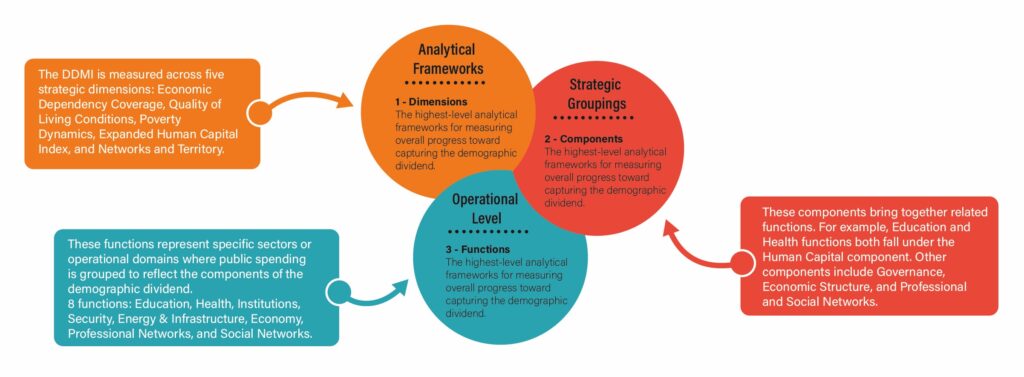
These three levels work together to provide a comprehensive view of how public spending aligns with demographic dividend priorities. Functions (specific budget regroupings) feed into Components (strategic action levers), which then contribute to the overall progress measured by the Dimensions (analytical frameworks). This structure allows for a shift from traditional program-based budgets to a functional budget aligned with demographic, social, and economic development objectives.
The DDMI equips decisionmakers with a tool to evaluate and identify priority areas of investments to amplify demographic gains. It is meant to assesshow far a country has come in harnessing its demographic potential,and it provides insight into which sectors or dimensions are advancing and where strategic investment is still necessary to accelerate progress.
The Five DDMI Dimensions
What Is Budgeting Sensitive to Demographic Dividend BSDD and How Does It Work?
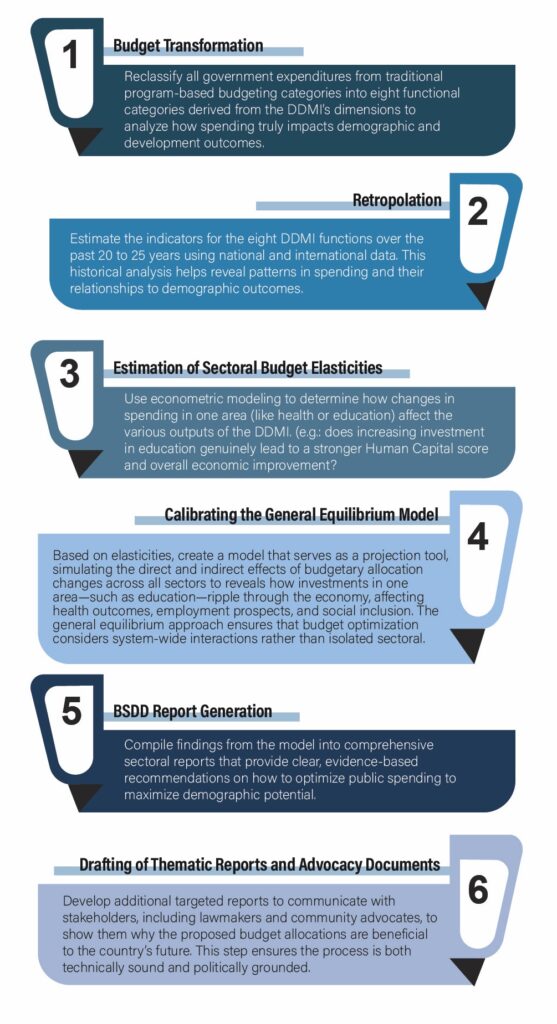
The BSDD process is a multistep approach that helps governments align their national budgets with demographic realities and development goals. It is a technical yet politically collaborative process stemming from the Demographic Dividend Monitoring Index (DDMI).
The process starts by reclassifying budget expenditures into eight functional categories (like education and health) linked to the DDMI’s dimensions to move beyond traditional administrative silos and analyze actual impact. Next, retropolation involves analyzing historical spending patterns and their relation to demographic changes over two decades. Econometric modeling then estimates how spending in different areas influences DDMI outputs such as human capital. These insights feed into a general equilibrium model, allowing governments to simulate the interconnected effects of budget changes across various sectors. Finally, comprehensive BSDD reports provide evidence-based recommendations for optimizing public spending to maximize demographic potential, supported by targeted advocacy materials for policymakers and civil society actors (see Figure 2). This approach fosters government ownership in aligning budgets with long-term development.
BSDD is a process designed to align a country’s budget with the DDMI, essentially establishing an optimal budget structure to achieve the best performance across the demographic dividend dimensions. It is a complex but incredibly insightful process, typically taking 8 to 12 months to complete.
Changing the Budgeting Mindset
Successful implementation of the BSDD process requires integration across entire planning cycles, from sectoral prioritization through parliamentary budget adoption. Countries must align BSDD exercises with strategic planning timelines while building technical capacity among policymakers and development planners.
Realigning country budgets through the BSDD process is not only about changing spending but also about changing the way decisionmakers think about spending decisions for the good of African people and nations. Focusing national budgeting on societal needs by considering demographic changes is an innovation that has only recently been understood and attempted.
The functional budgeting that can result from implementing BSDD centers on the overall outcome sought for society and the effectiveness of public policies—both of which are essential conditions for successfully managing the demographic transition. Following these steps can help public finance decisions directly align with the goal of maximizing the demographic transition for sustainable development in African countries. The BSDD tool is already helping African countries make informed spending decisions, ensuring that national budgets truly serve the goal of harnessing the power of the African people, especially youth and women, for a brighter future.
Related Posts
Five Facts and Trends We're Watching in 2026
Care, the future of work and AI, and other themes we're keeping an eye on in the new year

In Dakar, a New Generation Steps Forward to Lead Their Countries' Development
Supporting localization isn’t about stepping back—it’s about showing up differently. In Dakar, we witnessed what’s possible when we stop talking about youth leadership and start listening to it.
To Fix the Care Economy, the United States Should Look Internationally
On this World Population Day, we’re examining the state of the care economy in the United States—and looking abroad for ways to strengthen it.

The Nation’s Preexisting Condition: How Rising Inequality Exacerbated the Economic Toll of the Coronavirus
In 2019, many economic indicators seemed to be pointing in the right direction. The unemployment rate had fallen to its lowest level since 1969, the poverty rate fell to the lowest level in 60 years, and the Dow Jones Industrial Average reached an all-time high.

Aging and Health in China: What Can We Learn From the World’s Largest Population of Older People?
The United Nations projects that there will be 366 million older Chinese adults by 2050, which is substantially larger than the current total U.S. population of 331 million.